Home
» New Trends
»
Engineering the Sky: Overcoming Battery and Payload Constraints in Industrial UAVs
Engineering the Sky: Overcoming Battery and Payload Constraints in Industrial UAVs
Industrial UAV engineering is rarely a contest to find the drone with the longest advertised flight time. The useful question is whether an aircraft can carry the sensor, tool, cargo, compute hardware, and safety margin required for a specific mission while still completing the work reliably. Battery mass creates lift demand, payload mass creates more lift demand, powered payloads consume energy directly, and wind, temperature, altitude, hover time, and reserve policy all reduce the usable margin.
For procurement teams and engineering groups, that means “battery versus payload” should be treated as a system-level tradeoff rather than a single specification. A 50-minute aircraft that carries the wrong sensor may be less productive than a 35-minute aircraft that captures twice as much useful data per pass. Likewise, a heavy-lift platform may solve a payload problem but introduce new regulatory, transport, charging, and staffing requirements.
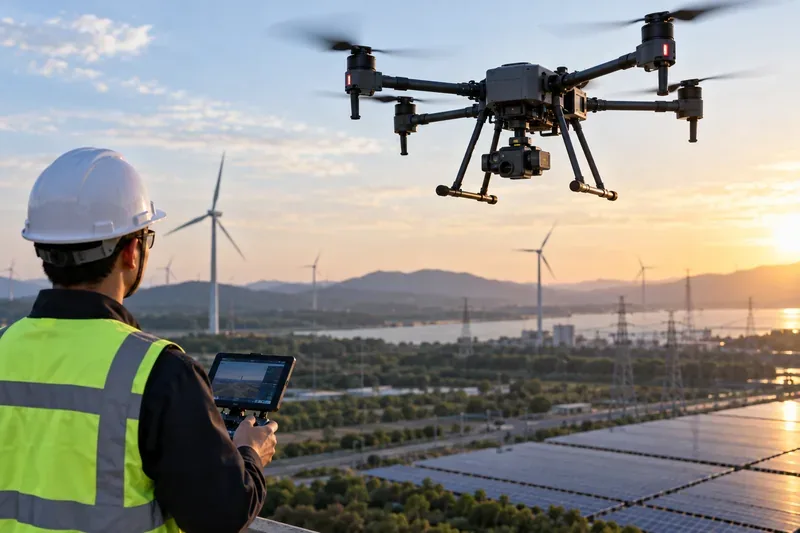
An industrial multirotor carries an inspection camera above a renewable-energy site while a field operator monitors the flight. Payload mass, onboard electrical loads, wind, and reserve requirements all compete with propulsion for the available energy budget.
What actually limits industrial UAV endurance?
For an electric multirotor, endurance is constrained by more than battery capacity. The aircraft must continuously generate thrust roughly equal to its weight in hover, and extra mass raises the required thrust. Larger batteries add energy, but they also add weight, so simply increasing battery capacity eventually produces diminishing returns. A peer-reviewed endurance model for multirotors found that payload weight, aerodynamic drag, propulsion efficiency, and battery discharge behavior all influence the optimum operating point. The study also validated its estimation method against flight tests, with an average error of 2.3 percent in its test configuration. See the original multirotor endurance study in Energies.
In practical terms, seven factors dominate the usable flight-time budget:
Payload mass: cameras, LiDAR, gas sensors, sprayers, cargo hooks, grippers, computers, and protective housings all increase lift demand.
Payload electrical draw: spotlights, radios, onboard computers, heaters, and active sensors can consume battery energy even when their mass is modest.
Aerodynamic drag: bulky or poorly placed payloads can cost more energy than their weight alone suggests.
Flight regime: sustained hover is particularly energy-intensive for rotorcraft; moderate forward flight can be more efficient for many multirotors.
Air density: high altitude and high temperature reduce rotor performance and can lower payload capability or endurance.
Wind and maneuvering: gust rejection, accelerations, repeated climbs, and high-speed flight increase power demand.
Operational reserve: published maximum flight times commonly use ideal conditions and may run a battery from 100 percent to 0 percent, which is not a normal field reserve policy.
Use manufacturer test conditions as a baseline, not a mission promise
Current industrial platforms show how sharply specifications can change once payload and electrical loads are included. DJI lists the Matrice 400 at a maximum takeoff weight of 15.8 kg and a maximum payload of 6 kg at its third gimbal connector under sea-level conditions. DJI also states that payload capability decreases as altitude increases. Its published maximum flight time is 59 minutes in no wind while flying forward at 10 m/s with an H30T payload and a total aircraft weight of 10,670 g, from 100 percent battery to 0 percent. The TB100 battery is rated at 977 Wh and weighs 4,720 g. These figures are useful engineering inputs, but DJI explicitly notes that actual results depend on environment, use, and firmware. See the official DJI Matrice 400 specifications.
A smaller example makes the electrical-load penalty especially clear. DJI's published Matrice 4 accessory test lists a maximum flight time of 49 minutes unloaded. With its speaker and spotlight installed but disabled, the published maximum falls to 39.6 minutes. With both enabled, at a combined listed payload weight of 189 g and payload power of 35 W, the published maximum falls to 32.1 minutes. The point is not that every UAV will lose the same percentage; it is that engineers need to budget both kilograms and watts. See DJI's official Matrice 4 flight-time-with-accessories table.
Heavy-lift systems demonstrate the same tradeoff at a larger scale. Freefly's current Alta X Gen2 specifications list 40:02 of flight time with no payload and 17:00 at maximum payload in the manufacturer's test conditions. Freefly also explains that these hover tests run the batteries from 100 percent to 0 percent to create a comparison baseline rather than a recommended field operating procedure. See the official Alta X Gen2 specifications and test notes.
Quick reference: choose the airframe around the mission
Mission need
Architecture that usually fits
Primary advantage
Main tradeoff
Close inspection, hover, confined maneuvering
Battery multirotor
Precise positioning and flexible sensor aiming
Endurance falls quickly as payload and hover demand rise
Large-area mapping or corridor survey
Fixed-wing or VTOL fixed-wing
Efficient forward flight and high area coverage
Less suitable for sustained stationary hover or close-in work
Ground-supplied power can remove the normal battery-endurance limit
Tether restricts mobility and adds ground equipment
Heavy sensor, lifting, delivery, or tool-carrying mission
Heavy-lift multirotor
High payload capacity with hover capability
Shorter endurance, larger batteries, higher logistics burden, and potentially different regulatory pathway
Longer endurance where battery-only performance is insufficient
Hybrid or fuel-cell system
Potentially more onboard energy than a battery-only architecture
More complex power management, fueling, thermal control, maintenance, and certification
When fixed-wing efficiency is more valuable than hover time
For mapping and survey work, the useful metric is often hectares, miles of corridor, or assets completed per shift rather than minutes in the air. Wingtra's documentation makes this distinction explicitly. Its WingtraOne GEN II reference data shows that a heavier camera configuration can reduce flight time while still increasing area covered because sensor performance and ground sampling requirements allow the aircraft to collect useful data more efficiently. Wingtra also notes that wind, temperature, altitude, payload, and VTOL transition height affect flight time. See the manufacturer's flight time, coverage, and job-time guidance.
The newer WingtraRAY illustrates the same mission-first approach: the company lists up to 59 minutes for RGB and multispectral configurations but 45 minutes with LiDAR, while emphasizing coverage and sensor-dependent performance. It is a VTOL fixed-wing platform, so it can take off vertically but spends the mapping portion of the mission in wing-borne forward flight. See the official WingtraRAY technical summary.
Practical recommendation: if the mission is primarily linear or area coverage, compare square miles, hectares, poles, towers, or lane-miles completed per battery set. If the job requires holding position beside a structure, flying under a bridge, or placing a tool precisely, a multirotor's hover capability may be worth the endurance penalty.
Battery strategy: optimize usable energy, not battery size
1. Size the pack for the real takeoff weight
Start with the complete aircraft: batteries, landing gear, mounts, payload, cables, antennas, protective housings, and any onboard computer. Do not base endurance estimates on “aircraft plus camera” if the operational configuration includes a spotlight, LTE modem, RTK radio, parachute, or custom enclosure.
2. Separate mass budget from electrical budget
A passive camera may mainly cost endurance through mass and drag. An active LiDAR, spotlight, compute module, pump, or radio can impose both mass and electrical load. Ask payload vendors for maximum continuous and peak power draw, not only average power.
3. Keep a mission reserve
Manufacturer maximum-endurance tests are valuable for comparison, but industrial operations need margins for go-arounds, unexpected wind, positioning delays, battery variation, and a safe return. The correct reserve depends on the aircraft, operation, environment, company procedures, and applicable regulations; there is no single percentage that fits every mission.
4. Treat battery aging as a fleet variable
Capacity, internal resistance, temperature, storage practice, and cycle count affect battery behavior. As one current example, DJI lists a 400-cycle count for the Matrice 400 TB100 battery, but that number should not be generalized to other packs. Fleet software should track battery identity and performance so the aircraft assigned to a high-demand payload is paired with a battery whose measured condition supports the mission.
When a tether is the better answer
For stationary industrial tasks, adding ever-larger batteries may be the wrong optimization. A tether can supply power from the ground while the onboard battery provides buffering or emergency capability, depending on the system design. This is especially relevant for perimeter observation, temporary communications, lighting, or persistent sensing at a fixed point.
DJI's Matrice 400 ecosystem includes the TB100C tethered battery, which the manufacturer says must be used with a compatible ecosystem partner's tethered power system or drone dock. DJI does not publish one universal tethered endurance figure because the full system depends on the partner implementation. That is an important procurement lesson: evaluate the complete tether system, including cable mass, voltage conversion, ground power, wind limits, emergency descent behavior, and deployment time, rather than treating the tether battery as a standalone endurance specification. See the official Matrice 400 support specifications.
Where hybrid and fuel-cell power systems fit
Hybrid and hydrogen fuel-cell architectures are attractive when mission endurance cannot be achieved with batteries alone, but they move complexity from battery sizing into power management. Multirotors demand rapid transient power during climbs, gust rejection, and maneuvering. A 2026 peer-reviewed study of a proton-exchange-membrane fuel-cell and battery hybrid quadcopter focused specifically on managing those dynamic loads while protecting the fuel cell and extending endurance. The research supports the engineering rationale for hybridization, but it should not be read as proof that every fuel-cell UAV is operationally superior to a battery system. See the 2026 fuel-cell/battery hybrid UAV study.
Use hybrid or fuel-cell power when the endurance gain has enough operational value to justify fuel logistics, additional components, maintenance, thermal management, control integration, and certification work. For routine inspections with easy battery swaps, a simpler electric fleet can still produce better shift-level productivity.
Payload can trigger a regulatory change, not just a flight-time penalty
In the United States, the FAA's Part 107 small-UAS framework applies to drones weighing less than 55 lb at takeoff. The FAA states that external loads are permitted when securely attached and when they do not adversely affect flight characteristics or controllability. For transportation of property under Part 107, the aircraft, attached systems, payload, and cargo must remain below 55 lb total at takeoff. See the FAA's current Part 107 overview.
If the aircraft weighs 55 lb or more at takeoff, the FAA says operators may apply for an exemption under 49 U.S.C. § 44807 rather than operating that aircraft under standard Part 107. See the FAA's Section 44807 guidance. This means a payload upgrade can change not only the propulsion requirement but also the regulatory pathway, documentation burden, and schedule.
Field acceptance checklist
Weigh the actual configuration: include batteries, mounts, cables, payload, accessories, and safety equipment.
Measure payload power: record continuous and peak watts for powered equipment.
Test the actual mission profile: hover-heavy inspection, mapping cruise, repeated climbs, or cargo transport can produce very different energy use.
Repeat at realistic temperature and altitude: do not extrapolate sea-level lab numbers to hot, high-elevation sites without testing.
Define the reserve before the test: compare usable mission time, not 100-to-0 percent headline endurance.
Record wind and route geometry: headwind, climb rate, turns, and distance from home affect the return-energy requirement.
Validate handling: confirm center of gravity, vibration, control authority, landing clearance, and low-battery behavior with the intended payload integration.
Track battery condition: identify packs individually and flag abnormal voltage sag, temperature, or reduced usable capacity.
Check regulatory weight thresholds: calculate takeoff weight in the jurisdiction where the mission will actually be flown.
Optimize job completion: measure assets inspected, acres mapped, or payload delivered per crew-hour and per battery cycle, not only minutes aloft.
The engineering target is mission productivity
Industrial UAV performance improves when battery, propulsion, payload, airframe, and mission design are treated as one system. For close inspection, the best solution may be a battery multirotor with modest endurance but excellent hover control. For mapping, a VTOL fixed-wing aircraft can trade hover flexibility for much higher coverage efficiency. For a fixed observation point, a tether can be more sensible than carrying additional battery mass. For extreme endurance or payload requirements, hybrid power or heavy-lift platforms may be justified, but their logistical and regulatory costs must be included in the decision.
The most reliable procurement question is therefore not “Which drone flies the longest?” It is “Which configuration completes this mission with the required payload, data quality, reserve, environmental margin, and regulatory compliance at the lowest total operational burden?” That framing turns battery and payload constraints from frustrating limitations into measurable engineering choices.
Technical references and manufacturer specifications in this article were checked on September 12, 2026. Product capabilities, firmware behavior, certification status, and operating rules can change; verify current manuals and local aviation requirements before deployment.