Home
» New Trends
»
Brain-Computer Interfaces: A Beginner’s Guide to How Neural Tech Is Redefining Human Capability
Brain-Computer Interfaces: A Beginner’s Guide to How Neural Tech Is Redefining Human Capability
Brain-computer interfaces are moving from neuroscience laboratories toward real clinical use, but the technology is easier to understand when you separate what is already demonstrated from what is still experimental. A brain-computer interface (BCI) is a system that measures neural activity and translates selected patterns into commands, communication, or feedback without relying entirely on the usual path through muscles and peripheral nerves.
For a newcomer, the most useful starting point is not “Can a computer read my mind?” It is “What signal is being measured, what task is the system trained to decode, and what output is it designed to control?” Those three questions explain most of the tradeoffs in neural technology.
As of September 13, 2026, BCIs have produced impressive research results in communication and device control for people with paralysis, while several implanted systems remain in early-feasibility clinical studies rather than routine consumer use. The U.S. Food and Drug Administration (FDA) has a dedicated guidance document for implanted BCI devices intended to restore lost motor or sensory capabilities in people with paralysis or amputation. See the FDA guidance on implanted BCI devices.
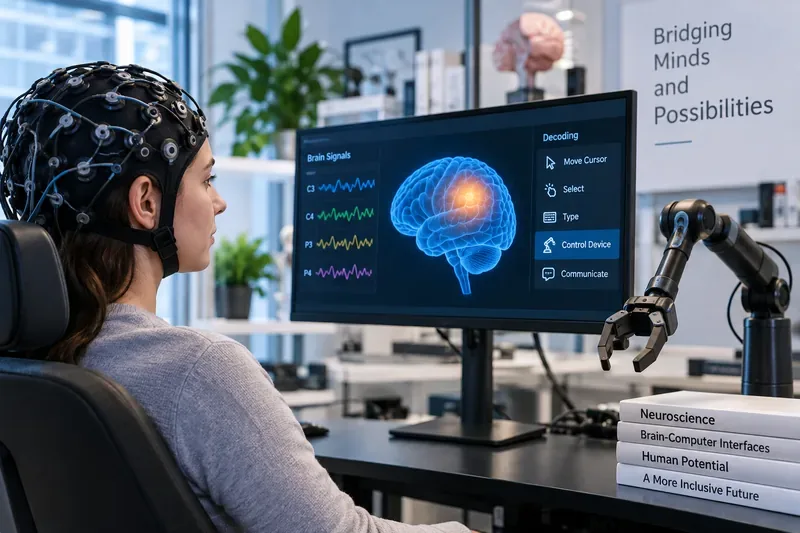
A noninvasive EEG-style BCI setup illustrates the basic idea: record neural activity, decode task-related patterns, and use the output to control or communicate with an external system.
Start with the basic idea: a BCI is a translation system
Neurons communicate through electrical and chemical activity. A BCI does not usually interpret the entire brain at once. Instead, it records a particular class of neural signals, processes those signals, and uses a trained algorithm to infer a limited intention or state relevant to the task.
The computational component is often called a decoder: a model that maps recorded neural patterns to an output such as “move the cursor left,” “select this letter,” or “the user is attempting to say this word.” Many modern decoders use machine learning, including neural networks.
A simple BCI pipeline looks like this:
Acquire: sensors measure neural activity.
Clean and process: software reduces noise and extracts useful features.
Decode: an algorithm estimates the intended command, word, or movement.
Act: the system moves a cursor, synthesizes speech, drives an assistive device, or delivers feedback.
Adapt: the user and algorithm may both improve with calibration and repeated use.
The National Institute of Neurological Disorders and Stroke (NINDS) describes neural engineering as spanning neural interfaces, neuroprostheses, prosthetic control, neuromodulation, and BCI development from basic research through clinical studies. See the NINDS neural engineering overview.
Next, understand the three main ways BCIs can access brain signals
1. Noninvasive BCIs: sensors stay outside the skull
The best-known example is electroencephalography (EEG), which records tiny voltage changes from electrodes placed on the scalp. EEG is widely used in BCI research because it is noninvasive, relatively portable, and has high temporal resolution, meaning it can track fast changes in neural activity.
The tradeoff is signal quality and localization. The skull and scalp blur and attenuate electrical activity, and the recording is vulnerable to eye movements, muscle activity, poor electrode contact, and environmental noise. A 2025 systematic review of noninvasive BCIs found that EEG remains heavily studied for communication, motor assistance, and rehabilitation, while convenience, decoding accuracy, electrode design, and patient-specific variability remain important challenges. See the systematic review indexed by PubMed.
2. Surface or endovascular interfaces: closer to the brain without penetrating deeply into cortex
Electrocorticography (ECoG) records electrical activity using electrodes positioned on the brain's surface. Because the sensors are closer to the source than scalp EEG, ECoG can capture more spatially specific activity, but it requires an invasive procedure.
Another approach places electrodes inside blood vessels near motor areas of the brain. This is sometimes called an endovascular BCI. ClinicalTrials.gov lists the Synchron COMMAND study as an early-feasibility study of an implanted motor neuroprosthesis for people with severe motor impairment, and newer Synchron studies continue to evaluate the approach. See the COMMAND study record.
3. Intracortical interfaces: electrodes record within brain tissue
An intracortical BCI uses microelectrodes placed in the cortex to record activity at much finer spatial resolution. These systems can capture signals useful for detailed movement or speech decoding, but they also introduce surgical, biological, hardware, and long-term reliability considerations.
The FDA's implanted-BCI guidance emphasizes both nonclinical testing and clinical study design because implanted systems must be evaluated not just for performance but also for safety, reliability, durability, and risks associated with implantation.
What can BCIs actually do today?
Restore communication
Communication is one of the strongest areas of current BCI progress. In a 2024 study published in the New England Journal of Medicine, an intracortical speech neuroprosthesis for a man with amyotrophic lateral sclerosis (ALS) reached 99.6% accuracy on a 50-word vocabulary after 30 minutes of calibration on the first day of use. After more training, the system achieved high accuracy on a much larger vocabulary and supported self-paced conversation. Read the original study record on PubMed.
In 2025, researchers reported a brain-to-voice system that continuously translated activity related to attempted speech into synthesized speech in 80-millisecond increments. This was a research neuroprosthesis for a participant with severe paralysis, not a general-purpose thought reader. See the original Nature Neuroscience study.
Control computers and digital devices
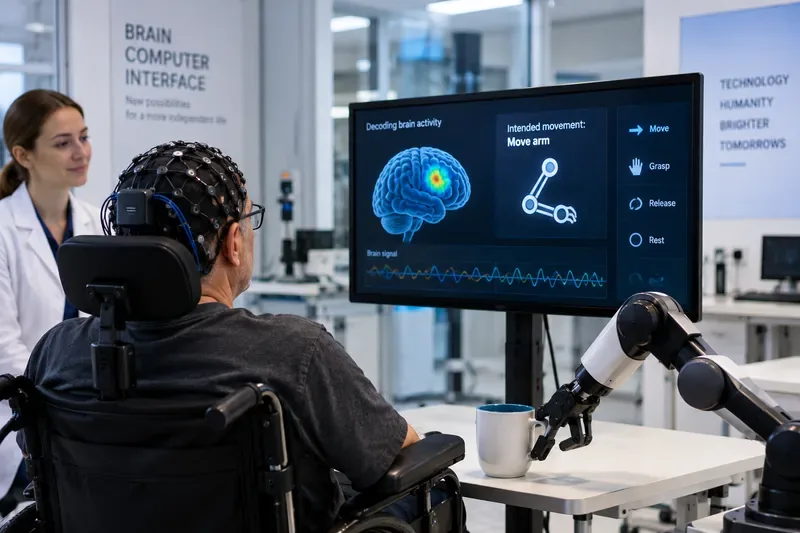
Motor BCIs can map activity associated with attempted or imagined movement to cursor movement, clicking, typing, or other digital commands. Clinical trials are testing implanted systems specifically for people who have lost upper-limb function.
For example, ClinicalTrials.gov lists Neuralink's PRIME study as a first-in-human early-feasibility study evaluating safety and device functionality for control of external devices in people with tetraparesis or tetraplegia. The record was last updated January 9, 2026 and listed the study as recruiting at that time. See the PRIME study record.
Support rehabilitation
Noninvasive BCIs are also being studied for rehabilitation after stroke and other neurological injuries. A typical rehabilitation design detects a motor intention from EEG and links it to feedback such as a robotic device, functional electrical stimulation, or a virtual movement. This creates a closed loop: brain activity produces feedback, and the feedback can in turn influence learning and neural adaptation.
Evidence is promising, but outcomes vary with the condition, protocol, signal quality, training, and patient. Rehabilitation BCIs should therefore be understood as a developing clinical technology, not a replacement for individualized medical care.
Decode inner speech — with important limits
Research published in 2025 showed that patterns associated with inner speech, meaning silently imagined words or sentences, can be represented in motor cortex and decoded under experimental conditions. This is scientifically important, but it does not establish unrestricted access to private thoughts. The experiments used implanted recordings, defined tasks, trained models, and cooperative participants. See the original 2025 research article.
Before using or evaluating a BCI, define the capability you actually need
A beginner can avoid a lot of confusion by defining the intended outcome before comparing devices or research claims.
Goal
Likely BCI approach
Main tradeoff
Hands-free computer control
EEG or implanted motor BCI
Noninvasive convenience versus implanted signal fidelity and surgical risk
Speech restoration
ECoG or intracortical speech decoding in current research
High-performance decoding versus invasiveness and trial eligibility
Motor rehabilitation
Often noninvasive EEG with feedback
Low procedural risk versus variable signal quality and training demands
Sensory restoration or bidirectional control
Implanted recording plus stimulation research
Potentially richer interaction versus greater technical and clinical complexity
General cognitive enhancement
No single established clinical BCI pathway
Many public claims exceed what has been demonstrated in controlled studies
If the goal is medical, the next step is not to buy hardware based on specifications alone. It is to identify whether the technology is an approved clinical product, an investigational device in a registered study, or a research prototype.
What preparation does real BCI use require?
Calibration
Calibration means collecting paired examples of neural activity and known tasks so the decoder can learn the relationship between signals and intended outputs. The 2024 speech study above required only 30 minutes for its initial 50-word calibration, but that result came from one participant with a specific implanted system and should not be generalized to every BCI.
User training and fatigue management
BCI performance depends on the user as well as the algorithm. Attention, fatigue, electrode placement, movement artifacts, medication, disease progression, and day-to-day changes can all affect signals. Noninvasive systems in particular often need careful setup and repeated practice.
Signal quality and drift
Signal-to-noise ratio is the amount of useful neural information relative to unwanted noise. Better sensors do not eliminate the need for robust processing. Signals can also change over time, a problem often called drift. A system that works well in one session may require adaptation later.
Clinical and surgical evaluation for implants
An implanted BCI involves much more than selecting a decoder. Study teams may evaluate medical eligibility, anatomy, infection and bleeding risk, device placement, anesthesia, long-term monitoring, rehabilitation goals, and the participant's ability to follow the study protocol. Early-feasibility trials are designed partly to learn about those risks and practical issues.
Data governance
Neural data should be treated as sensitive. Before joining a study or using a consumer neurotechnology product, ask what data are collected, whether raw signals are stored, how long they are retained, who can access them, whether they are used to train models, and how withdrawal or deletion works.
The NIH BRAIN Initiative defines neuroethics as the study of ethical, legal, and societal implications of neuroscience and supports research on issues including autonomy, privacy, safety, and access. See the NIH BRAIN Initiative neuroethics program.
Common beginner mistakes to avoid
Mistake 1: Treating every BCI as “mind reading”
Most present-day BCIs are task-specific decoders. They are trained on particular neural patterns under defined conditions. Speech BCIs may decode attempted or imagined speech; motor BCIs may decode movement intention. That is very different from continuously extracting arbitrary beliefs, memories, or thoughts.
Mistake 2: Comparing EEG caps directly with implanted arrays
Both are BCIs, but they operate with different signal quality, setup burden, risk, and intended use. A scalp EEG system avoids surgery but receives weaker and spatially blurred signals. An implanted system can capture richer local activity but adds medical and engineering risks.
Mistake 3: Assuming a research record is a commercial specification
A striking result in one or a few participants can prove feasibility without proving broad effectiveness. Early-feasibility trials are deliberately small and are often designed primarily to evaluate safety and device function.
Mistake 4: Ignoring the human learning loop
A BCI is not merely a sensor plus software. Users learn to produce more consistent signals, while decoders adapt to users. Comfort, training time, fatigue, accessibility, and support can matter as much as peak laboratory accuracy.
Mistake 5: Forgetting privacy because the device is “medical” or “wearable”
Medical research and consumer products can operate under different privacy frameworks and terms. Neural data may be deeply sensitive even when the device only uses a narrow signal today, because future algorithms may extract more information from stored data.
Mistake 6: Jumping from restoration to enhancement
Restoring communication for someone with paralysis and augmenting the abilities of a healthy person are different technical, ethical, and regulatory goals. The strongest human evidence today is concentrated in assistive and restorative applications. Claims about broad memory, intelligence, or productivity enhancement should be treated as separate hypotheses unless supported by direct evidence.
A practical checklist for evaluating a BCI claim
What signal is measured? EEG, ECoG, intracortical activity, or another modality?
Is it invasive? If yes, what procedure and long-term risks are involved?
What exactly is decoded? Cursor intent, attempted speech, motor imagery, attention, or something else?
How much calibration is required? Minutes, hours, repeated sessions, or continuous adaptation?
Who was tested? Healthy volunteers, people with ALS, spinal cord injury, stroke, or another group?
How many participants were studied? A case study and a large clinical trial support different levels of confidence.
What is the real-world output? A laboratory score, communication rate, home use, or functional independence?
What is the regulatory status? Research prototype, investigational device, or cleared/approved clinical product?
What happens to the neural data? Storage, sharing, model training, security, and deletion policies matter.
Where the field is going
The direction of travel is clear even if the destination is not. Sensors are becoming smaller and more capable, decoding models are improving, speech systems are becoming faster, and researchers are exploring more natural control with less calibration. At the same time, long-term stability, surgical risk, usability, affordability, cybersecurity, privacy, and equitable access remain unresolved engineering and social problems.
One important trend is the move from one-way decoding toward bidirectional interfaces that both record neural activity and provide stimulation or sensory feedback. In principle, that could make prosthetic control feel more natural by returning information to the nervous system instead of only reading commands from it. The FDA's BCI guidance already treats restoration of motor and sensory capabilities as relevant goals for implanted neuroprostheses, but broad clinical adoption will depend on evidence of safety and durable benefit.
Bottom line
Brain-computer interfaces are redefining human capability first by restoring functions that injury or disease has taken away. Current research shows that neural signals can support communication, computer control, rehabilitation, and increasingly natural speech synthesis. Those achievements are real, but they do not mean BCIs can freely read any thought or that implanted neural technology is ready for general consumer enhancement.
For a beginner, the best way to evaluate the field is to follow the signal: identify how brain activity is measured, what the decoder was trained to infer, what output it controls, who was studied, and what risks or data obligations come with the interface. That framework makes it much easier to separate meaningful progress from speculation while appreciating how quickly neurotechnology is advancing.