Why Is ASML Down Today? MATCH Act Fears Weigh on Shares — November 25, 2026
ASML fell 5.8% to €1,131.60 on November 25 as concern over proposed U.S. chip-equipment export controls revived China-sales risks. Here’s what may matter next.
Verified and updated: November 20, 2026, 8:17 a.m. JST (UTC+09:00).
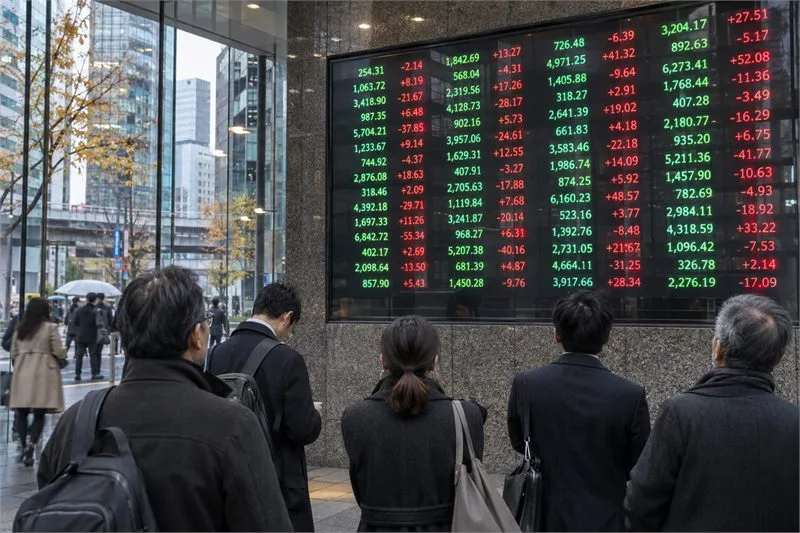
Japan’s stock market suffered a steep, broad-based selloff on Friday, November 20. The supplied delayed quote data puts the Nikkei 225 at 56,436.65, down 5.06% from its previous close, and Mitsubishi UFJ Financial Group (8306.T) at ¥3,024, down 5.41%. The clearest confirmed catalyst was a sharp Wall Street decline that reignited concern about AI valuations and semiconductor demand, pulling technology and chip-related shares lower across Asia.
That explains the market backdrop, but it does not establish a separate company-specific cause for Mitsubishi UFJ’s decline. Available reporting describes broad selling across Japanese shares; it does not identify a fresh MUFG announcement as the reason for the stock’s move.
The supplied session data shows the Nikkei’s fall of 3,007.56 points from 59,444.21 to 56,436.65. MUFG fell ¥173 from ¥3,197 to ¥3,024. These figures are the provided Yahoo Finance delayed daily observations, not independently verified exchange closing records. The session timestamp supplied for the Nikkei is 06:30 UTC, equivalent to 3:30 p.m. in Tokyo (JST, UTC+09:00), the end of the regular Tokyo cash session.
Reporting during the session supports the picture of widespread pressure. Jiji Press reported that the Nikkei had fallen nearly 4.8% by 9:54 a.m. Tokyo time, with AI and chip-related stocks tumbling after the previous night’s Wall Street selloff; roughly 90% of Tokyo Stock Exchange Prime Market shares were lower at that point. The Associated Press also reported early Friday losses in Asian benchmarks and declines among Tokyo AI-related names including Advantest and SoftBank. Those intraday figures provide context, while the supplied data gives the later session close. (Jiji Press’s November 20 market report; Associated Press report on the Asian selloff)
The reported trigger came from the United States. On Thursday, November 19, the S&P 500 fell 2%, the Dow Jones Industrial Average lost 2.2%, and the Nasdaq Composite dropped 2.3%, according to the Associated Press. Investors remained uneasy about the durability of the AI investment boom and semiconductor demand. Despite Anthropic’s strong stock-market debut, Nvidia reversed an early gain and ended lower; AP also reported the sudden resignation of Nvidia CEO Jensen Huang as an added source of uncertainty.
That combination matters for Tokyo because chipmakers and other technology-linked companies can have substantial influence on sentiment and index performance. When investors reassess expected growth or valuations in those sectors, selling can spread to other shares as portfolios are reduced. Jiji’s reporting identified AI and chip-related shares as a drag on the Nikkei. This supports a global risk-off explanation for the index’s fall; it does not prove that every constituent declined for the same reason.
MUFG fell more than the Nikkei in percentage terms in the supplied observations, but the reporting reviewed does not attribute that move to a specific bank announcement. A bank’s share price can respond to broad market selling as well as interest-rate expectations, bond-market moves, currency changes and company news. Those are possible channels, not confirmed explanations for MUFG on this date.
Investors seeking a company-specific cause should check MUFG’s investor-relations releases and Tokyo Stock Exchange disclosures for announcements dated November 20 before drawing a conclusion. The price move alone cannot identify its cause. (MUFG investor relations; Japan Exchange Group)
The next regular Tokyo cash-market session after Friday is Monday, November 23. The Japan Exchange Group calendar notes that markets will not open that day because of a planned group-wide business-continuity exercise, so the next regular session is Tuesday, November 24. Investors can still see developments in overseas markets before Tokyo reopens; the JPX notes that derivatives trading may operate on holidays, subject to its schedules. (JPX holiday-trading information)
Bull case: If U.S. technology shares stabilize and chip-related selling eases, Japanese equities could see bargain buying and a partial rebound. That would be a scenario, not a confirmed outlook.
Base case: If global markets remain unsettled, volatility may stay elevated and performance may vary by sector and company. Traders will likely watch overseas technology shares, semiconductor sentiment, currency moves and fresh company disclosures.
Bear case: If concerns about AI investment and chip demand deepen, further risk reduction could pressure Japanese technology shares and weigh on the broader index. MUFG could also remain exposed to broad market selling, though its direction would depend on bank-specific and macroeconomic factors as well.
These scenarios describe possible market conditions, not price targets or guarantees. The key confirmed development was the international risk-off move; what happens next depends on subsequent data, announcements and investor positioning.
The supplied delayed quote data records a 5.06% fall to 56,436.65.
MUFG fell 5.41% to ¥3,024 in the supplied data. Broad selling was the market context, but the sources reviewed did not confirm a separate company-specific catalyst.
After Friday, November 20, the next regular cash-market session is Tuesday, November 24. JPX says markets will be closed Monday, November 23 for a planned business-continuity exercise.
ASML fell 5.8% to €1,131.60 on November 25 as concern over proposed U.S. chip-equipment export controls revived China-sales risks. Here’s what may matter next.
The Nikkei 225 fell 2.78% to 57,011.62 on November 25 as global AI and semiconductor stocks sold off. Here are the verified drivers and conditional scenarios for the next Tokyo session.
Why did China markets fall on November 25, 2026? Analysis of the Shenzhen Component's 3.24% drop and Shanghai Composite's 2.03% slide, key catalysts, and next-session outlook.
KOSPI plummeted 6.16% and Samsung Electronics dropped 9.87% on November 25, 2026. Explore verified catalysts, global semiconductor downgrades, and next-session outlook.
Natural gas rebounded while silver slid on Nov. 24. See the verified contract moves, weather and rate drivers, rollover caveat, and next-session catalysts.
Nvidia (NVDA) dropped 5.86% to $155.38 on November 24, 2026. Explore the primary catalysts behind the pullback, fundamental valuation, and next-session outlook.
Sanofi rose 9.76% on Nov. 24 after announcing a $41 billion Insmed acquisition. Here are the confirmed deal terms, risks and conditional outlook for the next session.
ASML.AS closed lower on Nov. 24 as the chip rally faded and export-control risks lingered. See the verified close, confirmed catalysts, and conditional outlook for Nov. 25.
Why is Nvidia up today? Analysis of NVDA's 31.48% surge on November 23, 2026, examining core catalysts, verified market data, and the next-session outlook.
The KOSPI jumped 6.32% and Samsung Electronics gained 6.70% on Nov. 24 as a Wall Street technology rally lifted Korean chip stocks. Here are the confirmed drivers and conditional scenarios for the next session.