Why Is ASML Down Today? MATCH Act Fears Weigh on Shares — November 25, 2026
ASML fell 5.8% to €1,131.60 on November 25 as concern over proposed U.S. chip-equipment export controls revived China-sales risks. Here’s what may matter next.
Market data checked: November 23, 2026, 6:49:05 p.m. Pacific Standard Time (PST, UTC−08:00). The regular U.S. stock session ended Monday, November 23, at 4:00 p.m. in New York, Eastern Standard Time (EST, UTC−05:00), or 21:00 UTC.
Tesla, Meta Platforms and Alphabet all finished higher on November 23 as investors returned to technology and AI-linked stocks after Nvidia announced that Jensen Huang was being reinstated as CEO. Tesla rose the most, gaining 11.46% to $385.46. Meta climbed 6.55% to $597.60, and Alphabet’s Class A shares (GOOGL) gained 6.34% to $282.10. Tesla also had a company-specific headline over the weekend: its official account said the FSD (Supervised) v15 rollout was starting.
The broad AI-related rebound is the clearest shared explanation for the three stocks’ gains, according to market reporting. The Tesla software announcement may have added a separate catalyst, but available evidence does not quantify how much it contributed. Meta and Alphabet had no same-day earnings or guidance revision identified in the company materials checked.
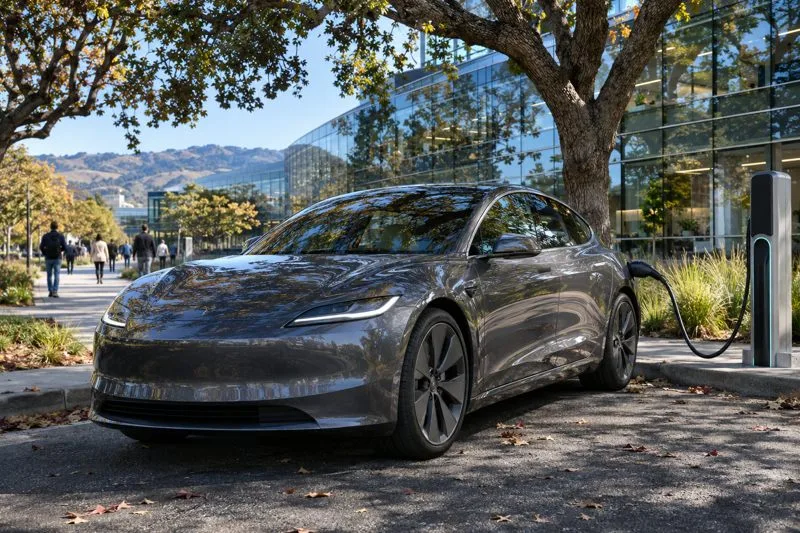
These are regular-session closes from Yahoo Finance delayed daily data, measured against the immediately preceding valid daily close:
| Company / ticker | Nov. 23 close | Dollar change | Percentage change |
|---|---|---|---|
| Tesla (TSLA) | $385.46 | +$39.64 | +11.46% |
| Meta Platforms (META) | $597.60 | +$36.76 | +6.55% |
| Alphabet Class A (GOOGL) | $282.10 | +$16.81 | +6.34% |
Reuters’ end-of-day report rounded Meta’s advance to 6.6% and Alphabet’s to 6.3%, in line with the delayed quote data. The comparison covers these three shares only; it is not a measure of the entire U.S. market.
The main common catalyst was a change in expectations around Nvidia, a key supplier at the center of the AI trade. Nvidia announced on November 23 that its board had reinstated Huang as president and CEO, effective immediately. The company’s announcement says the board acted unanimously and that an independent investigation it had opened would continue. The SEC filing confirms the reinstatement and the date of the board action.
Reuters reported that the announcement helped bring investors back to AI-related shares after the previous week’s selloff. It reported Meta up about 6.6% and Alphabet up about 6.3% alongside a broader advance in large technology companies. That supports a sector-wide sentiment explanation for both stocks; it does not establish a separate company-specific cause for either share move.
Meta’s newsroom published an item on November 23 about researchers using its open-weight AI models in medical research. The post describes research projects and does not announce a new quarterly forecast or financial result. No checked source tied that newsroom item specifically to Meta’s intraday rally. Alphabet’s investor-relations page likewise showed its latest quarterly results announcement on October 28, rather than a new earnings release on November 23.
Tesla participated in the same technology-led relief rally, but its larger gain coincided with news about its driver-assistance software. On Saturday, November 21, Tesla’s official account on X said FSD (Supervised) v15 was “now starting to roll out” and listed changes to the system. The post’s timestamp was 7:24 p.m. UTC on November 21 (2:24 p.m. EST in New York). The wording described a rollout beginning, not a completed release to every customer.
Tesla’s post included a company claim about improved handling of safety-critical cases but did not provide independent test results in the announcement. FSD is still labeled “Supervised” by Tesla; the software news should not be described as proof of autonomous driving. The timing makes the rollout a plausible additional factor in Tesla’s outperformance, but the share-price data alone cannot separate that effect from the broader AI rebound or other trading activity.
Tesla’s investor-relations press page did not show a November 23 earnings or guidance release. The available reporting instead points to the Nvidia-led rebound and the weekend software update as the clearest developments surrounding the move. Speculation about possible deals or other unconfirmed explanations is not treated here as an established catalyst.
For Tuesday, November 24, a bullish scenario would require the technology rebound to hold and buying to extend beyond the initial reaction to Nvidia. Tesla would also need investors to keep viewing the FSD v15 rollout as evidence of product progress, while Meta and Alphabet would need to benefit from sustained demand for AI-related companies. Those are conditions to watch, not a prediction.
A base case is a choppy session or partial pullback after one unusually strong day. The three stocks rose alongside a sharp rebound across technology shares; none of the closing prices proves that the prior week’s concerns about AI valuations, spending or future returns have been resolved. Tesla’s software rollout is at an early stage, while the specific same-day catalysts for Meta and Alphabet remain less clear.
A bearish scenario would become more plausible if investors again question the scale or return on AI spending, Nvidia’s rebound fades, or Tesla investors decide the FSD rollout does not yet change the company’s business outlook. Company announcements, subsequent rollout details and market breadth would matter more than a single session’s percentage gain. These scenarios are conditional and include no price targets.
The Conference Board has scheduled its November Consumer Confidence Index for Tuesday, November 24, at 10:00 a.m. in New York, EST (UTC−05:00), or 15:00 UTC. The release could affect views on consumer demand and interest rates, though it is not a company-specific report for these three stocks. Tesla’s 2026 shareholder meeting is scheduled for Thursday, December 3, at 3:00 p.m. Central Standard Time (UTC−06:00), or 21:00 UTC, according to its SEC proxy statement. The U.S. market calendar is shortened for Thanksgiving: exchanges are closed Thursday, November 26, and Nasdaq and NYSE list a 1:00 p.m. Eastern early close Friday, November 27 (EST, UTC−05:00; 18:00 UTC).
Tesla joined the AI-related market rebound and had a separate FSD (Supervised) v15 rollout announcement over the weekend. The available data cannot isolate each catalyst’s contribution.
No same-day earnings or guidance release was identified in the company materials checked. Reuters linked both stocks’ gains to the wider technology rebound.
The Conference Board’s consumer-confidence report is due Tuesday, November 24, at 10:00 a.m. EST in New York (15:00 UTC). Tesla’s annual shareholder meeting is scheduled for December 3.
Sources checked: Yahoo Finance Tesla historical prices, Meta historical prices and Alphabet historical prices; Reuters’ November 23 market report; Nvidia’s announcement and its SEC filing; Tesla’s FSD v15 post and investor-relations press page; Meta’s newsroom post and Alphabet investor relations; the Conference Board release schedule; Tesla’s SEC proxy statement; the Nasdaq trading calendar and NYSE holiday calendar; and NIST’s daylight-saving schedule.
ASML fell 5.8% to €1,131.60 on November 25 as concern over proposed U.S. chip-equipment export controls revived China-sales risks. Here’s what may matter next.
The Nikkei 225 fell 2.78% to 57,011.62 on November 25 as global AI and semiconductor stocks sold off. Here are the verified drivers and conditional scenarios for the next Tokyo session.
Why did China markets fall on November 25, 2026? Analysis of the Shenzhen Component's 3.24% drop and Shanghai Composite's 2.03% slide, key catalysts, and next-session outlook.
KOSPI plummeted 6.16% and Samsung Electronics dropped 9.87% on November 25, 2026. Explore verified catalysts, global semiconductor downgrades, and next-session outlook.
Natural gas rebounded while silver slid on Nov. 24. See the verified contract moves, weather and rate drivers, rollover caveat, and next-session catalysts.
Nvidia (NVDA) dropped 5.86% to $155.38 on November 24, 2026. Explore the primary catalysts behind the pullback, fundamental valuation, and next-session outlook.
Sanofi rose 9.76% on Nov. 24 after announcing a $41 billion Insmed acquisition. Here are the confirmed deal terms, risks and conditional outlook for the next session.
ASML.AS closed lower on Nov. 24 as the chip rally faded and export-control risks lingered. See the verified close, confirmed catalysts, and conditional outlook for Nov. 25.
Why is Nvidia up today? Analysis of NVDA's 31.48% surge on November 23, 2026, examining core catalysts, verified market data, and the next-session outlook.
The KOSPI jumped 6.32% and Samsung Electronics gained 6.70% on Nov. 24 as a Wall Street technology rally lifted Korean chip stocks. Here are the confirmed drivers and conditional scenarios for the next session.