Why Is ASML Down Today? MATCH Act Fears Weigh on Shares — November 25, 2026
ASML fell 5.8% to €1,131.60 on November 25 as concern over proposed U.S. chip-equipment export controls revived China-sales risks. Here’s what may matter next.
Updated: November 20, 2026, 06:58 UTC (15:58 KST, Seoul).
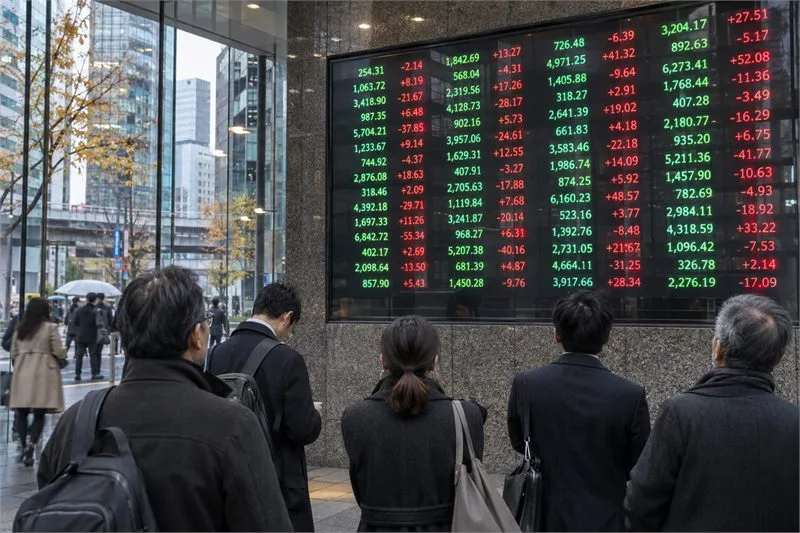
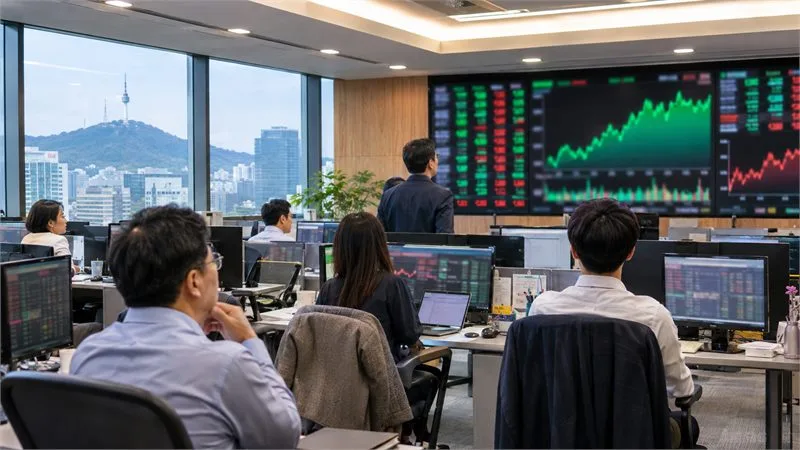
South Korean shares sold off sharply on Friday, November 20, as investors renewed concerns about returns on artificial-intelligence spending and the outlook for chipmakers. The supplied delayed Yahoo Finance data records the KOSPI at 4,869.96, down 5.21% from its prior close, and Samsung Electronics at ₩183,100, down 7.01%. These figures are attributed to that feed: same-day reports from the session cited different intraday index readings, and a final KRX close matching the supplied numbers could not be independently confirmed.
The decline followed a sharp overnight retreat in U.S. technology shares. Reports also pointed to concerns about U.S. semiconductor rules affecting China. Those factors provide context for the selloff, but they do not establish that any single event caused the precise move in either security.
The supplied session data marks a steep decline in both the benchmark and Samsung, a major index constituent and one of South Korea’s most closely watched technology companies. The two losses should be read separately: an index reflects many listed companies, while Samsung’s share price also responds to company-specific expectations and trading. The observed percentages describe the feed’s change versus the immediately preceding valid daily close; they are not an explanation of the move.
Contemporaneous coverage captured the selloff as it unfolded. The Associated Press reported early Friday that the KOSPI was lower alongside other Asian markets and identified Samsung among regional AI-related shares under pressure. Yonhap later reported the KOSPI down 4.24% at 11:20 a.m. Korea Standard Time. These are intraday snapshots, not confirmation of the supplied closing figure. Associated Press coverage of Asian markets and Yonhap’s Nov. 20 market report provide those session snapshots.
Market reports described investors questioning whether the scale of spending on AI infrastructure will produce returns quickly enough to support high technology valuations. The concern followed losses in U.S. technology and semiconductor stocks. When global investors reduce exposure to the AI trade, Korean chipmakers can face selling pressure even without a new company announcement from Samsung that day. This is a market-level explanation reported by news outlets, not proof of each investor’s motive.
South Korean coverage also cited concern about U.S. semiconductor restrictions involving China. Policy uncertainty can affect expectations for chip demand, supply chains, and access to major markets. The reports available for this article establish that the concern was part of the day’s market discussion; they do not quantify its contribution to the KOSPI or Samsung’s decline. SBS’s Nov. 20 report discussed both lingering AI-investment doubts and U.S. chip-policy concerns.
Samsung’s newsroom published a leadership announcement dated Nov. 20, naming leaders for its memory and mobile businesses and confirming existing leaders for its device divisions. The announcement establishes a corporate development on the same date, but the available evidence does not show that investors treated it as the cause of the share decline. The wider market context and the stock’s fall alone are not enough to make that claim. Samsung’s leadership announcement.
The next-session outlook is conditional. In a bullish scenario, a recovery in U.S. technology shares, calmer chip-policy signals, or evidence of buyers returning to large-cap semiconductors could support a rebound. In a base case, investors may remain cautious and prices could move unevenly as they reassess AI valuations and chip demand. In a bearish scenario, renewed losses in global technology shares or more restrictive policy headlines could extend pressure on Samsung and the broader market. These are scenarios, not price targets or predictions.
Investors will also watch for fresh company disclosures, policy developments, and global market cues before Seoul’s next session. The evidence reviewed here does not establish a scheduled event that guarantees a catalyst or a particular direction. A large one-day fall does not by itself show that a rebound is due. This article explains market context and is not investment advice.
The supplied delayed Yahoo Finance data shows a 5.21% decline to 4,869.96. That precise close was not independently corroborated by the same-day reports reviewed here.
Reports pointed to global AI-investment worries, weakness in U.S. technology shares, and uncertainty around U.S. chip policy. The evidence does not isolate one cause for Samsung’s move.
That is uncertain. A rebound would be more plausible if global technology sentiment improves; renewed AI or policy worries could keep pressure on shares.
Sources checked: Associated Press, Yonhap News Agency, SBS, and Samsung Global Newsroom. Market prices are attributed to the supplied delayed Yahoo Finance data.
ASML fell 5.8% to €1,131.60 on November 25 as concern over proposed U.S. chip-equipment export controls revived China-sales risks. Here’s what may matter next.
The Nikkei 225 fell 2.78% to 57,011.62 on November 25 as global AI and semiconductor stocks sold off. Here are the verified drivers and conditional scenarios for the next Tokyo session.
Why did China markets fall on November 25, 2026? Analysis of the Shenzhen Component's 3.24% drop and Shanghai Composite's 2.03% slide, key catalysts, and next-session outlook.
KOSPI plummeted 6.16% and Samsung Electronics dropped 9.87% on November 25, 2026. Explore verified catalysts, global semiconductor downgrades, and next-session outlook.
Natural gas rebounded while silver slid on Nov. 24. See the verified contract moves, weather and rate drivers, rollover caveat, and next-session catalysts.
Nvidia (NVDA) dropped 5.86% to $155.38 on November 24, 2026. Explore the primary catalysts behind the pullback, fundamental valuation, and next-session outlook.
Sanofi rose 9.76% on Nov. 24 after announcing a $41 billion Insmed acquisition. Here are the confirmed deal terms, risks and conditional outlook for the next session.
ASML.AS closed lower on Nov. 24 as the chip rally faded and export-control risks lingered. See the verified close, confirmed catalysts, and conditional outlook for Nov. 25.
Why is Nvidia up today? Analysis of NVDA's 31.48% surge on November 23, 2026, examining core catalysts, verified market data, and the next-session outlook.
The KOSPI jumped 6.32% and Samsung Electronics gained 6.70% on Nov. 24 as a Wall Street technology rally lifted Korean chip stocks. Here are the confirmed drivers and conditional scenarios for the next session.