Why Is ASML Down Today? MATCH Act Fears Weigh on Shares — November 25, 2026
ASML fell 5.8% to €1,131.60 on November 25 as concern over proposed U.S. chip-equipment export controls revived China-sales risks. Here’s what may matter next.
Verified and updated: November 20, 2026, 07:37 UTC (15:37 China Standard Time, UTC+08:00).
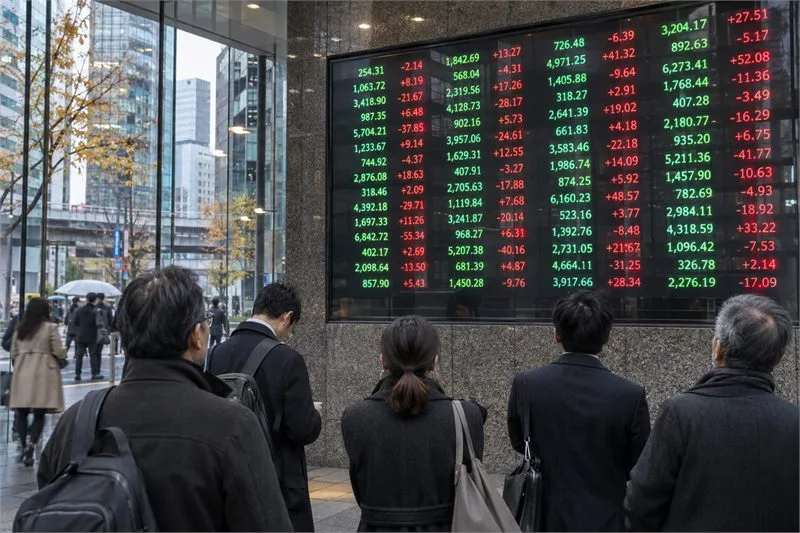
The Shenzhen Component closed at 10,256.39 on November 20, down 3.09% from its previous valid close of 10,583.20, according to the supplied Yahoo Finance delayed quote. That is a sharp one-session decline. Available reporting points to broad risk aversion across Asian equities and pressure on technology shares, but the evidence reviewed does not establish a single confirmed catalyst for the index’s exact loss.
Reports published during the session described weakness in Chinese shares and renewed concerns around technology and artificial-intelligence stocks. Those reports offer context, not proof that any one headline caused the Shenzhen close. Another market-data report gives a different Shenzhen level and percentage change, so the figures below follow the supplied Yahoo Finance snapshot; readers should not treat intraday reports or another provider’s close as interchangeable with it.
The supplied quote for index 399001.SZ records a close of 10,256.3887, compared with 10,583.2002 at the preceding valid daily close. That equals a 3.088% loss, rounded here to 3.09%. The session date is November 20, 2026; the data snapshot identifies the session close at 07:00 UTC, which is 15:00 China Standard Time (UTC+08:00). The quote timestamp is later than the close, at 08:10 UTC.
These are index points, not a percentage move in every Shenzhen-listed stock. The index represents a segment of the market, and individual shares can rise even during a broad index decline. The supplied snapshot also does not include constituent-level breadth, turnover, or sector attribution, so it cannot by itself show which stocks contributed most.
The clearest confirmed fact is the size of the decline in the supplied quote. Its precise cause is less certain. Associated reporting described a risk-off session in Asian equities and weakness in technology-related shares. The Associated Press reported declines in several Asian markets and noted that technology stocks were among those under pressure. That gives useful regional context, but does not independently verify the Shenzhen index’s closing move or establish causation. See the Associated Press report on Asian markets.
Other session coverage discussed concern about artificial-intelligence and semiconductor shares, including uncertainty around technology restrictions. Investors may have treated those issues as reasons to reduce exposure to growth-sensitive stocks. That remains a possible sentiment factor, not a verified attribution for this index decline. A headline arriving near a sell-off does not prove it caused the move.
There is also a data caveat. A separate market report published during November 20 quoted a different Shenzhen level and smaller decline than the supplied delayed quote. Reporting can reflect different times, feeds, or calculation conventions. For this article, the stated return is calculated only from the provided quote and its listed prior close; the discrepancy means the closing figures should be checked against the exchange’s official historical data when available. The Shenzhen Stock Exchange index information is the primary place to consult for exchange materials.
The next-session outlook is conditional, not a directional prediction. In a bull scenario, selling pressure could ease if technology shares stabilize, market breadth improves, and investors respond positively to credible policy or corporate news. A rebound would still need confirmation from actual trading and broader participation.
In a base scenario, the index could remain volatile as investors reassess risk after a steep fall. Mixed sector performance would be consistent with rotation rather than a uniform view of every company. Traders may watch turnover and whether declines continue to spread beyond technology-related shares.
In a bear scenario, continued weakness in growth-sensitive stocks, fresh adverse policy headlines, or broader global risk aversion could keep pressure on the index. These are conditions to monitor, not claims that such events will occur. The next session’s result cannot be inferred from one closing percentage alone.
Check official exchange data once published, including the index close, constituent moves, and turnover. Compare that record with the delayed quote used here. Then review primary company disclosures and policy announcements rather than relying on an unverified social-media explanation. China’s National Bureau of Statistics publishes official releases on its English-language release page; any newly released data should be assessed by its contents and timing, not assumed to explain a prior session.
This is a market explainer, not investment advice. The confirmed observation is a 3.09% fall in the supplied quote. Reports of regional weakness and technology-sector concerns provide context, while the exact drivers and the next-session direction remain uncertain.
Yes. The supplied delayed quote shows a close of 10,256.39, down 3.09% from 10,583.20.
No specific catalyst was confirmed in the primary sources reviewed. Coverage pointed to regional risk aversion and technology-stock pressure as possible context.
That is not established. The next move depends on fresh news, market breadth, and trading behavior; bull, base, and bear outcomes are all possible.
ASML fell 5.8% to €1,131.60 on November 25 as concern over proposed U.S. chip-equipment export controls revived China-sales risks. Here’s what may matter next.
The Nikkei 225 fell 2.78% to 57,011.62 on November 25 as global AI and semiconductor stocks sold off. Here are the verified drivers and conditional scenarios for the next Tokyo session.
Why did China markets fall on November 25, 2026? Analysis of the Shenzhen Component's 3.24% drop and Shanghai Composite's 2.03% slide, key catalysts, and next-session outlook.
KOSPI plummeted 6.16% and Samsung Electronics dropped 9.87% on November 25, 2026. Explore verified catalysts, global semiconductor downgrades, and next-session outlook.
Natural gas rebounded while silver slid on Nov. 24. See the verified contract moves, weather and rate drivers, rollover caveat, and next-session catalysts.
Nvidia (NVDA) dropped 5.86% to $155.38 on November 24, 2026. Explore the primary catalysts behind the pullback, fundamental valuation, and next-session outlook.
Sanofi rose 9.76% on Nov. 24 after announcing a $41 billion Insmed acquisition. Here are the confirmed deal terms, risks and conditional outlook for the next session.
ASML.AS closed lower on Nov. 24 as the chip rally faded and export-control risks lingered. See the verified close, confirmed catalysts, and conditional outlook for Nov. 25.
Why is Nvidia up today? Analysis of NVDA's 31.48% surge on November 23, 2026, examining core catalysts, verified market data, and the next-session outlook.
The KOSPI jumped 6.32% and Samsung Electronics gained 6.70% on Nov. 24 as a Wall Street technology rally lifted Korean chip stocks. Here are the confirmed drivers and conditional scenarios for the next session.