Why Is ASML Down Today? MATCH Act Fears Weigh on Shares — November 25, 2026
ASML fell 5.8% to €1,131.60 on November 25 as concern over proposed U.S. chip-equipment export controls revived China-sales risks. Here’s what may matter next.
Information checked: November 20, 2026, at 5:00 p.m. UTC.
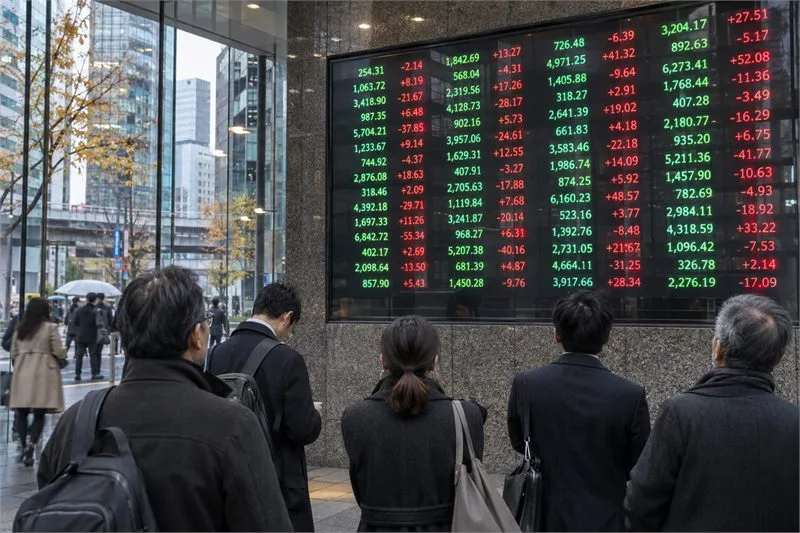
The EURO STOXX 50 finished sharply lower on Friday, November 20, as European shares were caught in a global risk-off move tied to renewed doubts about the returns from heavy artificial-intelligence spending. Technology and chip stocks were among the weakest groups in early European trading, extending a multi-session retreat. The session ended at 5:30 p.m. Central European Time (CET, UTC+01:00) in Frankfurt-based index time, or 4:30 p.m. UTC.
The exact closing print needs a caveat. The delayed Yahoo Finance feed supplied for this report lists 5,941.95, down 2.81% from 6,113.86, but that figure is below the session low reported by other market-history feeds, which also disagree on the final level. Because those records do not reconcile, this article confirms the selloff direction and the documented market catalysts, but does not treat the supplied point level or percentage as a verified official close.
Destaques

The strongest same-day explanation reported by market coverage was a broader reassessment of technology and AI valuations. Investors had hoped that Anthropic's high-profile U.S. stock-market debut would renew confidence in the AI trade. Instead, the listing did not calm concerns about whether very large investments in AI infrastructure and chips will produce sufficient returns. Reuters described investors as unwinding AI-linked positions and taking profits after European shares had already weakened during the week.
This is a market explanation, not a statement that one event mechanically caused the index move. The EURO STOXX 50 tracks large euro-area companies, so its daily change reflects the combined and weighted performance of its constituents. A global shift away from riskier growth shares can put pressure on the benchmark even when there is no single euro-area announcement that explains the whole decline.
Technology weakness provided a visible channel. In its November 20 morning report, Reuters said chip-linked shares ASML, ASM International, and STMicroelectronics were each down more than 5%, while the STOXX 600 technology sector had fallen 3.7% to its lowest level since May. Those figures were a morning snapshot for the broader pan-European market, not a final EURO STOXX 50 attribution. They support the view that semiconductor-related selling was part of the session's pressure, but do not establish how much each stock contributed to the index's final move.
Risk aversion also extended beyond Europe: Reuters reported falling technology shares and lower global equity benchmarks as investors questioned the sustainability of AI spending. That weak external backdrop likely weighed on European stocks, though the available reporting does not isolate a precise contribution for the EURO STOXX 50.
Yes, some company-specific news may have amplified pressure in individual constituents and related European shares. Vallourec announced third-quarter results on November 20. Its official release reported EBITDA of $181 million, down 26% year over year, and cited higher logistics costs for Middle East deliveries, a less favorable product mix, and a temporary U.S. subcontractor issue. Reuters separately reported that Vallourec shares fell sharply after the results. That is a confirmed company catalyst, but Vallourec's move alone cannot explain the broader blue-chip index decline.
Economic news was mixed rather than uniformly negative. The European Commission's November flash consumer-confidence estimate improved by 1.0 percentage point in the euro area to -16.9, but remained well below its long-term average. The better monthly reading offered a counterpoint; it did not erase the day’s broader risk-off pressure. The Commission's next detailed business and consumer survey update is scheduled for November 27.
For the index quote itself, STOXX describes its end-of-day data as closing values based on market closing levels. The accessible delayed quote supplied for this article conflicts with other displayed historical values and ranges, so readers should check the index provider or their market-data terminal for a corrected settlement-quality close before using the figure in calculations.
The next regular European cash session after Friday, November 20, is Monday, November 23. No direction is assured. The immediate watchpoints are whether chipmakers stabilize, whether investors keep reducing AI-related exposure, and whether fresh company news changes expectations. The next scheduled euro-area survey release confirmed in the European Commission calendar is the detailed business and consumer survey update on November 27.
These are conditional scenarios, not price targets or investment advice. A single day's index fall does not establish a longer-term trend, and a disputed delayed quote should not be used as a precise reference level.
Available delayed feeds disagree on the exact close. The supplied Yahoo Finance record showed a 2.81% loss, but its closing value fell below another feed's reported session low, so that exact figure is not independently confirmed here. The direction of the session was clearly lower.
No single cause is confirmed. Reuters identified AI-trade repricing, profit-taking, and chip-stock weakness as key pressures; company-specific results also affected individual shares.
The supplied session record gives 4:30 p.m. UTC on November 20, which was 5:30 p.m. CET (UTC+01:00) in Europe. November dates fall after the shift from Central European Summer Time to standard time.
ASML fell 5.8% to €1,131.60 on November 25 as concern over proposed U.S. chip-equipment export controls revived China-sales risks. Here’s what may matter next.
The Nikkei 225 fell 2.78% to 57,011.62 on November 25 as global AI and semiconductor stocks sold off. Here are the verified drivers and conditional scenarios for the next Tokyo session.
Why did China markets fall on November 25, 2026? Analysis of the Shenzhen Component's 3.24% drop and Shanghai Composite's 2.03% slide, key catalysts, and next-session outlook.
KOSPI plummeted 6.16% and Samsung Electronics dropped 9.87% on November 25, 2026. Explore verified catalysts, global semiconductor downgrades, and next-session outlook.
Natural gas rebounded while silver slid on Nov. 24. See the verified contract moves, weather and rate drivers, rollover caveat, and next-session catalysts.
Nvidia (NVDA) dropped 5.86% to $155.38 on November 24, 2026. Explore the primary catalysts behind the pullback, fundamental valuation, and next-session outlook.
Sanofi rose 9.76% on Nov. 24 after announcing a $41 billion Insmed acquisition. Here are the confirmed deal terms, risks and conditional outlook for the next session.
ASML.AS closed lower on Nov. 24 as the chip rally faded and export-control risks lingered. See the verified close, confirmed catalysts, and conditional outlook for Nov. 25.
Why is Nvidia up today? Analysis of NVDA's 31.48% surge on November 23, 2026, examining core catalysts, verified market data, and the next-session outlook.
The KOSPI jumped 6.32% and Samsung Electronics gained 6.70% on Nov. 24 as a Wall Street technology rally lifted Korean chip stocks. Here are the confirmed drivers and conditional scenarios for the next session.