Why Is ASML Down Today? MATCH Act Fears Weigh on Shares — November 25, 2026
ASML fell 5.8% to €1,131.60 on November 25 as concern over proposed U.S. chip-equipment export controls revived China-sales risks. Here’s what may matter next.
Checked: November 23, 2026 at 5:59 PM Frankfurt time (Central European Time, CET, UTC+01:00). This article covers the completed Monday, November 23, 2026 trading session, not a live or rolling quote.
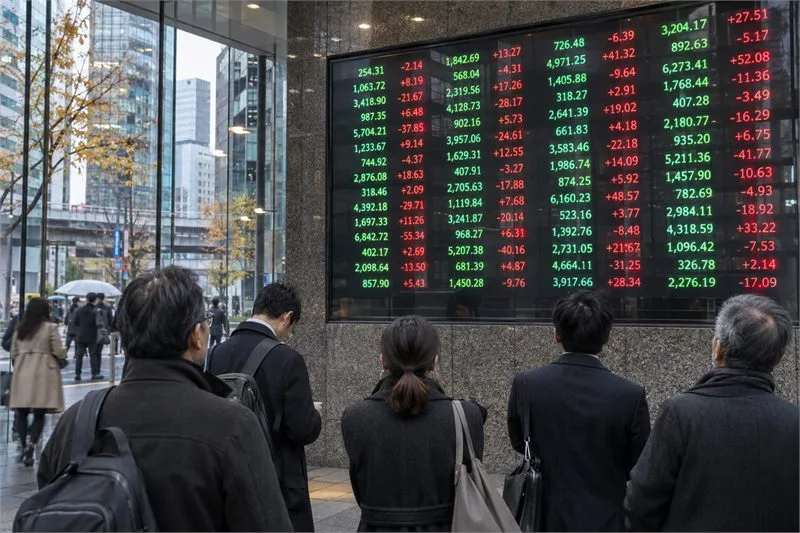
Germany’s DAX 40 rose sharply on November 23, 2026, as European technology shares recovered from the prior week’s selloff and a surprisingly strong German business survey improved the backdrop for industrial stocks. The supplied delayed Yahoo Finance session observation places the index at 25,337.27 points, up 534.49 points or 2.155% from Friday’s 24,802.78. That closing observation is the starting point for this report; the exact final index print should be checked against the exchange’s historical record once posted. The direction of the rebound is independently supported by contemporaneous Frankfurt exchange and financial-market readings.
The important caveat is that the rebound did not erase the preceding week’s losses. Investors were reassessing both the technology sector’s steep slide and Germany’s growth prospects, while higher borrowing costs and persistent European inflation risks remained in view. Those forces can coexist: strong factory data may help earnings expectations without guaranteeing that stock prices will keep rising on Tuesday.

Monday’s move followed a difficult Friday, when the DAX finished at 24,802.78, down 2.60% for that session. The new session began with a modest recovery, then advanced as trading continued. The benchmark quoted here is the DAX performance index, symbol ^GDAXI and ISIN DE0008469008, not a DAX futures contract or a price-only index. DAX values are index points; despite the euro-denominated constituents, the index level is not an amount of euros.
| November 23 snapshot | Value |
|---|---|
| DAX session observation | 25,337.27 points |
| Prior valid close, November 20 | 24,802.78 points |
| Reported change | +534.49 points (+2.155%) |
| Session closing reference | November 23, 5:30 PM Frankfurt CET (UTC+01:00), or 4:30 PM UTC |
| Data status | Yahoo Finance delayed index observation supplied for this session; independent final-print confirmation pending |
Deutsche Börse’s live index page showed the DAX already positive earlier Monday, while contemporary exchange quotes documented the rebound developing during the afternoon. Since those snapshots were published at earlier times, they should not be mistaken for the final close. For the latest exchange reference, consult Deutsche Börse’s DAX index listing and Yahoo Finance’s DAX quote page.
European technology shares had fallen heavily in the preceding week amid investor questions about the pace at which large artificial-intelligence investments would generate profits. Monday brought renewed buying interest in chip and technology companies. Early European-market reporting showed technology shares outperforming, and Frankfurt market quotes during the day showed gains in names including Infineon and Siemens Energy. This is observable market participation, not proof that any one stock or headline caused the full index gain. A reversal after a sharp selloff can reflect bargain hunting, short covering, or investors reducing bearish positions; the relative contribution of each cannot be established from the index close alone.
S&P Global’s November flash survey showed Germany’s composite PMI rising to 55.0 from 53.4 in October, the highest since March 2022. Manufacturing improved to 55.0 from 54.2, and services reached 54.0 from 52.5. Because values above 50 indicate expansion from the previous month, the releases pointed to an acceleration rather than simply an end to contraction. Improving manufacturing orders, including exports, offered a plausible fundamental reason for greater confidence in Germany’s economically sensitive businesses. The figures do not show that every DAX company’s earnings rose Monday.
The broader eurozone picture was more mixed. S&P Global reported an unchanged eurozone composite PMI of 51.7 and a widening divergence between Germany and weaker activity in France. Its commentary also warned that persistent price pressures and borrowing costs could weigh on demand. Read S&P Global’s November 23 eurozone flash PMI analysis for the original survey interpretation.
Contemporaneous German-market reporting also identified strength in industrials, defense-related manufacturers and financial shares, with Rheinmetall and Deutsche Bank among stocks showing gains during the session. That broadening helps explain why the DAX advance could exceed the relatively modest positive opening move. Nevertheless, the index is weighted by free-float market capitalization, so a strong percentage move in a constituent does not necessarily mean it was the day’s biggest contributor in index points. A certified contribution breakdown would be needed to make that claim.
Monday’s rise is consistent with a rebound from oversold conditions, but it does not by itself settle the longer-term outlook. The prior Friday’s sharp decline and the recent fall in technology valuations left sentiment vulnerable. Germany’s PMI was an encouraging surprise, yet S&P Global also flagged the possibility that elevated price pressures could support tighter European Central Bank policy. Rising bond yields can reduce the present value investors place on future corporate profits, especially for growth-oriented businesses.
For context, a 2.155% daily gain is substantial, but percentage changes are measured against the immediately preceding valid close. It is not evidence that the DAX has returned to its earlier November high, nor does it establish that the entire German economy improved by the same percentage. This article does not infer a direct one-to-one causal relationship from the price change.
Germany’s ifo Business Climate release is scheduled for November 24 at 10:30 AM Frankfurt CET (UTC+01:00), equivalent to 9:30 AM UTC, according to the ifo Institute’s release page. Traders will compare it with expectations and the encouraging PMI reading. The next session’s Xetra trading will take place in Frankfurt under CET, with the regular DAX cash session running from 9:00 AM to 5:30 PM CET (8:00 AM to 4:30 PM UTC), subject to the exchange calendar.
If the ifo survey confirms the improving business mood, European bond yields remain manageable, and global chip and technology stocks continue to stabilize, buyers could extend Monday’s recovery. That is a scenario, not a target or a promised Tuesday gain.
If business confidence is broadly in line with expectations and no major new global catalyst emerges, the market could pause or trade unevenly as investors reassess Monday’s sharp bounce. Differing performances among technology, banks, autos and defensive stocks would be consistent with that outcome.
If the ifo release disappoints, yields climb on renewed expectations of tighter monetary policy, or US technology shares resume their decline, the DAX could surrender some of its rebound. The preceding selloff makes sentiment particularly sensitive to adverse surprises.
These conditional scenarios are not investment recommendations. Investors should separate verified releases from market narratives and check the next official exchange data before treating any indicative or delayed price as final. I'm not a financial advisor.
A rebound in European technology and industrial stocks coincided with better-than-expected German flash PMI data. These are supported drivers of sentiment, not an audited allocation of the exact index gain.
The supplied delayed Yahoo Finance session reading was 25,337.27, up 534.49 points or 2.155% from November 20. The definitive exchange historical close should be checked independently.
Germany’s ifo Business Climate release on Tuesday, November 24 at 10:30 AM Frankfurt CET (UTC+01:00), or 9:30 AM UTC, is an important scheduled indicator. The market reaction depends on the result versus expectations and wider risk sentiment.
Primary references: Deutsche Börse index quotations; S&P Global PMI release, November 23; ifo Institute release schedule; Yahoo Finance DAX 40 index data.
ASML fell 5.8% to €1,131.60 on November 25 as concern over proposed U.S. chip-equipment export controls revived China-sales risks. Here’s what may matter next.
The Nikkei 225 fell 2.78% to 57,011.62 on November 25 as global AI and semiconductor stocks sold off. Here are the verified drivers and conditional scenarios for the next Tokyo session.
Why did China markets fall on November 25, 2026? Analysis of the Shenzhen Component's 3.24% drop and Shanghai Composite's 2.03% slide, key catalysts, and next-session outlook.
KOSPI plummeted 6.16% and Samsung Electronics dropped 9.87% on November 25, 2026. Explore verified catalysts, global semiconductor downgrades, and next-session outlook.
Natural gas rebounded while silver slid on Nov. 24. See the verified contract moves, weather and rate drivers, rollover caveat, and next-session catalysts.
Nvidia (NVDA) dropped 5.86% to $155.38 on November 24, 2026. Explore the primary catalysts behind the pullback, fundamental valuation, and next-session outlook.
Sanofi rose 9.76% on Nov. 24 after announcing a $41 billion Insmed acquisition. Here are the confirmed deal terms, risks and conditional outlook for the next session.
ASML.AS closed lower on Nov. 24 as the chip rally faded and export-control risks lingered. See the verified close, confirmed catalysts, and conditional outlook for Nov. 25.
Why is Nvidia up today? Analysis of NVDA's 31.48% surge on November 23, 2026, examining core catalysts, verified market data, and the next-session outlook.
The KOSPI jumped 6.32% and Samsung Electronics gained 6.70% on Nov. 24 as a Wall Street technology rally lifted Korean chip stocks. Here are the confirmed drivers and conditional scenarios for the next session.