Why Is ASML Down Today? MATCH Act Fears Weigh on Shares — November 25, 2026
ASML fell 5.8% to €1,131.60 on November 25 as concern over proposed U.S. chip-equipment export controls revived China-sales risks. Here’s what may matter next.
Last checked: November 20, 2026, at 5:03:09 p.m. UTC (6:03:09 p.m. in Frankfurt, Central European Time, CET, UTC+01:00).
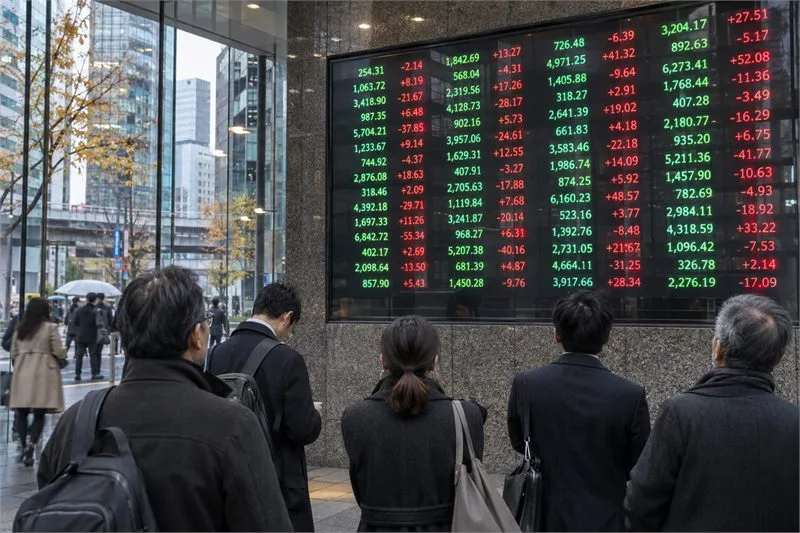
The DAX 40 ended Friday’s Xetra session lower as investors extended a global retreat from technology and artificial-intelligence trades. Yahoo Finance’s current historical row lists the DAX at 24,879.56 for November 20, down about 2.3% from Thursday’s 25,463.81 close. That is a delayed market-data reading; the exchange’s regular Xetra session ends at 5:30 p.m. Frankfurt time (16:30 UTC), and live quote pages can show different snapshots. The direction and scale of the decline are clear, but no single headline fully explains every sale.
The best-supported drivers were renewed doubts about returns on AI spending, broad weakness in technology shares, and rate concerns. Germany’s producer-price release showed an 8.1% annual increase in October, while Bundesbank President Joachim Nagel said the ECB would likely need to tighten policy in December. The latter comment came late in Friday’s session. These factors add context; they do not prove that any one item caused a precise share of the DAX’s decline.

The current Yahoo Finance historical table lists a November 20 close of 24,879.56, compared with 25,463.81 on November 19. That works out to a decline of roughly 2.3%. The same row shows a session range of 24,815.15 to 25,194.64. Deutsche Börse’s live index page also showed the DAX down more than 2% in a late-session quote, although that timestamped live figure was not itself the official daily close. For exact comparisons, use one provider’s historical close series consistently rather than mixing delayed intraday snapshots with end-of-day values.
Xetra’s regular trading hours are Monday through Friday, 9:00 a.m. to 5:30 p.m. CET. On November 20, Germany was on CET (UTC+01:00), so the scheduled session close corresponded to 16:30 UTC. Deutsche Börse notes that closing auctions and extended retail trading can affect the timing of individual prices. The quoted index move is a market-data comparison with the previous close, not a guaranteed execution price for any investment.
That is the clearest same-session market explanation in the reporting. Reuters said European shares opened lower as investors continued to unwind AI-linked positions, and the successful Anthropic debut did not restore confidence in the sector. Investors remained concerned about whether the very large sums being invested in AI would generate adequate returns. Chip-related shares were particularly weak across Europe; Reuters reported declines of more than 5% for ASML, ASM International, and STMicroelectronics in its morning snapshot, while the regional technology index fell 3.7%. That data describes the broader European market, not a full attribution of the DAX’s closing loss.
The story was therefore less “IPO bad news” than a failure of a prominent listing to reverse an existing risk-off mood. Anthropic shares had opened at a high valuation, but investors continued to reassess expectations for AI-linked companies. A weaker technology sector can weigh on a benchmark even when its other constituents have different business drivers.
They added a second source of caution. Destatis reported that German producer prices rose 8.1% year over year and 1.4% from September in October. Energy prices were 18.7% higher than a year earlier; Destatis attributed much of the increase to energy, including a 51.9% annual rise in mineral-oil products amid the Iran and Middle East conflict. Producer prices are not consumer inflation, but persistent input-cost increases can complicate the outlook for margins and interest rates.
At 4:01 p.m. UTC on Friday, Bundesbank President Joachim Nagel said the ECB would likely need to tighten policy in December because euro-area inflation remained too high. The statement was public and close to the Xetra close, but timing alone does not establish that it drove the index’s final move. It reinforced a rate-risk narrative already in circulation. The Destatis producer-price release and Reuters’ report on Nagel’s comments document those developments.
The next Xetra session is Monday, November 23. Because Saturday and Sunday intervene, overnight developments in U.S. technology shares, AI-company valuations, interest-rate expectations, and geopolitical risks could reset sentiment before Frankfurt opens. No direction is confirmed in advance.
The next scheduled German sentiment data point is the ifo Business Climate Index for November, due Tuesday, November 24, at 10:30 a.m. CET (UTC+01:00), according to the ifo Institute calendar. It is not a Monday release, but it may shape the following sessions’ assessment of Germany’s economy. The index uses survey responses across manufacturing, services, construction, and trade; markets will compare the new reading with October’s 90.2.
The immediate takeaway is that the DAX fell amid a wider repricing of technology and AI expectations, while inflation and policy concerns formed a difficult backdrop. Friday’s price action alone cannot identify how much each catalyst contributed. The next session will show whether sellers remain in control or buyers step in, and neither outcome is assured. This article is for information only and is not investment advice.
Yahoo Finance’s currently surfaced historical row lists 24,879.56, about 2.3% below the previous close. Delayed providers may show different intraday snapshots.
No single cause is confirmed. Reporting tied the broad selloff to AI and technology valuation concerns; German producer-price inflation and ECB rate expectations were additional pressures.
The ifo Business Climate Index for November is scheduled for Tuesday, November 24, 2026, at 10:30 a.m. Frankfurt CET (UTC+01:00).
Sources checked: Yahoo Finance DAX historical data; Deutsche Börse index quotes; Reuters on European equities and AI-linked selling; Reuters on the broader risk-off move; Destatis producer prices; Deutsche Börse trading hours; ifo release schedule.
ASML fell 5.8% to €1,131.60 on November 25 as concern over proposed U.S. chip-equipment export controls revived China-sales risks. Here’s what may matter next.
The Nikkei 225 fell 2.78% to 57,011.62 on November 25 as global AI and semiconductor stocks sold off. Here are the verified drivers and conditional scenarios for the next Tokyo session.
Why did China markets fall on November 25, 2026? Analysis of the Shenzhen Component's 3.24% drop and Shanghai Composite's 2.03% slide, key catalysts, and next-session outlook.
KOSPI plummeted 6.16% and Samsung Electronics dropped 9.87% on November 25, 2026. Explore verified catalysts, global semiconductor downgrades, and next-session outlook.
Natural gas rebounded while silver slid on Nov. 24. See the verified contract moves, weather and rate drivers, rollover caveat, and next-session catalysts.
Nvidia (NVDA) dropped 5.86% to $155.38 on November 24, 2026. Explore the primary catalysts behind the pullback, fundamental valuation, and next-session outlook.
Sanofi rose 9.76% on Nov. 24 after announcing a $41 billion Insmed acquisition. Here are the confirmed deal terms, risks and conditional outlook for the next session.
ASML.AS closed lower on Nov. 24 as the chip rally faded and export-control risks lingered. See the verified close, confirmed catalysts, and conditional outlook for Nov. 25.
Why is Nvidia up today? Analysis of NVDA's 31.48% surge on November 23, 2026, examining core catalysts, verified market data, and the next-session outlook.
The KOSPI jumped 6.32% and Samsung Electronics gained 6.70% on Nov. 24 as a Wall Street technology rally lifted Korean chip stocks. Here are the confirmed drivers and conditional scenarios for the next session.