Why Is ASML Down Today? MATCH Act Fears Weigh on Shares — November 25, 2026
ASML fell 5.8% to €1,131.60 on November 25 as concern over proposed U.S. chip-equipment export controls revived China-sales risks. Here’s what may matter next.
Market data checked Nov. 21, 2026, at 5:30 a.m. Indochina Time (UTC+07:00).
Nvidia (NASDAQ: NVDA) fell 14.01% on Friday, Nov. 20, closing at $125.53, down $20.45 from the prior close of $145.98. The sharpest leg of the decline followed a Reuters report that the U.S. Securities and Exchange Commission is examining potential accounting issues at Nvidia. Reuters said the stock had already lost more than 6% before its report, so the SEC story intensified an existing selloff rather than explaining the entire move.
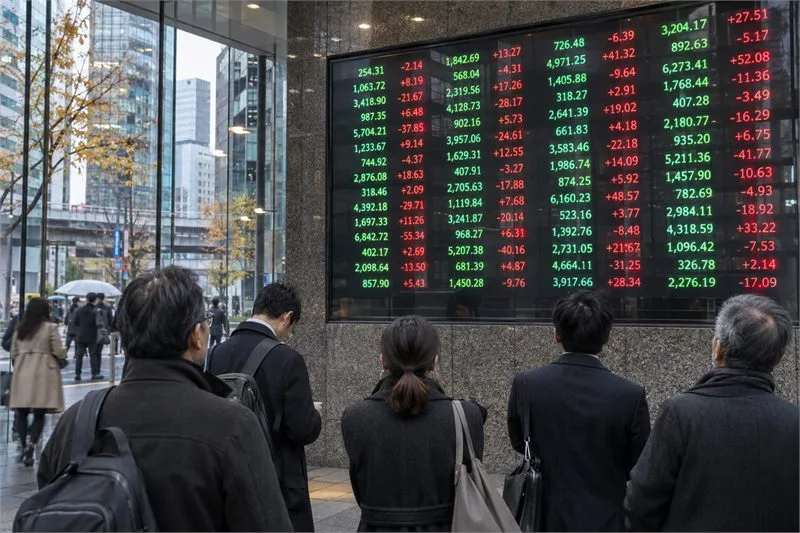
The plunge also came amid a steep retreat across technology and AI-related stocks: Nasdaq’s own data show the Nasdaq Composite fell 5.28% on Nov. 20. The SEC inquiry is reported, not a public agency finding of misconduct. Reuters said the SEC declined to comment, the company had not immediately responded, and the inquiry’s timing and precise scope were not known. For the next regular session, Monday, Nov. 23, the evidence points to heightened event-driven volatility—not a reliable prediction of direction.

NVDA opened at $143.57, reached an intraday high of $143.73 and a low of $124.51, then closed at $125.53. The previous regular-session close was $145.98. That is a 14.01% decline based on the supplied Yahoo Finance delayed historical quote, which is consistent with the closing price shown by other market-data summaries. This article uses the regular-session close, not a later after-hours quote.
Nasdaq’s index page records the Composite at 22,617.73, down 1,264.19 points, or 5.28%, from 23,879.20. Reuters separately described the Nasdaq’s drop as 5.3% and the semiconductor index’s fall as 11%. The wide market move matters: Nvidia’s decline was unusually large, but investors were also reducing exposure to technology and AI names broadly.
The U.S. regular session on Friday ended at 4:00 p.m. Eastern Standard Time (UTC−05:00), which was 9:00 p.m. UTC on Nov. 20. Nasdaq’s regular session is 9:30 a.m. to 4:00 p.m. Eastern Time. The separate after-hours market can trade at different prices and often has lower liquidity.
On Nov. 20, Reuters reported, citing two people briefed on the matter, that SEC enforcement staff were examining potential accounting issues at Nvidia. The report followed earlier coverage that the SEC was probing Nvidia but did not specify the focus. Reuters said it could not determine when the inquiry began or exactly which accounting practices are under review. The SEC declined to comment; Nvidia did not immediately respond to requests for comment.
That distinction is important. An investigation is not proof of wrongdoing, and Reuters noted that many investigations close without enforcement action. The agency has not published findings establishing accounting violations. Reuters said shares were down more than 6% before its report and fell further after publication, making the story a clear catalyst for the late-session acceleration, while not accounting for the earlier losses.
Reuters reported that scrutiny centers in part on the company’s past change to reporting geographic revenue by customer headquarters rather than billing address, and broader investor questions about complex AI financing arrangements. Those details describe issues reportedly under review and investor concerns; they are not confirmed conclusions by regulators. More clarity about the scope, timing or outcome of any inquiry remains unknown.
Nvidia’s latest reported quarter was strong by the company’s own results: on Nov. 17 it reported fiscal third-quarter revenue of $115.8 billion, up 103% year over year, and data-center revenue of $107.6 billion, up 110%. It forecast fiscal fourth-quarter revenue of $130 billion, plus or minus 3%, while saying the outlook assumed no data-center compute revenue from China. The figures do not remove risks around valuation, leadership, regulation or future demand, but they show that Friday’s price drop followed results that were growing rapidly rather than a newly reported quarterly revenue miss.
Leadership uncertainty was already part of the backdrop. In a Nov. 12 filing, Nvidia said its board had accepted Jensen Huang’s resignation as CEO and director effective immediately, appointed CFO Colette Kress interim CEO, and begun a search for a permanent successor. That official transition preceded Friday’s SEC report. Reuters also described a wider AI-stock selloff and investor reassessment of AI-related valuations. These factors can reinforce one another, but the available evidence does not quantify how much each contributed to the day’s decline.
The next regular Nasdaq session is Monday, Nov. 23, from 9:30 a.m. to 4:00 p.m. Eastern Standard Time (UTC−05:00), or 2:30 p.m. to 9:00 p.m. UTC. Three conditional paths are worth watching:
There is no verified Monday catalyst that guarantees a direction. The practical signals are any new statements from Nvidia or regulators, follow-through in the Nasdaq and semiconductor shares, and whether selling pressure eases after the sharp weekly decline. The next regular session follows the weekend; U.S. markets are scheduled to close for Thanksgiving on Thursday, Nov. 26, according to Nasdaq’s 2026 holiday calendar.
A Reuters report about an SEC inquiry into potential accounting issues accelerated selling, while Nvidia shares were already down more than 6% amid a broad AI and technology selloff.
No public finding was reported. Reuters said the inquiry’s scope was unclear; an investigation is not proof of wrongdoing.
The next regular session is Monday, Nov. 23, 2026, 9:30 a.m.–4:00 p.m. Eastern Standard Time (UTC−05:00), equivalent to 2:30–9:00 p.m. UTC.
ASML fell 5.8% to €1,131.60 on November 25 as concern over proposed U.S. chip-equipment export controls revived China-sales risks. Here’s what may matter next.
The Nikkei 225 fell 2.78% to 57,011.62 on November 25 as global AI and semiconductor stocks sold off. Here are the verified drivers and conditional scenarios for the next Tokyo session.
Why did China markets fall on November 25, 2026? Analysis of the Shenzhen Component's 3.24% drop and Shanghai Composite's 2.03% slide, key catalysts, and next-session outlook.
KOSPI plummeted 6.16% and Samsung Electronics dropped 9.87% on November 25, 2026. Explore verified catalysts, global semiconductor downgrades, and next-session outlook.
Natural gas rebounded while silver slid on Nov. 24. See the verified contract moves, weather and rate drivers, rollover caveat, and next-session catalysts.
Nvidia (NVDA) dropped 5.86% to $155.38 on November 24, 2026. Explore the primary catalysts behind the pullback, fundamental valuation, and next-session outlook.
Sanofi rose 9.76% on Nov. 24 after announcing a $41 billion Insmed acquisition. Here are the confirmed deal terms, risks and conditional outlook for the next session.
ASML.AS closed lower on Nov. 24 as the chip rally faded and export-control risks lingered. See the verified close, confirmed catalysts, and conditional outlook for Nov. 25.
Why is Nvidia up today? Analysis of NVDA's 31.48% surge on November 23, 2026, examining core catalysts, verified market data, and the next-session outlook.
The KOSPI jumped 6.32% and Samsung Electronics gained 6.70% on Nov. 24 as a Wall Street technology rally lifted Korean chip stocks. Here are the confirmed drivers and conditional scenarios for the next session.