Why Is ASML Down Today? MATCH Act Fears Weigh on Shares — November 25, 2026
ASML fell 5.8% to €1,131.60 on November 25 as concern over proposed U.S. chip-equipment export controls revived China-sales risks. Here’s what may matter next.
Information checked November 23, 2026, at 6:33 p.m. Seoul time (KST, UTC+09:00), or 09:33 UTC. South Korea’s KOSPI dropped 161.42 points, or 3.31%, to close at 4,708.54 on Monday, November 23, 2026, compared with Friday’s 4,869.96 close. The index had fallen as low as 4,586.80 during the session before recovering some ground. The central market explanation was a sharp preceding selloff in U.S. semiconductor and artificial-intelligence-linked shares, reinforced by selling from overseas investors in Seoul. Those are market-linked explanations, not proof that any one event caused the entire 3.31% move.
The decline was broad enough to hit the KOSDAQ as well, which finished at 635.45, down 1.58%, but the two indexes did not fall by the same amount. The next KOSPI session is scheduled for Tuesday, November 24 in Seoul; whether Monday’s rebound from the intraday low continues depends heavily on overseas technology trading, foreign-investor flows, and the won.
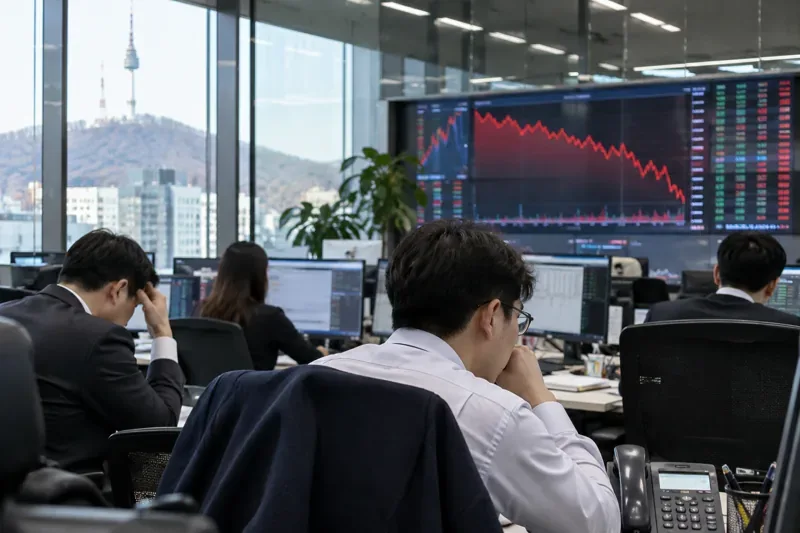
The KOSPI opened at approximately 4,734.90, about 2.77% below the preceding close, and subsequently dropped to 4,586.80. It then recovered part of the loss to finish just above 4,700. This distinction matters: the final 3.31% fall was severe, but smaller than the worst loss seen intraday. It would be incorrect to describe the session as a steady, uninterrupted decline or to use an intraday quote as the final close.
South Korean closing reports also put the KOSDAQ at 635.45, down 10.23 points. On the main market, one closing account recorded roughly 366.8 billion won in net selling by individuals and 247.2 billion won in net selling by foreigners, while institutions were net buyers. These figures indicate which investor groups supplied net demand or supply on the day, not the motive behind every order. Yonhap’s November 23 closing report and The Korea Herald's market close reporting provide independent checks on the session outcome.
Reports from Seoul describe a sell-side sidecar during the November 23 selloff, the second consecutive trading day on which such a measure was reported. A sidecar briefly restricts certain program-selling orders when futures-market triggers are met; it is not synonymous with suspending every stock trade on the exchange. The Korea Exchange explains its market-interruption mechanisms in its official guide to trading in the Korean stock market. A November 23-specific exchange notice was not independently accessible in the sources checked, so the occurrence is attributed to contemporaneous market reporting rather than characterized as a newly verified KRX filing.
U.S. technology stocks had sold off sharply in the preceding Wall Street session on Friday, November 20. The Philadelphia Semiconductor Index reportedly fell 10.73%, amid heavy losses among chip-related names. That backdrop was particularly relevant for a Korean benchmark with large semiconductor constituents, notably Samsung Electronics and SK hynix. Korean market reports connected the opening gap and subsequent weakness to this external shock. This is an evidence-backed interpretation of correlated markets, not a claim that every Korean stock moved for exactly the same reason.
A broader concern was whether enormous capital expenditures on artificial-intelligence infrastructure will produce earnings quickly enough to justify elevated valuations. Concerns about AI-company profitability and the possibility of additional U.S. monetary tightening were cited in post-close assessments of the global selloff. These concerns can hurt suppliers of chips and memory even without a newly disclosed deterioration in an individual company’s quarterly results. They remain an explanation offered by market analysts, not a single officially established cause of Monday’s index move.
Foreign investors initially showed buying interest but turned net sellers as the session unfolded, according to Korean market coverage. When overseas investors sell heavily in a concentrated benchmark, the impact can be amplified in highly weighted stocks. Retail investors were also net sellers, while institutional demand offset some of the outflow. It is important not to infer that the complete session was driven by foreigners alone: price changes also reflect U.S. risk sentiment, domestic orders, and how investors respond to market volatility.
The won also weakened against the U.S. dollar in the November 23 Seoul foreign-exchange session, with the reported dollar/won closing rate at around 1,345.9 won per dollar. A weaker local currency can coincide with foreign-equity outflows and concern about international financial conditions, but correlation is not proof of which market moved first. Exchange-rate quotations should be checked by venue and fixing time rather than compared indiscriminately with the stock-market close.
Some buying emerged after the deeper intraday decline. Analysts quoted in Korean market coverage pointed to bargain hunting and expectations that authorities could support financial-market stability if necessary. A potential stabilization fund or policy response is not the same thing as confirmed purchases sufficient to reverse the market. No verified evidence examined here establishes that one official intervention caused the partial recovery. The measured fact is simply that KOSPI closed 121.74 points above its session low while remaining sharply negative for the day.
The 4,700 area is a useful round-number reference for understanding the close, not a validated support line or a price target. Investors should avoid treating a single closing level or a one-day recovery from the low as evidence that volatility has ended.
The regular next session is Tuesday, November 24, 2026. Under the Korea Exchange trading calendar, Korean stock trading normally takes place on weekdays, and the regular cash session runs from 9:00 a.m. to 3:30 p.m. Seoul time (KST, UTC+09:00), equivalent to 00:00–06:30 UTC. These are scheduled hours, not a prediction of liquidity or price direction.
If U.S. chip stocks stabilize, the won steadies, and foreign-investor selling decreases, KOSPI could extend its recovery from Monday’s intraday low. Traders would look for broader participation beyond a handful of large-cap names. Even in this scenario, a bounce after a steep fall need not signal that underlying AI-valuation concerns have disappeared.
If international markets remain mixed and foreign flows are still fragile, choppy trading around Monday’s closing area is plausible. Under this conditional scenario, sector and stock selection may matter more than a uniform move across the entire Korean market. The index could change direction several times without giving a clear trend signal.
If U.S. semiconductor shares fall again, the won weakens further, or selling in major Korean chip names accelerates, KOSPI could revisit lower intraday territory. This is a risk scenario, not a forecast that Monday’s low must break. A large one-day loss alone does not determine what happens next.
Beyond the next U.S. trading session and fresh corporate disclosures, the Bank of Korea’s official calendar lists its next monetary-policy decision meeting for Thursday, November 26, 2026. That upcoming decision can influence interest-rate and won expectations, but its outcome should not be assumed in advance. See the Bank of Korea’s 2026 policy meeting schedule. The central bank also lists a November 24 consumer survey release on its statistical calendar; check the release itself before citing a result.
For a practical next-session check, compare overnight U.S. chip-sector moves with KOSPI’s opening, monitor Samsung Electronics and SK hynix for leadership, examine foreign net buying or selling during the day, and follow the won alongside equities. A confirmed change in several of those indicators would be more informative than an isolated opening print. The analysis explains market conditions rather than recommending that anyone buy or sell a security.
It closed at 4,708.54, down 161.42 points or 3.31% from the prior valid trading close of 4,869.96.
No single-company cause was established. Weakness in global semiconductor and AI-related shares, domestic investor flows, and broader risk sentiment were all relevant. An index decline does not prove which individual stock or headline caused it.
That cannot be established from Monday’s close. A rebound would become more plausible if overseas tech sentiment and foreign flows improve; further weakness remains possible if they deteriorate.
ASML fell 5.8% to €1,131.60 on November 25 as concern over proposed U.S. chip-equipment export controls revived China-sales risks. Here’s what may matter next.
The Nikkei 225 fell 2.78% to 57,011.62 on November 25 as global AI and semiconductor stocks sold off. Here are the verified drivers and conditional scenarios for the next Tokyo session.
Why did China markets fall on November 25, 2026? Analysis of the Shenzhen Component's 3.24% drop and Shanghai Composite's 2.03% slide, key catalysts, and next-session outlook.
KOSPI plummeted 6.16% and Samsung Electronics dropped 9.87% on November 25, 2026. Explore verified catalysts, global semiconductor downgrades, and next-session outlook.
Natural gas rebounded while silver slid on Nov. 24. See the verified contract moves, weather and rate drivers, rollover caveat, and next-session catalysts.
Nvidia (NVDA) dropped 5.86% to $155.38 on November 24, 2026. Explore the primary catalysts behind the pullback, fundamental valuation, and next-session outlook.
Sanofi rose 9.76% on Nov. 24 after announcing a $41 billion Insmed acquisition. Here are the confirmed deal terms, risks and conditional outlook for the next session.
ASML.AS closed lower on Nov. 24 as the chip rally faded and export-control risks lingered. See the verified close, confirmed catalysts, and conditional outlook for Nov. 25.
Why is Nvidia up today? Analysis of NVDA's 31.48% surge on November 23, 2026, examining core catalysts, verified market data, and the next-session outlook.
The KOSPI jumped 6.32% and Samsung Electronics gained 6.70% on Nov. 24 as a Wall Street technology rally lifted Korean chip stocks. Here are the confirmed drivers and conditional scenarios for the next session.