Why Is ASML Down Today? MATCH Act Fears Weigh on Shares — November 25, 2026
ASML fell 5.8% to €1,131.60 on November 25 as concern over proposed U.S. chip-equipment export controls revived China-sales risks. Here’s what may matter next.
Updated: November 20, 2026, 4:59 p.m. UTC (5:59 p.m. CET, Milan).
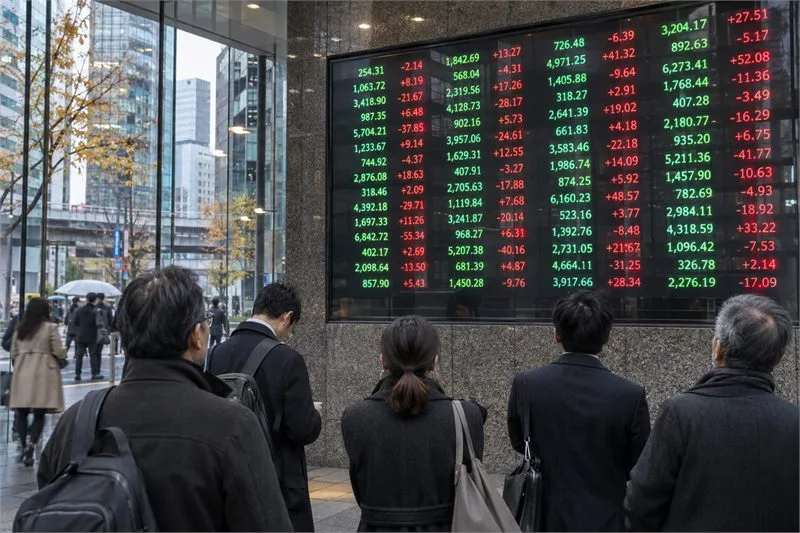
Italy’s FTSE MIB fell 2.48% on Friday, November 20, to 48,703.72, according to the delayed Yahoo Finance quote supplied for this report. The clearest pressure came from technology and electronics shares: Borsa Italiana’s constituent data showed STMicroelectronics down 10.78%, Technoprobe down 9.31%, and Prysmian down 6.29%. The declines fit a wider global retreat from technology stocks amid renewed concern about AI-related valuations, financing costs, and the returns on heavy investment. The available evidence supports that as the main market explanation; it does not establish a single company announcement as the cause of the index’s fall.
Destaques
The index opened at 49,467.49 and the supplied delayed quote was 48,703.72, down 1,237.28 points from the preceding close of 49,941.00. That is a 2.48% decline. Borsa Italiana’s live index page showed the benchmark lower earlier in the session as well, alongside losses in the FTSE Italia All-Share, Mid Cap, and Small Cap indexes. Its constituent performance table, calculated against the prior day’s reference prices, confirms that weakness was broad but uneven: STMicroelectronics, Technoprobe, and Prysmian fell sharply, while names including Italgas, Snam, and Saipem were positive. The underlying exchange snapshots are delayed and do not necessarily match the final index close exactly.
That distinction matters when reconciling sources. Borsa Italiana’s page showed an earlier reading of 48,878.13, down 2.13%, at 4:39 p.m. Milan time; the later Yahoo Finance quote supplied for this article is timestamped 5:35 p.m. CET. These are different observation times, so the earlier exchange snapshot should not be mistaken for the final reading. The exchange’s constituent table separately reports individual share performance, not the index’s exact point change. Borsa Italiana’s index page and daily FTSE MIB constituent performance provide the exchange data.
They were the most visible source of pressure in the available data. STMicroelectronics, a major semiconductor company, and Technoprobe, which makes semiconductor testing equipment, both suffered large declines. Prysmian, an industrial group with substantial exposure to cables and energy infrastructure, also fell sharply. Those moves are consistent with investors reducing exposure to growth and technology-linked shares as global markets reassessed the prospects and valuations of AI-related businesses.
A market report published during the session described the Milan selloff as part of a broader global technology pullback and cited concern about stretched AI valuations, rising financing costs, and uncertain investment returns. That is useful context, but it is a reported market interpretation rather than proof of a specific catalyst for each Italian stock. Separately, Associated Press coverage of the week’s U.S. trading described persistent swings in AI-related shares despite strong Nvidia results, reflecting questions about whether the boom can sustain its pace. The cross-market backdrop supports the risk-aversion explanation without proving that U.S. developments alone caused Friday’s Italian losses. Trading Economics’ November 20 market report and Associated Press coverage of global technology-stock volatility describe that context.
Yes. Borsa Italiana’s table showed declines in several financial shares, including Banca Mediolanum, Banco BPM, BPER Banca, and UniCredit. Stellantis and Moncler also fell. This breadth suggests selling was not limited to chip stocks, although the largest losses among the named constituents were concentrated in technology and industrial-growth exposures. Some utilities and other individual names rose, so it would be inaccurate to say that every FTSE MIB share fell.
The next regular trading session is Monday, November 23. Friday’s fall alone cannot establish the direction of the next session. The most useful signals to watch are whether global technology shares stabilize, whether selling in semiconductor-linked names continues, and whether bank shares find support. No verified, single Italian announcement has been established here as the trigger, so investors should also monitor company disclosures and scheduled macroeconomic releases rather than assume the move has one cause.
These scenarios are not price targets. They describe how the balance of risks may shift with new information; market gaps, corporate disclosures, and global news can change the setup before trading resumes.
The supplied delayed quote shows a 2.48% fall to 48,703.72 from the prior close of 49,941.00.
Technology-linked shares led the losses amid a broader global pullback from technology stocks. The available evidence does not identify one confirmed announcement as the sole cause.
After the Friday, November 20 session, the next regular session is Monday, November 23, 2026. The index’s direction will depend on new market and company information.
This is a market explainer, not investment advice.
ASML fell 5.8% to €1,131.60 on November 25 as concern over proposed U.S. chip-equipment export controls revived China-sales risks. Here’s what may matter next.
The Nikkei 225 fell 2.78% to 57,011.62 on November 25 as global AI and semiconductor stocks sold off. Here are the verified drivers and conditional scenarios for the next Tokyo session.
Why did China markets fall on November 25, 2026? Analysis of the Shenzhen Component's 3.24% drop and Shanghai Composite's 2.03% slide, key catalysts, and next-session outlook.
KOSPI plummeted 6.16% and Samsung Electronics dropped 9.87% on November 25, 2026. Explore verified catalysts, global semiconductor downgrades, and next-session outlook.
Natural gas rebounded while silver slid on Nov. 24. See the verified contract moves, weather and rate drivers, rollover caveat, and next-session catalysts.
Nvidia (NVDA) dropped 5.86% to $155.38 on November 24, 2026. Explore the primary catalysts behind the pullback, fundamental valuation, and next-session outlook.
Sanofi rose 9.76% on Nov. 24 after announcing a $41 billion Insmed acquisition. Here are the confirmed deal terms, risks and conditional outlook for the next session.
ASML.AS closed lower on Nov. 24 as the chip rally faded and export-control risks lingered. See the verified close, confirmed catalysts, and conditional outlook for Nov. 25.
Why is Nvidia up today? Analysis of NVDA's 31.48% surge on November 23, 2026, examining core catalysts, verified market data, and the next-session outlook.
The KOSPI jumped 6.32% and Samsung Electronics gained 6.70% on Nov. 24 as a Wall Street technology rally lifted Korean chip stocks. Here are the confirmed drivers and conditional scenarios for the next session.