Why Is ASML Down Today? MATCH Act Fears Weigh on Shares — November 25, 2026
ASML fell 5.8% to €1,131.60 on November 25 as concern over proposed U.S. chip-equipment export controls revived China-sales risks. Here’s what may matter next.
Verified and updated: November 20, 2026, 22:30 UTC (5:30 p.m. EST).
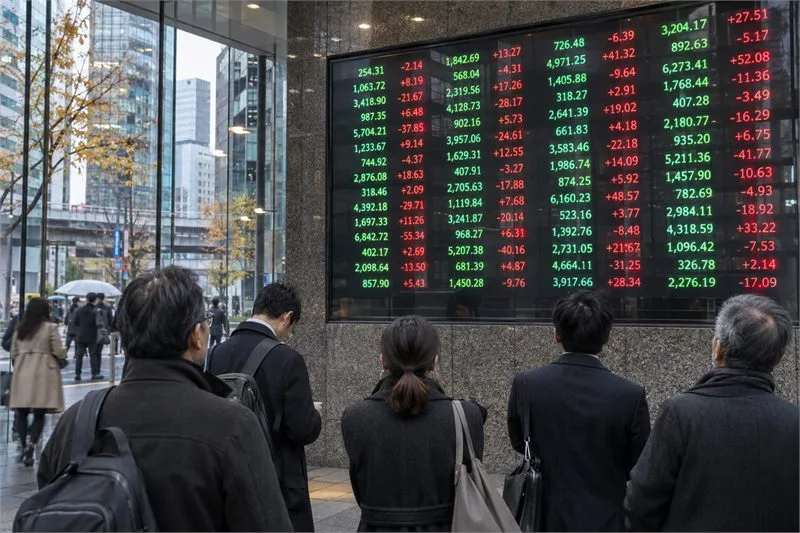
Broadcom, Tesla and Meta Platforms all finished sharply lower on Friday, November 20, as investors pulled back from technology and artificial-intelligence stocks. Based on the supplied delayed Yahoo Finance closing data, Broadcom (AVGO) fell 12.19% to $304.41, Tesla (TSLA) lost 7.64% to $345.82, and Meta (META) dropped 5.93% to $560.84, each compared with the previous valid daily close. The wider sell-off was severe: the S&P 500 fell 3.7% and the Nasdaq Composite dropped 5.3%, according to the Associated Press market recap.
Destaques
The common thread was risk reduction across AI-linked and large-cap technology shares. The Nasdaq’s 5.3% decline and the S&P 500’s 3.7% drop show that Friday’s pressure extended beyond these three companies. The AP reported that the AI-stock sell-off pushed the Nasdaq into negative territory for 2026 and gave the S&P 500 its worst weekly loss in more than 18 months. That broad backdrop helps explain why Tesla and Meta fell even without a verified, company-specific announcement directly tied to their session declines.
One market narrative was that Anthropic’s much-watched public debut had not settled investor concerns about the economics and valuation of the AI build-out. The listing initially attracted attention, but reports on Friday described its shares retreating after the debut, while technology stocks continued to sell off. This is a market interpretation of the session, not proof that the IPO alone caused any one stock’s move.
Broadcom’s decline was the steepest of the three. A November 20 report by 24/7 Wall St. attributed additional pressure to analyst Ming-Chi Kuo’s claim that Google had cut planned 2027 shipments of Broadcom-designed TPU 8i chips by about one million units, or roughly 20%. The report explicitly said that neither Google nor Broadcom had confirmed the figures. Treat this as an unverified supply-chain report, not a company disclosure or established change in orders.
Broadcom’s own recent results provide context for why investors may be sensitive to such reports. In its third-quarter fiscal 2026 release, the company reported $16.7 billion in AI semiconductor revenue, up 221% year over year. That confirms the importance of AI-related demand to the business; it does not confirm that Google changed its plans. Broadcom’s next update will matter because investors will want to compare reported demand and guidance with the market’s assumptions.
The sources reviewed did not establish a single new Tesla announcement as the cause of its 7.64% decline. Tesla’s fall occurred during a broad market retreat, and coverage described the AI-led sell-off as overwhelming a positive HSBC rating change. A broker opinion is not a company operating update, and the available evidence does not support assigning Tesla’s full daily move to one headline.
Meta also fell in the same risk-off session. A contemporaneous market analysis discussed investor scrutiny of large AI spending commitments, but the evidence reviewed does not establish a newly announced Meta development as the direct trigger for Friday’s close. The more defensible explanation is that Meta traded lower with technology shares as investors reassessed AI exposure and valuations. The distinction matters: the market backdrop is confirmed, while attributing the exact size of either stock’s decline to a particular concern remains an interpretation.
The next regular U.S. stock session is Monday, November 23. No direction is assured. In a bull case, selling could ease if investors treat Friday’s decline as an abrupt repricing and fresh company information fails to confirm the most concerning AI-demand narratives. In a base case, volatility could remain elevated as traders weigh broad technology weakness against company fundamentals. In a bear case, continued pressure on AI-linked shares or confirmation of weaker customer plans could extend losses, particularly for Broadcom.
For Broadcom, traders may watch for a response or clarification from the company or Google and for subsequent guidance. For Tesla and Meta, the key question is whether their shares stabilize when broader technology sentiment does. The week’s large index declines raise the importance of market breadth and follow-through, but a rebound or further decline cannot be inferred from Friday’s closing prices alone. These are scenarios, not forecasts or price targets.
Source note: The individual closing prices and percentage changes above use the supplied Yahoo Finance delayed-data snapshot. Broad index moves and the broader market context were checked against the AP recap. The Google-related Broadcom claim remains unconfirmed by the companies.
Broadcom fell the most, down 12.19% to $304.41 in the supplied closing data.
No. The report describing possible TPU 8i order reductions said neither Google nor Broadcom had confirmed the claim.
The next regular U.S. trading session is Monday, November 23, 2026.
ASML fell 5.8% to €1,131.60 on November 25 as concern over proposed U.S. chip-equipment export controls revived China-sales risks. Here’s what may matter next.
The Nikkei 225 fell 2.78% to 57,011.62 on November 25 as global AI and semiconductor stocks sold off. Here are the verified drivers and conditional scenarios for the next Tokyo session.
Why did China markets fall on November 25, 2026? Analysis of the Shenzhen Component's 3.24% drop and Shanghai Composite's 2.03% slide, key catalysts, and next-session outlook.
KOSPI plummeted 6.16% and Samsung Electronics dropped 9.87% on November 25, 2026. Explore verified catalysts, global semiconductor downgrades, and next-session outlook.
Natural gas rebounded while silver slid on Nov. 24. See the verified contract moves, weather and rate drivers, rollover caveat, and next-session catalysts.
Nvidia (NVDA) dropped 5.86% to $155.38 on November 24, 2026. Explore the primary catalysts behind the pullback, fundamental valuation, and next-session outlook.
Sanofi rose 9.76% on Nov. 24 after announcing a $41 billion Insmed acquisition. Here are the confirmed deal terms, risks and conditional outlook for the next session.
ASML.AS closed lower on Nov. 24 as the chip rally faded and export-control risks lingered. See the verified close, confirmed catalysts, and conditional outlook for Nov. 25.
Why is Nvidia up today? Analysis of NVDA's 31.48% surge on November 23, 2026, examining core catalysts, verified market data, and the next-session outlook.
The KOSPI jumped 6.32% and Samsung Electronics gained 6.70% on Nov. 24 as a Wall Street technology rally lifted Korean chip stocks. Here are the confirmed drivers and conditional scenarios for the next session.