Why Is ASML Down Today? MATCH Act Fears Weigh on Shares — November 25, 2026
ASML fell 5.8% to €1,131.60 on November 25 as concern over proposed U.S. chip-equipment export controls revived China-sales risks. Here’s what may matter next.
Information checked: November 23, 2026, 7:05 p.m. Pacific Standard Time (UTC−08:00); November 24, 2026, 03:05 UTC.
Brent crude fell on Monday, November 23, as traders weighed improving supply prospects against persistent Middle East security risks. The January 2027 Brent futures contract settled at $89.37 a barrel, down $3.20, or 3.46%, from the prior session, according to Reuters. That was the contract’s lowest settlement since August 31. A key near-term pressure was news that Libya’s Sharara pipeline had reopened and crude was flowing toward storage at Zawiya, easing fears of a fresh supply interruption.
There is a pricing caveat: the supplied Yahoo Finance BZ=F continuous-futures snapshot lists $86.72, down 6.32% from $92.57. That does not match the reported January 2027 contract settlement. The supplied snapshot does not identify its listed delivery month or roll treatment, so the two figures should not be treated as like-for-like. This explainer uses the contract-specific January settlement for the session move and does not attribute the larger continuous-feed change to a confirmed market event.
Key Takeaways
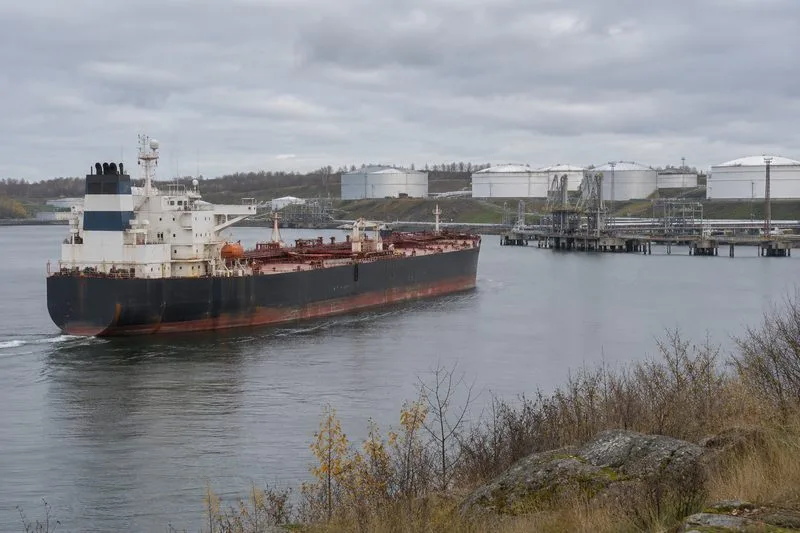
The market’s widely reported benchmark was the January 2027 Brent futures contract, which fell $3.20 to $89.37 a barrel at settlement. The move extended a weak stretch: Reuters reported that Brent had fallen 4% the previous week. The decline came even as geopolitical headlines would ordinarily support crude, showing that traders were assigning substantial weight to supply expectations rather than treating the regional risks as resolved.
Because Brent futures trade across multiple delivery months, the contract matters. Continuous symbols such as BZ=F stitch contracts together according to a data provider’s rules; a front-month changeover can make an unadjusted series look different from a specific exchange contract. The Yahoo figure supplied for this assignment is not reconciled to the January 2027 settlement. It is a data-quality warning, not proof of an additional 6.32% fall in the same contract.
Libya’s National Oil Corporation said a closure affecting the Sharara pipeline threatened production of about 350,000 barrels a day. Later on Monday, NOC chairman Masoud Suleiman told Reuters that the pipeline had reopened and crude was beginning to flow into storage tanks at the Akakus facility in Zawiya. The restart reduced the immediate risk of a prolonged interruption. It did not establish that all threatened production had already returned to normal, so the size and durability of the restored flow remained uncertain.
Yes, as a broader backdrop rather than a single-day trigger. The International Energy Agency’s November Oil Market Report said its balances pointed to a global oil surplus in the fourth quarter of 2026, with a larger build in 2027. The U.S. Energy Information Administration’s November outlook also forecast that production would outpace consumption in the fourth quarter, while noting that geopolitical constraints could delay the effect of stock builds. Those projections can pressure futures because traders price expected barrels as well as current deliveries; they are forecasts, not confirmed future inventories.
A Reuters poll of five analysts expected U.S. crude and product inventories to have risen by roughly 900,000 barrels in the week ended Nov. 20. That was a preliminary estimate, not the EIA’s released result. The official weekly report is an upcoming data point and could challenge or reinforce the surplus narrative.
Regional supply risks remained real. Reuters reported Houthi claims of an attack on a Saudi refinery and multiple shipping incidents reported by the UK Maritime Trade Operations near the Gulf and Strait of Hormuz. Bahrain also reported an attack on an industrial facility. Such events can raise freight, insurance, and disruption concerns. The Nov. 23 price drop means those risks were outweighed in that session by supply and balance expectations; it does not mean the risks disappeared.
No single direction is assured. The following are conditional scenarios, not price targets:
The next scheduled U.S. EIA Weekly Petroleum Status Report is due Wednesday, Nov. 25, at 10:30 a.m. Eastern Standard Time (UTC−05:00), under the agency’s standard schedule. A larger-than-expected inventory build could reinforce the bearish supply story; a draw or weaker production could soften it. OPEC+ has also scheduled a meeting for Nov. 29 to review market conditions and output policy. Any assessment of the next session should therefore remain conditional on fresh data and headlines.
This is a market explainer, not investment advice. The session settlement, the unverified continuous-contract snapshot, and forecasts describe different things and should not be conflated.
The January 2027 Brent futures contract settled at $89.37 a barrel, down $3.20, or 3.46%, from the prior session.
Supply expectations improved after Libya’s Sharara pipeline reopened, while forecasts of a potential global surplus added broader pressure. The exact weight of each factor cannot be measured from the settlement alone.
Watch contract-specific Brent prices, the next EIA inventory release, developments affecting Gulf shipping, and the OPEC+ meeting scheduled for Nov. 29.
ASML fell 5.8% to €1,131.60 on November 25 as concern over proposed U.S. chip-equipment export controls revived China-sales risks. Here’s what may matter next.
The Nikkei 225 fell 2.78% to 57,011.62 on November 25 as global AI and semiconductor stocks sold off. Here are the verified drivers and conditional scenarios for the next Tokyo session.
Why did China markets fall on November 25, 2026? Analysis of the Shenzhen Component's 3.24% drop and Shanghai Composite's 2.03% slide, key catalysts, and next-session outlook.
KOSPI plummeted 6.16% and Samsung Electronics dropped 9.87% on November 25, 2026. Explore verified catalysts, global semiconductor downgrades, and next-session outlook.
Natural gas rebounded while silver slid on Nov. 24. See the verified contract moves, weather and rate drivers, rollover caveat, and next-session catalysts.
Nvidia (NVDA) dropped 5.86% to $155.38 on November 24, 2026. Explore the primary catalysts behind the pullback, fundamental valuation, and next-session outlook.
Sanofi rose 9.76% on Nov. 24 after announcing a $41 billion Insmed acquisition. Here are the confirmed deal terms, risks and conditional outlook for the next session.
ASML.AS closed lower on Nov. 24 as the chip rally faded and export-control risks lingered. See the verified close, confirmed catalysts, and conditional outlook for Nov. 25.
Why is Nvidia up today? Analysis of NVDA's 31.48% surge on November 23, 2026, examining core catalysts, verified market data, and the next-session outlook.
The KOSPI jumped 6.32% and Samsung Electronics gained 6.70% on Nov. 24 as a Wall Street technology rally lifted Korean chip stocks. Here are the confirmed drivers and conditional scenarios for the next session.