Why Is ASML Down Today? MATCH Act Fears Weigh on Shares — November 25, 2026
ASML fell 5.8% to €1,131.60 on November 25 as concern over proposed U.S. chip-equipment export controls revived China-sales risks. Here’s what may matter next.
Checked: November 23, 2026, 5:03 p.m. UTC (6:03 p.m. Amsterdam time, CET, UTC+01:00).
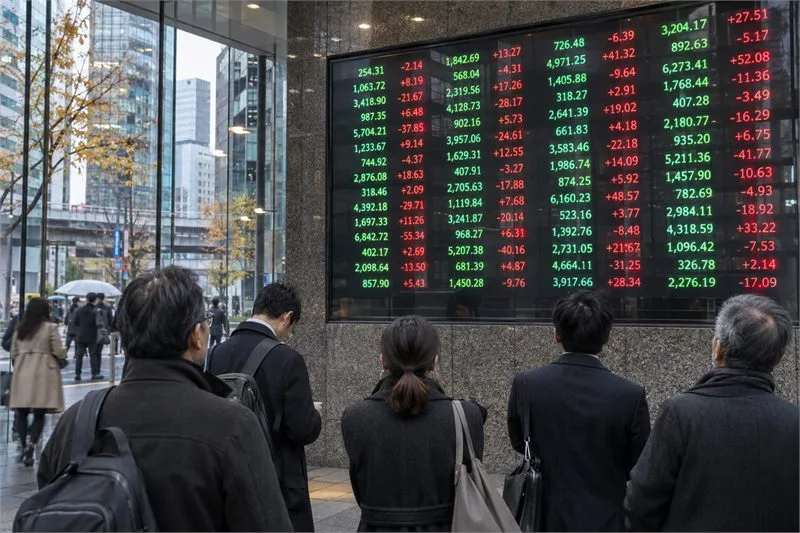
Dutch shares rallied on Monday, Nov. 23, as chipmakers rebounded from a punishing AI-led selloff and a surprise Nvidia leadership announcement helped restore appetite for technology stocks. Euronext’s post-close Amsterdam snapshot showed the AEX at 1,089.08, up 2.15%. ASML also advanced sharply: the delayed quote supplied for this session shows €1,272.20, a gain of 8.92% from €1,168.00, while a later Yahoo historical snapshot shows a higher close and roughly a 10% gain. The direction is clear; the precise ASML close differs across delayed snapshots.
The rally had two documented drivers. European chip stocks were already climbing early in the session after investors started buying back into technology following last week’s steep decline. Later, Nvidia announced that Jensen Huang had been reinstated as chief executive, and Reuters reported that the news ignited a broader rally in AI-linked shares. That is a plausible explanation for the additional bid under ASML, a major supplier to chipmakers, but it does not prove the Nvidia announcement alone caused ASML’s full-day gain. ASML did not publish a new order, forecast or earnings update on Nov. 23.

The AEX closed its Nov. 23 cash session near 1,089.08, with Euronext’s Amsterdam market page showing a 2.15% rise in a 5:48 p.m. CET post-close snapshot. That equals 4:48 p.m. UTC. The AEX All-Share index was also higher in the same snapshot, up 3.32%, showing that the advance was not limited to ASML alone.
ASML’s percentage move needs a data caveat. The delayed Yahoo quote captured for this article lists €1,272.20 against a prior close of €1,168.00, or +8.92%. Yahoo’s refreshed historical page later listed a Nov. 23 close of €1,285.40, or approximately +10.0%. The numbers are not interchangeable: one is a delayed quote snapshot and the other a later historical entry. Both indicate a very large one-day rise, so this article describes ASML as up roughly 9% to 10% instead of presenting one conflicting figure as definitive.
Euronext’s own stock list showed ASML up 4.98% at 2:06 p.m. Amsterdam time, an earlier intraday checkpoint. That earlier reading helps show the rally was underway before the U.S. afternoon; it should not be compared with the later close as if it were the final result.
The first factor was a rebound after investors had sharply reduced exposure to AI and semiconductor stocks. Reuters reported that European technology shares were higher early on Nov. 23 after the sector’s steepest weekly fall since 2020. At 9:33 a.m. GMT (10:33 a.m. Amsterdam time, CET, UTC+01:00), Reuters said ASML, ASM International and BE Semiconductor had each gained between 3% and 5%. The news report attributed the early move to a recovery after the AI-driven selloff, amid questions about how quickly heavy AI investment would generate returns.
A later catalyst was Nvidia’s board announcement. Nvidia said on Nov. 23 that it had reinstated Huang as president and CEO, effective immediately. The company also said its independent board investigation would continue. Reuters subsequently linked the reversal to a sharp rally across AI stocks. For ASML, investors may have read the leadership change as a reason to reconsider the durability of AI-related chip demand and the capital spending that supports it. That connection is an interpretation of the market response, not a new ASML forecast or confirmed change in customer orders.
ASML’s own Nov. 23 release concerned routine weekly transactions under its existing share-buyback program. It did not announce new guidance or a new contract. The company’s investor calendar lists its next quarterly and full-year results for Jan. 27, 2027, rather than the next session. This makes the broad semiconductor and AI sentiment a more evident explanation for the day’s move than fresh company-specific operating news.
For Tuesday, Nov. 24, the key question is whether the technology rebound broadens or fades. The Conference Board has scheduled its U.S. Consumer Confidence Index for 10:00 a.m. Eastern Time (EST, UTC−05:00), which is 4:00 p.m. Amsterdam time (CET, UTC+01:00) and 3:00 p.m. UTC. The release comes during the Amsterdam cash session and could influence global risk appetite, though it is not a direct measure of semiconductor demand.
These are conditional scenarios, not price targets or predictions. No next-session direction is confirmed. Investors will also be weighing the fact that a leadership change at Nvidia does not settle broader questions about AI valuations, customer spending or the pace at which chip investments produce returns.
The index benefited from a broad rebound in European technology shares after the prior week’s AI-led selloff. Nvidia’s announcement reinstating Jensen Huang later strengthened the global AI-stock rally.
Delayed snapshots put ASML’s gain between about 8.9% and 10%. The supplied quote and a later historical listing show different values, so the exact closing figure should be checked against a consistent exchange feed.
No new forecast or earnings release was found for Nov. 23. The clearest documented drivers were the wider semiconductor rebound and renewed AI-stock buying after Nvidia’s leadership announcement.
Sources checked: Euronext Amsterdam index snapshot; Euronext Amsterdam stock list and intraday ASML record; Nvidia board announcement; Reuters report on Europe’s technology rebound; Reuters report on Nvidia’s announcement and the AI-stock rally; ASML share-buyback transactions; ASML investor calendar; The Conference Board consumer-confidence release calendar.
This article is a market-session explainer, not investment advice.
ASML fell 5.8% to €1,131.60 on November 25 as concern over proposed U.S. chip-equipment export controls revived China-sales risks. Here’s what may matter next.
The Nikkei 225 fell 2.78% to 57,011.62 on November 25 as global AI and semiconductor stocks sold off. Here are the verified drivers and conditional scenarios for the next Tokyo session.
Why did China markets fall on November 25, 2026? Analysis of the Shenzhen Component's 3.24% drop and Shanghai Composite's 2.03% slide, key catalysts, and next-session outlook.
KOSPI plummeted 6.16% and Samsung Electronics dropped 9.87% on November 25, 2026. Explore verified catalysts, global semiconductor downgrades, and next-session outlook.
Natural gas rebounded while silver slid on Nov. 24. See the verified contract moves, weather and rate drivers, rollover caveat, and next-session catalysts.
Nvidia (NVDA) dropped 5.86% to $155.38 on November 24, 2026. Explore the primary catalysts behind the pullback, fundamental valuation, and next-session outlook.
Sanofi rose 9.76% on Nov. 24 after announcing a $41 billion Insmed acquisition. Here are the confirmed deal terms, risks and conditional outlook for the next session.
ASML.AS closed lower on Nov. 24 as the chip rally faded and export-control risks lingered. See the verified close, confirmed catalysts, and conditional outlook for Nov. 25.
Why is Nvidia up today? Analysis of NVDA's 31.48% surge on November 23, 2026, examining core catalysts, verified market data, and the next-session outlook.
The KOSPI jumped 6.32% and Samsung Electronics gained 6.70% on Nov. 24 as a Wall Street technology rally lifted Korean chip stocks. Here are the confirmed drivers and conditional scenarios for the next session.