Home
» News
»
London Trash and Recycling Collection in October 2026: Check Your Borough’s Schedule
London Trash and Recycling Collection in October 2026: Check Your Borough’s Schedule
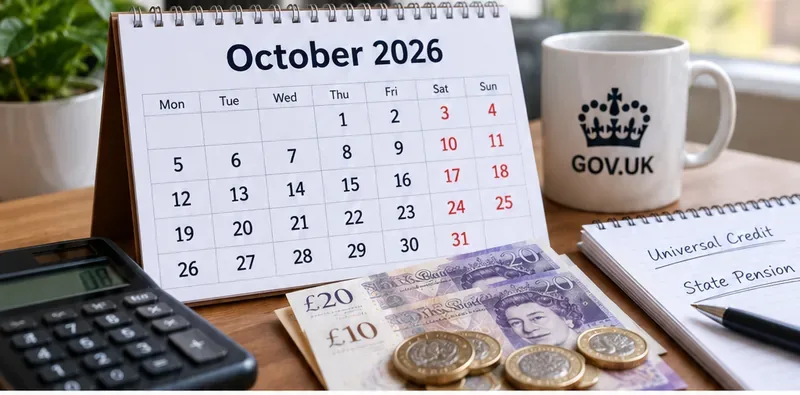
There is no England-and-Wales bank holiday in October 2026. The official calendar lists the next bank holiday after August 31 as Christmas Day on December 25. That means there is no October bank-holiday shift to apply across London. It does not mean every address has the same collection day or that every borough will run every service as usual: borough councils set local arrangements, and collection calendars can vary by street, building, and waste type.
As of September 29, 2026, residents should use the live collection checker for their own address before putting out rubbish (the UK term commonly used for household trash), recycling, food scraps, garden waste, or a bulky item. This guide explains how to find that schedule, what to check around public holidays, and where to take extra or missed waste without guessing at a London-wide date.
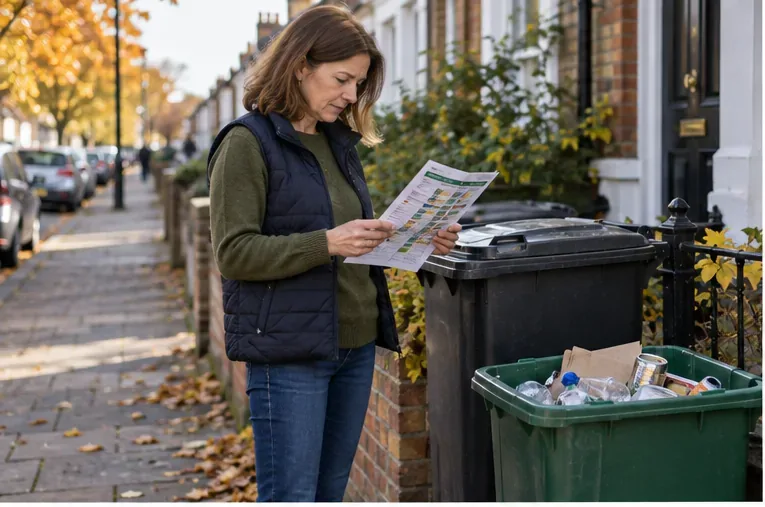
A resident comparing a household collection calendar with the bins outside a terraced home.
Will October 2026 public holidays change London trash and recycling pickup?
No England-and-Wales bank holiday falls in October 2026, according to the GOV.UK bank-holiday calendar. London has no separate October public holiday that creates a citywide household collection change. October 25 is the date the clocks go back, but it is not a bank holiday and does not establish a new collection day.
Still, check the council’s address-level calendar for October. A borough may announce local service changes, building-specific arrangements, or a disruption unrelated to a public holiday. Do not assume that a familiar Monday route moves by one day, or that a holiday-week pattern from another borough applies. City Hall says London borough councils are responsible for household rubbish and recycling collections, so the responsible council is the one serving the address.
How do I find the correct collection day for my London address?
Identify the council by postcode. Enter your postcode in GOV.UK’s local council finder if you are unsure which authority covers the property.
Open the borough’s official waste or bin-day checker. GOV.UK directs residents to their council’s website to check rubbish collection dates. Use the council page rather than an old paper calendar, search result, or third-party bin-day listing.
Select the full address and building type. Some checkers return more than one result for a street; flats with shared bin stores, estates, and houses may have different instructions. Use the exact flat or property entry when offered, then note any collection point or time-band rule displayed.
Check each waste stream separately. Look for general rubbish, mixed recycling, food waste, and garden waste. Confirm the next date, frequency, container, set-out time, and any holiday or service notice. Save or print the council calendar if available, but revisit the live page before an unusual week.
For example, Lewisham’s official collection-day checker asks residents to search by postcode or street name and select an address. That is a useful model of address-specific checking, not a schedule for other boroughs. A council’s web form may show the usual weekly or fortnightly pattern; always look for the actual date for your selected address.
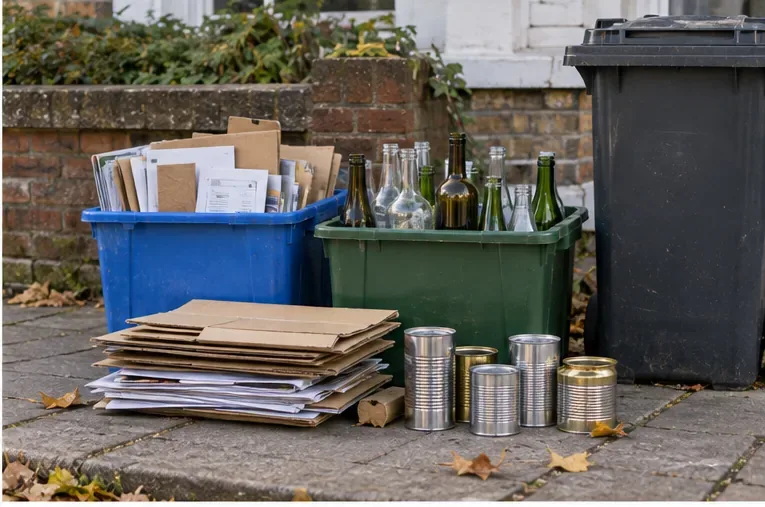
Separate dry recyclables and check your borough’s accepted-material list before putting them out.
What should I check for regular rubbish and recycling?
Confirm which container is for residual waste (items that cannot go in the local recycling collection) and which accepts dry recycling. Accepted materials and container colors are not fully standardized across London. Rinse containers if instructed, flatten cardboard where practical, and keep recyclables free of food and liquid. Do not use another borough’s list as proof that an item belongs in your own recycling bin.
Check collection-day instructions for the latest set-out time, location, and whether bins should be returned after pickup. In some streets the council uses timed presentation windows; apartment residents may use a communal store instead of setting bins at the curb. If you moved recently, ask the landlord, building manager, or council which service applies to your property.
Is garden-waste collection included in the regular service?
Not necessarily. GOV.UK notes that some councils provide home garden-waste collection and that a fee may apply. A borough may require a subscription, use a seasonal service, collect only certain bags or bins, or not offer a home pickup for a particular property. Leaves, grass clippings, branches, soil, and food scraps may have different rules; do not put garden clippings in a food-waste container unless the council expressly allows it.
Check whether your subscription is active for October 2026, the collection frequency, the correct container, and the exact presentation time. Lewisham, for example, lists a 2026–27 annual subscription period and weekly collections on its garden-waste service page; that is a local example and not a London-wide entitlement. If you do not have a subscribed collection, check your borough’s composting guidance or approved household recycling center before transporting garden material.
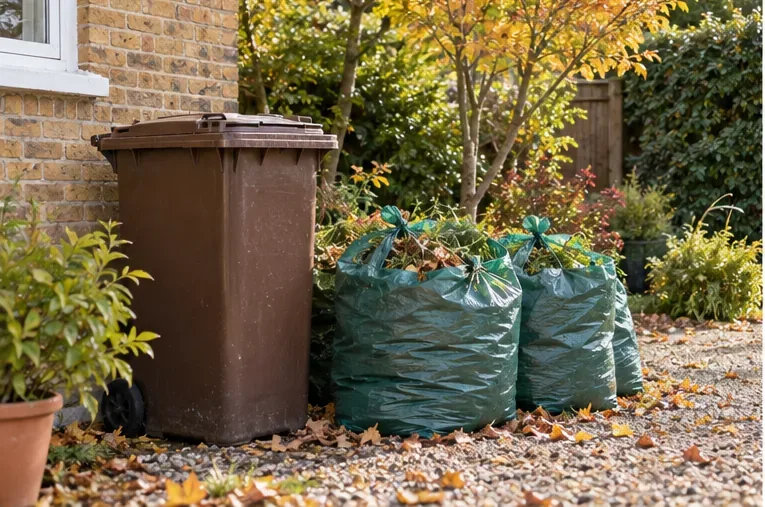
Garden waste set out in a lidded bin and tied sacks; use only the containers and service rules listed by your council.
What if the collection was missed?
First check the service notice and confirm the crew has completed the route. Then check that the right container was out at the required time, at the correct collection point, and that it was not contaminated, overloaded, or blocked. A bin left out late or containing prohibited material may not count as a council miss.
Use the official missed-collection form and follow its waiting period and reporting deadline. These differ: Hackney tells residents to wait until 6 p.m. on collection day before reporting; Camden allows reports within two working days after the collection day. These examples show why a neighbor’s advice may not fit your council. The council form should say whether a return visit is planned, when to leave the container out, or whether the waste must wait for the next scheduled collection. Keep the report reference and check the status before submitting it again.
If the online form rejects the report, read the reason and contact the council’s waste team using the details on its site. A missed pickup is not automatically permission to leave bags on the public pavement indefinitely, and dumping waste beside a communal bin can obstruct access or be treated as fly-tipping.
A large household item being taken to a reuse and recycling center; check resident eligibility, accepted items, and booking rules first.
Where can I take extra rubbish or a bulky item?
Start with the council’s approved household reuse and recycling center (sometimes called a household waste recycling center or tip). The Mayor of London’s waste map can help locate facilities, but check the site operator’s current rules before traveling. Access can depend on borough residency, proof of address, vehicle type, a booking, or a permit. Confirm opening hours, accepted materials, and any limits on vans, trailers, DIY debris, electricals, or garden waste.
If you cannot transport the item, search your borough website for “bulky waste collection” or “large item collection.” Councils may charge, cap the number of items, restrict what they take, or require an appointment. Some items in usable condition may be donated or collected by a reuse organization. Ask before leaving furniture, mattresses, appliances, or bags outside: an ordinary bin crew may not collect them.
Do not overfill a bin or place extra sacks beside it unless the council specifically permits side waste. For an urgent overflow, look for the council’s excess-waste instructions, an extra collection option, or the nearest authorized center. Keep hazardous materials, batteries, paint, and electrical equipment out of general rubbish unless the council confirms the correct disposal route.
Quick October 2026 check before setting waste out
Confirm the council and exact address in the borough’s official collection checker.
Check the separate dates and set-out rules for rubbish, recycling, food, and garden waste.
There is no October 2026 England-and-Wales bank holiday; still read local service alerts.
For a missed pickup, wait and report within the window specified by your own council.
For extra waste, bulky items, or a recycling-center trip, confirm fees, booking, access, and accepted materials first.
The reliable October schedule is the one your council currently displays for your address. London’s borough-by-borough system means no single citywide date can safely answer every household’s question.