You book a haircut because your ends look rough, your shape has collapsed, or you are trying to grow your hair longer without feeling like every trim erases your progress. Then a lunar haircut calendar tells you to choose a waxing Moon for “faster growth” or a waning Moon for “slower regrowth,” and suddenly a simple salon appointment feels more complicated than it should.
The useful way to handle that problem is to separate two different questions. First: what are the actual Moon phases in October 2026? Second: what can a haircut realistically change? The astronomy can be checked precisely. The claim that cutting on a certain lunar phase changes the biological speed of hair growth cannot. Hair grows from follicles in the scalp, while a haircut removes part of the already-formed shaft. The National Library of Medicine overview of hair-follicle anatomy explains that scalp hair is produced by the follicle and that most scalp hairs in anagen grow about 1 centimeter per month. A trim can improve the appearance of the ends and preserve a haircut shape, but it does not move the follicle into a faster or slower growth cycle.
That does not make a lunar haircut calendar useless. If you enjoy using the Moon as a scheduling ritual, it can be a simple way to choose between several otherwise acceptable appointment dates. The key is to use it as a planning preference, not as a medical mechanism.
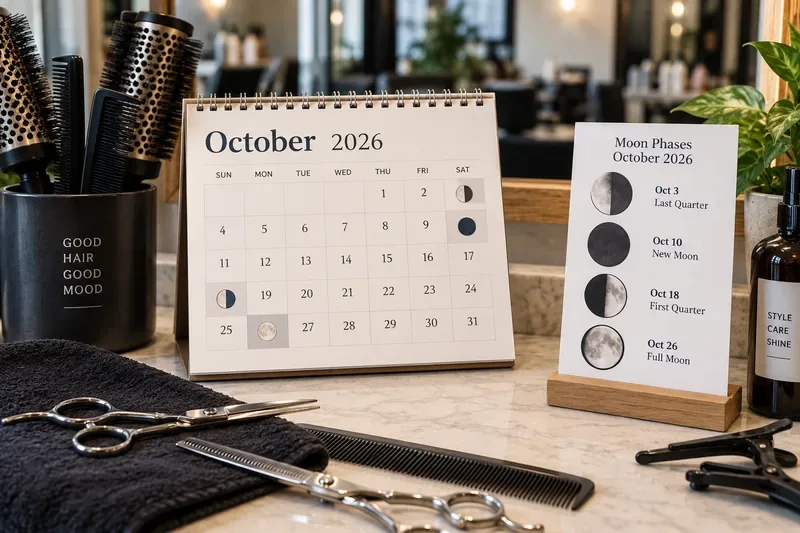
What are the main Moon phases in October 2026?
The U.S. Naval Observatory’s 2026 primary Moon-phase table lists the following October phases in Universal Time (UTC):
| Moon phase | UTC date and time | Practical calendar meaning |
|---|---|---|
| Last Quarter | October 3, 13:25 UTC | The Moon is in the waning half of its cycle. |
| New Moon | October 10, 15:50 UTC | A new waxing cycle begins after this point. |
| First Quarter | October 18, 16:12 UTC | The waxing phase is about halfway to full. |
| Full Moon | October 26, 04:12 UTC | The cycle turns from waxing to waning after full. |
For U.S. readers, local clock time matters. The Full Moon occurs just after midnight on October 26 in Eastern Daylight Time but late on October 25 in Pacific Daylight Time. If you follow lunar timing closely, use the phase instant for your own time zone rather than assuming the UTC calendar date applies everywhere.
If your goal is longer hair, which October dates make the most sense?
In lunar folklore, people who want “faster growth” often choose a haircut during the waxing Moon, the period from New Moon toward Full Moon. In October 2026, that means roughly after the New Moon on October 10 through the Full Moon on October 25 or 26, depending on your U.S. time zone.
A practical window is October 11–17 or October 19–24. Those ranges sit clearly within the waxing phase and avoid the exact quarter-phase dates if you prefer not to schedule directly on a transition.
Biologically, though, the benefit comes from what you ask the stylist to do, not from the Moon. If you are trying to retain length, ask for a conservative dusting or a clearly defined maximum amount to remove. The haircut can make the perimeter look fuller by removing split or weathered ends, which may make your hair appear healthier as it grows. It does not increase the rate at which the follicle produces hair.
This distinction matters because an overly aggressive “growth trim” can work against your real goal. If your hair grows around 1 centimeter per month and you repeatedly remove more length than you gain, the calendar cannot compensate for that. The simplest strategy is to trim only what is needed to keep damaged ends from becoming a styling problem.
What if your priority is keeping the haircut shape longer?
If your main frustration is that bangs, a bob, a tapered cut or a layered shape seems to lose definition quickly, the traditional lunar preference is the opposite: choose the waning Moon, which some calendars associate with slower-looking regrowth and longer-lasting shape.
For October 2026, the clearest waning windows are October 1–9 and, after the Full Moon, approximately October 27–31. On the West Coast, the Full Moon occurs during the evening of October 25, so the waning phase begins earlier by local date than it does for someone using Eastern Time.
Again, there is no established evidence that hair follicles slow down because the Moon is waning. The real reasons a shape lasts longer are more ordinary: the cut suits your texture, the stylist leaves enough weight in the right places, your bangs are not cut too short, and your daily styling does not distort the intended silhouette.
For short cuts and bangs, timing matters less than the maintenance interval
A short fringe can look “overgrown” long before shoulder-length layers do, even though both are growing from follicles at roughly their own normal rates. That is because a few millimeters make a larger visual difference in a short, precise shape. If you wear blunt bangs, a pixie, a close taper or a geometric bob, scheduling a realistic maintenance appointment often matters more than choosing a lunar phase.
What if you just want easier maintenance?
Easier maintenance is the most practical goal because it can be checked in daily life. Instead of asking whether the Moon will make your hair cooperate, look at the parts of your haircut that create work for you.
- If the ends tangle easily, remove enough damaged length to reduce snagging.
- If layers flip out in ways you dislike, ask whether the layer placement or weight line should change.
- If a fringe needs constant heat styling, consider a slightly longer or softer version.
- If curly or coily hair loses its shape unevenly, discuss shrinkage, density and how the cut behaves when dry.
- If your ends split quickly, review heat, chemical processing and brushing habits in addition to trim timing.
The American Academy of Dermatology notes that practices such as excessive heat, tight hairstyles and rough handling can contribute to breakage. Its guidance on styling without damage recommends limiting excessive heat and minimizing practices that put unnecessary stress on hair. That kind of adjustment can make a haircut easier to maintain regardless of when in the lunar month you booked it.
October 2026 lunar haircut calendar by goal
| Your main goal | Lunar-tradition window | What actually improves the result |
|---|---|---|
| Retain length while tidying ends | October 11–17 or 19–24 | Ask for a minimal trim and define the maximum length to remove. |
| Keep a short or precise shape looking fresh | October 1–9 or 27–31 | Choose a cut designed for your texture and book maintenance before the shape collapses. |
| Refresh layers without losing much length | Any convenient date; waxing dates if you enjoy the tradition | Target only the layers or face frame that have lost structure. |
| Reduce split, thin or frayed ends | Any date that works | Remove compromised ends and reduce the habits causing breakage. |
| Make styling easier | No lunar phase has a proven advantage | Adjust weight, length and shape to match your daily routine. |
Should you avoid the exact New Moon or Full Moon?
Some lunar haircut traditions treat the exact New Moon and Full Moon as special dates and prefer to cut on them. Others deliberately avoid transition days and schedule in the middle of a waxing or waning period. There is no scientific basis for declaring either approach superior for hair growth.
If you want a simple rule that reduces decision fatigue, skip the exact phase days and choose a nearby date that fits your goal. That would mean avoiding October 3, 10, 18 and 25–26 as “transition anchors” and using the surrounding windows instead. This is a scheduling convention, not a safety requirement.
Why can a trim still help hair look like it is growing better?
This is where the lunar-growth idea can feel convincing even when the biology points elsewhere. A trim may remove thin, split or uneven ends. Afterward, the lower edge of the hair can look denser and more uniform. If the hair also breaks less, you may retain more of the length your follicles were already producing.
That is very different from making the follicle grow faster. The NCBI description of the hair cycle places active growth in the follicle’s anagen phase beneath the skin. Cutting the external shaft does not reach the dermal papilla or matrix cells that generate new hair.
So if your goal is “growth,” a better question is often: am I keeping enough of the length I grow? Breakage, repeated bleaching, high heat and mechanical stress can make progress seem slow because the ends are being lost while the roots continue to grow.
How should texture change your choice of haircut date?
Texture does not require a different Moon phase, but it can change how often a haircut feels necessary. Straight, wavy, curly and coily hair show shape changes differently. Shrinkage can make a small amount of cutting look like a larger change when curls dry. Fine hair can lose a sharp perimeter sooner, while dense hair may keep visible length but become bulky as internal weight builds.
If you have curls or coils, the more useful scheduling question is whether your stylist evaluates the hair in the state in which you normally wear it. If you regularly wear it natural and dry, a cut planned only around stretched length may not predict the finished shape well. That practical issue matters far more than the Moon phase.
When should you ignore the lunar calendar entirely?
Ignore it when your scalp or hair needs attention now. If you notice sudden shedding, bald patches, scalp inflammation or a major change in density, a haircut date is not the central issue. The American Academy of Dermatology distinguishes ordinary shedding from forms of hair loss that may need diagnosis and treatment. Its overview of hair shedding and hair loss explains that many different causes can interrupt normal growth.
You should also ignore lunar timing if delaying a trim will make damaged ends more difficult to manage, or if your preferred stylist has one opening that clearly fits your schedule. A well-executed cut on a convenient day is usually more useful than an inconvenient cut chosen only because the Moon is in a preferred phase.
A simple way to choose your October appointment
Start with the easiest question: what do you want to notice when you look in the mirror two weeks after the cut?
- If the answer is “I kept my length but the ends look cleaner,” choose a conservative trim and, if you enjoy lunar tradition, favor October 11–17 or 19–24.
- If the answer is “my shape stays neat with less frequent cleanup,” choose a cut designed for longevity and, if you follow the tradition, favor October 1–9 or 27–31.
- If the answer is “my hair takes less work every morning,” prioritize shape, weight distribution and damage reduction over lunar timing.
Then check the salon reality: Is your stylist available? Will you have time to explain your goal? Are you planning chemical services near the same appointment? Do you have an event immediately afterward that makes a major change risky? Those practical constraints should outrank lunar preference.
How to tell afterward whether your timing choice worked
Give yourself a simple self-check instead of judging the haircut by the Moon. After two to four weeks, ask three questions.
- Length: Did you retain the amount of length you expected, or did the trim remove more than planned?
- Shape: Does the outline still sit where you want without extra styling effort?
- Maintenance: Are detangling, drying and styling easier, the same or harder than before?
If those answers are positive, the appointment timing worked for your real goal. If they are not, adjust the cut strategy next time: remove less length, change the layer placement, alter the fringe, or shorten the maintenance interval. You can still keep the lunar calendar as a personal ritual, but use your own results to decide whether the haircut itself is doing what you need.
For October 2026, the lunar calendar is clear: Last Quarter on October 3, New Moon on October 10, First Quarter on October 18 and Full Moon on October 26 in UTC, according to the U.S. Naval Observatory. What those dates cannot tell you is how fast your follicles will grow. Use the Moon to narrow your appointment choices if you enjoy the tradition; use hair biology, texture and your actual maintenance needs to decide what kind of cut to get.