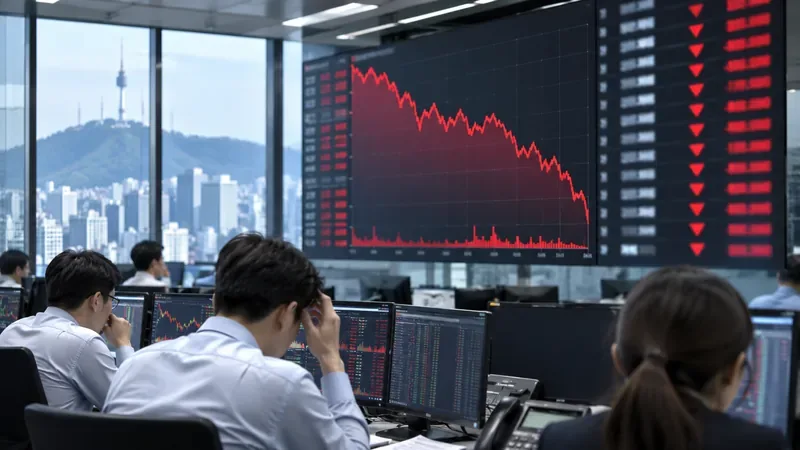
The Shenzhen Component Index fell 2.73% on Friday, October 30, 2026, finishing at 10,833.78 points after another technology-led selloff in mainland Chinese equities. The most credible explanation is a combination of pressure on AI-linked hardware and communications stocks, renewed scrutiny of the returns from large AI investments, and broader risk aversion. Those are observed market themes and plausible contributing factors—not a verified formula assigning a precise percentage of the index’s decline to any single headline.
This was the Shenzhen Component Index (code 399001; Yahoo symbol 399001.SZ), a benchmark of mainland China’s Shenzhen-listed A-shares. It was not a Taiwanese stock index, and its level was measured in index points, not an amount of Chinese yuan paid for one share.
October 30, 2026: the verified closing numbers
The delayed Yahoo Finance snapshot supplied for the session shows a final level of 10,833.7842, versus 11,138.2002 on October 29, a change of -2.7331%. Rounded to the customary two decimals, that is a fall of about 304.42 index points to 10,833.78, or -2.73%. An independent Xinhua closing report also recorded the October 30 close at 10,833.78 and the 2.73% loss. The historical values describe Friday’s completed session, not a live quotation on October 31.
The quote timestamp was October 30, 2026, at 07:12:19 UTC, equivalent to 3:12:19 p.m. in Shenzhen, China Standard Time (UTC+08:00). That is an observation timestamp for the data provider, not the moment the closing auction ended. The Shenzhen Stock Exchange trading schedule places its closing call auction at 2:57–3:00 p.m. in Shenzhen, China Standard Time (UTC+08:00), equivalent to 06:57–07:00 UTC on October 30. China did not observe a daylight-saving clock change on that date.
| Session measure | October 30, 2026 |
|---|
| Instrument | Shenzhen Component Index (399001 / 399001.SZ) |
| Previous close: October 29 | 11,138.20 points |
| October 30 close | 10,833.78 points |
| One-day move | -304.42 points; -2.73% |
| Exchange / market | Shenzhen Stock Exchange, mainland China A-shares |
| Regular market close | 3:00 p.m., Shenzhen, China Standard Time (UTC+08:00); 07:00 UTC |
Cross-checks: Xinhua October 30 market-close report and the session-specific Yahoo Finance Shenzhen Component quote page. Yahoo’s currency metadata may show CNY, but the quoted index number itself is expressed in points.
Why did the Shenzhen Component Index decline so sharply?
1. AI hardware and communication-equipment shares remained under pressure
On October 30, mainland trading showed pronounced weakness in communications, electronics, semiconductor-related and media shares, even as a few consumer-oriented sectors held up better. This matters for Shenzhen because its component benchmark contains major growth companies and technology businesses. Weakness in a heavily represented group can pull down the overall index without every constituent declining by the same percentage.
The index provider’s CNI Shenzhen Component Index methodology identifies the Shenzhen Component as a free-float-weighted measure drawn from 500 eligible Shenzhen-listed A-shares. Consequently, market-cap weighting and the performance of larger members are relevant to its daily movement. A precise attribution to individual companies, however, requires verified constituent weights and close-to-close contribution data for that date; a general sector headline alone cannot establish those contributions.
2. Investors questioned the economics of the AI spending boom
Concern over whether AI infrastructure spending would translate into durable earnings was already affecting global technology valuations. Reuters reporting on China’s AI-stock repricing, October 26 described a pullback in China’s AI-related shares before the October 30 session, while Reuters October 30 reporting on Asian AI-hardware demand and investor concerns reported continuing signs of real Asian hardware demand alongside market unease about financing and the eventual return on AI investment.
That distinction is central: falling AI-related stock prices do not prove that AI demand vanished or that every company’s operations deteriorated. A share price can drop when the market lowers the valuation multiple it is willing to pay, even when sales or earnings are still growing. The October 30 decline is consistent with that repricing process, but the size of its contribution to Shenzhen’s exact 2.73% move is not independently established.
3. A second consecutive steep decline amplified the move
The Shenzhen Component had already fallen approximately 2.92% on Thursday, October 29, closing at 11,138.20. Friday’s additional 2.73% fall took the benchmark below 11,000 points and to 10,833.78. Compounding the two daily moves gives a decline of roughly 5.6% across the two sessions, not merely their arithmetic sum. This sequence underscores how quickly sentiment can reset in an index exposed to fast-changing growth-stock valuations.
The wider market corroborated the weakness. Xinhua reported that the Shanghai Composite fell 1.44% to 3,599.02 and the ChiNext Index declined 4.13% to 2,413.63 on October 30. Because the growth-focused ChiNext gauge fell more sharply than Shanghai’s broader benchmark, the cross-index comparison supports the interpretation of disproportionately heavy pressure on growth-oriented stocks. It does not, by itself, prove that one sector caused all the losses.
Did everything in mainland China fall?
No. Xinhua’s post-close report described shipping, banking, and food-and-beverage shares among the day’s gainers, while media and communications stocks were among the significant decliners. That rotation matters: a headline about a major index can hide substantial differences between industries and companies. The selloff was broad enough to hit the leading equity benchmarks, yet not uniform across the market.
Market turnover for stocks covered by the Shanghai and Shenzhen headline indices was approximately 1.69 trillion yuan, according to Xinhua, compared with roughly 1.56 trillion yuan the previous session. Those are trading values in CNY, unlike the index close, which is quoted in points. Higher turnover during a decline is consistent with heavier trading and position changes, but it does not by itself identify sellers, reveal their motives, or establish that investors were all liquidating positions.
What the 2.73% drop means in practical terms
Consider a hypothetical investor holding a fund designed to track the Shenzhen Component Index. If the fund tracked the index perfectly with no fees, timing differences, distributions, premiums, or currency effects, a 2.73% daily index drop would imply about a 2.73% decline in the value of that index exposure. A notional 10,000-unit exposure would therefore fall by approximately 273 units over the session. This is a calculation for illustration, not the measured performance of any actual fund.
The example only applies directly when the product truly tracks the Shenzhen Component Index and the holding’s valuation uses the same market-close basis. It may not apply to a CSI 300 fund, a broad China ETF, a Hong Kong technology index product, or a Taiwan-market fund. For an overseas investor, exchange-rate changes against CNY, fees, fund tracking differences and trading-hour mismatches can make the realized result different from the benchmark percentage.
It also helps explain why the Shenzhen and Shanghai benchmarks did not fall by the same amount. They follow different baskets of listed companies with different weights. Their percentage moves are not interchangeable measures of a single stock, a country-wide currency change, or the performance of every Chinese company.
What to watch after the October 30 close
The final October session established a weak starting point for the next trading week, but it did not determine the next direction. If mainland markets reopen on their usual schedule, the next regular trading session would be Monday, November 2, 2026; any actual market holiday or trading notice would take precedence. The key conditional questions are whether communications and AI-hardware names stabilize, whether the selling remains broad or narrows to specific groups, and whether forthcoming company disclosures change earnings expectations.
Investors following the story can also compare trading volume, constituent contributions and the performance of the ChiNext and Shanghai benchmarks rather than extrapolating from one daily percentage. A rebound would not necessarily resolve concerns about AI investment economics; another decline would not prove that all underlying businesses were weakening. Both possibilities depend on information and trading conditions that were not known at the October 30 close.
Bottom line
The Shenzhen Component Index ended October 30, 2026 at 10,833.78 points, down 2.73% from the prior close of 11,138.20, extending the previous day’s 2.92% fall. Technology-linked selling, uncertainty about AI spending returns and generally weak equity sentiment offer a coherent explanation for the market reaction, supported by that day’s sector and benchmark performance. They remain interpretations of the session—not a proven single cause, a price forecast or investment advice.
Primary reference material: Xinhua October 30 market-close report; CNI Shenzhen Component Index methodology; Shenzhen Stock Exchange trading schedule. Session-quote reference: Yahoo Finance Shenzhen Component quote page. Background on market narratives: Reuters reporting on China’s AI-stock repricing, October 26 and Reuters October 30 reporting on Asian AI-hardware demand and investor concerns.