Home
» Today
»
Why Are KOSPI and Samsung Electronics Down Today? November 5, 2026 Selloff and Next-Session Outlook
Why Are KOSPI and Samsung Electronics Down Today? November 5, 2026 Selloff and Next-Session Outlook
Information checked: November 5, 2026, 4:14 p.m. Korea Standard Time (KST, UTC+09:00), equivalent to 07:14 UTC. This is the actual review time, not the publication schedule or the market closing time.
South Korean stocks fell sharply on Thursday, November 5, 2026. A post-session delayed market-data snapshot put the benchmark KOSPI at 5,383.80, down 5.28% from November 4, while Samsung Electronics common shares (005930) stood at KRW 201,500, down 7.57%. The decline was centered on semiconductor and artificial intelligence (AI) infrastructure companies, even as some banks, automakers, and healthcare names held up better.
The clearest observable pressures were heavy foreign-investor selling, a fall in U.S. semiconductor shares before Seoul opened, and concern that the outcome of the November 3 U.S. midterm elections could lead to tighter oversight of AI data-center development. That last point is a market interpretation and a potential policy risk, not evidence that new rules were already enacted or that Samsung announced a same-day earnings cut. Yonhap’s November 5 opening report independently documents those cross-market concerns.
Destaques
The November 5 delayed-data snapshot showed the KOSPI losing 300.00 points to 5,383.80, while Samsung Electronics lost KRW 16,500 per share to KRW 201,500.
Semiconductor and AI-infrastructure shares led the drop; that does not mean every South Korean stock or sector declined.
The Korea Exchange activated a five-minute sell-side program-trading curb during the morning after a sharp fall in KOSPI 200 futures.
The next regular Seoul cash-equity session is Friday, November 6. U.S. semiconductor performance, foreign flows, and any concrete AI-policy developments will help shape the opening.
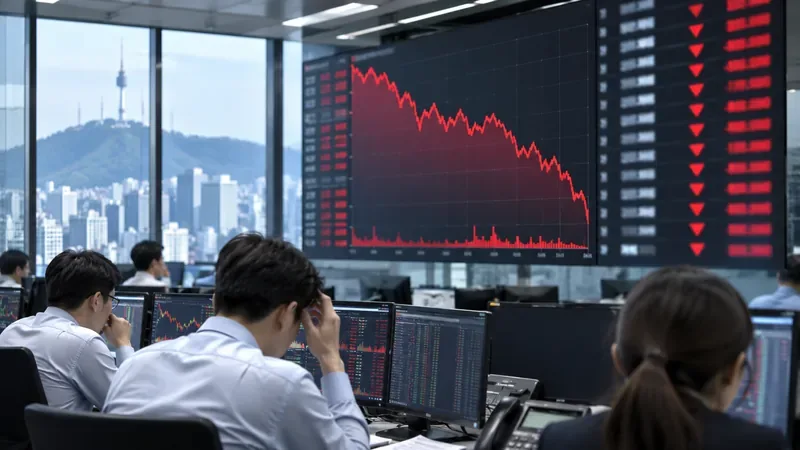
Illustration of a stock trading room during a market decline. This is not a photograph of the November 5, 2026 trading session, and the screen does not display verified KOSPI prices.
How much did the KOSPI and Samsung Electronics fall on November 5?
The following figures represent the provided Yahoo Finance delayed post-session snapshot, with the November 4 reference prices cross-checked against contemporaneous market reporting. They are presented as reported market data rather than an independently certified final exchange bulletin. A check of the Korea Exchange’s official historical close is advisable before using these numbers in a trading or regulatory record.
Instrument
Nov. 4 reference close
Nov. 5 reported close
Day-over-day move
KOSPI (^KS11), index points
5,683.80
5,383.80
-300.00 points (-5.28%)
Samsung Electronics (005930.KS), KRW/share
218,000
201,500
-KRW 16,500 (-7.57%)
Original quote references: Yahoo Finance KOSPI and Yahoo Finance Samsung Electronics. The quote timestamps supplied with the feed correspond to approximately 3:30–3:33 p.m. KST (UTC+09:00) on November 5, immediately after the regular 3:30 p.m. KST (06:30 UTC) cash-market close. Some other delayed pages continued showing intraday levels during this review, so differences between aggregators should not be mistaken for a separate market session.
What happened during the trading day?
The KOSPI opened at 5,580.09, already 1.82% below Wednesday’s 5,683.80 close. Selling accelerated in early trading. At 10:16 a.m. KST (UTC+09:00; 01:16 UTC), the Korea Exchange invoked a sell-side sidecar as KOSPI 200 futures met the relevant price-movement condition. The measure temporarily held eligible program sell orders for five minutes; it was not a full-day shutdown of all stock trading. Korean reporters documented heavy selling in Samsung Electronics, SK hynix, chip components, and power-equipment shares. The Kyunghyang Shinmun’s report citing the Korea Exchange describes the action and its timing.
Intraday price swings were substantial, so figures appearing in morning stories should not be substituted for the final close. Reports also showed selected automakers, financial companies, and biotech names gaining while chip stocks dropped, an important distinction from the claim that every part of the Korean equity market was down.
Why did Samsung Electronics and other Korean chip stocks fall?
1. U.S. semiconductor shares weakened despite a broader Wall Street rally
In the U.S. session immediately preceding Korea’s November 5 open, the Philadelphia Semiconductor Index fell about 3.1%, even though the S&P 500 and Nasdaq Composite gained. This divergence matters for South Korea because Samsung and SK hynix are major suppliers to global memory and computing supply chains. It provides a concrete cross-market signal of weaker sentiment toward semiconductor exposure; it does not, by itself, quantify any reduction in future chip orders. Yonhap’s market-open reporting records the U.S. chip-index move.
2. The U.S. election result raised questions about AI data-center investment
The U.S. midterm election outcome was interpreted as increasing the possibility of scrutiny over AI infrastructure, data-center construction, energy demand, and related permitting. Investors worried that slower data-center construction could eventually affect demand for advanced chips and supporting power equipment. Those are conditional concerns about the investment cycle, not a confirmed cancellation of projects, a verified reduction in Samsung’s 2026 orders, or an enacted U.S. rule as of this review. The wider global-market reaction was described by Reuters on November 5.
3. Foreign selling intensified the decline
South Korean market reporting attributed considerable selling pressure to overseas investors. By around 1:00 p.m. KST on November 5, reports citing Korea Exchange figures put foreign net selling on the main board at about KRW 1.97 trillion, while local individual and institutional investors were net buyers. This figure is an intraday flow snapshot, not a verified end-of-day total. Large sell orders in heavyweight semiconductor companies can amplify the percentage move in a capitalization-weighted index such as the KOSPI. Seoul Economic Daily’s intraday exchange-data report details the sector and investor-flow divergence.
Was the November 5 decline caused by bad Samsung earnings?
The sources reviewed for this article do not establish a new Samsung-specific earnings warning or a November 5 announcement that directly explains the 7.57% share-price fall. News reports focused instead on market-wide chip valuation and AI-capital-spending concerns, U.S. semiconductor weakness, and foreign outflows. Samsung’s actual business exposure and future results require separate assessment using its official investor-relations reports and disclosures. A one-day stock-price move cannot prove that revenue, margins, or customer orders have already changed.
The selloff was also not an identical response across all sectors. Expectations surrounding U.S. policy and falling oil prices created other winners and losers internationally. These broader conditions help explain why Korean chipmakers could fall while selected domestic financial, healthcare, and automotive shares traded higher.
What is the outlook for the next Korean trading session, November 6?
Seoul’s next scheduled regular cash-equity trading session is Friday, November 6, 2026, opening at 9:00 a.m. KST (UTC+09:00; 00:00 UTC) and normally closing at 3:30 p.m. KST (06:30 UTC). These are regular market hours, not a prediction of the opening index level. Investors will have a fresh U.S. trading session to assess before Seoul reopens.
Bull case: a relief rebound
If U.S. chip stocks stabilize, foreign selling slows and no immediate negative policy detail emerges, bargain-hunting could support a rebound in Korean semiconductor names. Any rebound would still need confirmation from market breadth and trading flows rather than from one strong opening print.
Base case: volatile, uneven trading
If uncertainty over AI spending remains but no new evidence alters company fundamentals, sharp two-way moves and rotation between chips and relatively defensive sectors are plausible. The November 5 sidecar and prior session’s swings underline the risk of extrapolating a single hourly move.
Bear case: chip selling continues
If U.S. semiconductor shares fall further, investors price in a clearer slowdown in AI infrastructure expenditure, or overseas funds keep reducing Korean equity exposure, pressure on Samsung, SK hynix and the KOSPI could persist. The scenario is conditional, not a price target or a forecast guaranteed to occur.
What should readers monitor before Friday’s KOSPI open?
U.S. semiconductor trading: look at the Philadelphia Semiconductor Index and major chip names in the November 5 U.S. session, rather than assuming all U.S. stocks move together.
Actual policy decisions: distinguish official U.S. legislative or regulatory proposals from investor speculation about election outcomes.
Foreign flows and KRW/USD: monitor whether the concentrated stock selling and currency pressure persist.
Market breadth: compare semiconductor declines with banks, autos, healthcare and the wider KOSPI and KOSDAQ, avoiding claims based only on two tickers.
Company announcements: check Samsung’s investor-relations materials and Korea Exchange information for verified market and disclosure updates.
FAQ
Did the entire South Korean stock market fall on November 5?
No. The KOSPI benchmark and major semiconductor shares fell sharply, but contemporaneous reports showed gains in selected automaker, financial and healthcare stocks. An index decline is not proof that every component declined.
Was trading completely halted on the KOSPI?
No. The reported action was a five-minute sell-side sidecar affecting program sell orders after a KOSPI 200 futures move. It should not be described as a complete market closure.
Will Samsung Electronics recover on November 6?
That cannot be established from the November 5 decline alone. A rebound would depend on subsequent U.S. chip trading, foreign-investor flows and any concrete AI-policy or company developments. This article is market commentary, not individualized investment advice.