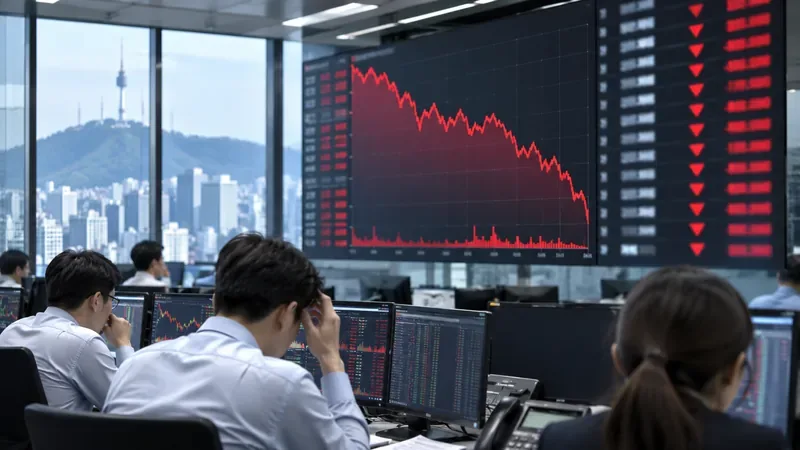
South Korea’s KOSPI rose 2.24% on Monday, November 2, 2026, closing at 5,859.08, up 128.34 points from Friday’s 5,730.74. The clearest documented forces behind the rebound were buying by domestic institutions, recovering large-cap semiconductor shares, and a better-than-expected backdrop from October export data. The market opened sharply lower after a U.S. technology selloff, so the gain was a reversal of early weakness—not an uninterrupted rally. These developments explain why investors became more willing to buy, but they do not prove that any single catalyst caused the entire 2.24% move.
This review covers the completed November 2 session in Seoul and the next regular trading session, Tuesday, November 3, 2026. It is a market explainer, not a forecast of guaranteed returns or personal investment advice.
KOSPI on November 2: the numbers that matter
| Measure | November 2, 2026 | How to interpret it |
|---|
| KOSPI close | 5,859.08 | Up 128.34 points, or 2.24%, from the prior valid session close |
| Previous close | 5,730.74 on Friday, October 30 | The comparison used to calculate Monday’s return |
| Monday opening level | 5,637.77 | Down 1.62% initially; the eventual rise required a substantial intraday reversal |
| Reported early-session low | 5,616.50 | Shows how much selling pressure appeared before buyers stepped in |
| Regular KRX session | 9:00 a.m.–3:30 p.m. Korea Standard Time (KST, UTC+9) | Monday’s regular-session close corresponds to 6:30 a.m. UTC |
The 5,859.08 close is also reported in a November 2 market-close bulletin published at 3:36 p.m. KST by Seoul Economic TV. The exchange’s official trading-hours guide identifies 3:30 p.m. KST as the end of regular trading. The supplied delayed Yahoo Finance observation was captured shortly after that time; refreshed quote pages can contain stale or interim readings, so this article does not use an unverified live figure in place of the dated closing report. See the November 2 close report, the KOSPI quote page, and KRX trading hours.
Why did the KOSPI rise despite the weak opening?
1. Domestic institutions supplied demand as other investors sold
Monday’s reversal has direct evidence in investor-flow reports. At 2:05 p.m. KST, institutions were reported to have bought a net 1.2114 trillion Korean won of main-board shares, while individuals and foreign investors were net sellers. These are time-stamped intraday flows, not audited full-day totals; they explain the direction of demand during the rebound without pretending that the exact same amounts held at the close. The recovery in price alongside institutional net purchases is consistent with bargain hunting after Friday’s sharp fall.
For the supporting intraday figures and timing, see Aju Press’s November 2 trading report. To test whether the rebound has staying power, watch whether institutions remain buyers on November 3 and whether foreign selling moderates. One strong domestic bid does not itself establish a durable trend.
2. Semiconductor heavyweights recovered, but the move was not uniform
Investors also returned to key electronics and semiconductor names after an exceptionally weak previous session. At 2:05 p.m. KST, Samsung Electronics was reported up 2.00% and SK hynix up 4.37%, with SK Square also higher. Those percentages are intraday snapshots rather than independently verified stock closing returns. Because these companies are important constituents of Korea’s equity market, their recovery helped explain the KOSPI’s change in direction.
The distinction matters: a semiconductor-led rebound is not the same as every listed company rising. At that same afternoon checkpoint, some major battery, biotechnology, and financial stocks were lower. A useful follow-up is to compare the November 3 advance/decline count, sector performance, and individual chip-company moves instead of assuming the index’s headline return describes the entire market.
3. Official October export data strengthened the fundamental case for chipmakers
South Korea’s Ministry of Trade, Industry and Resources reported on November 1 that October exports reached $115.28 billion, an increase of 93.7% from a year earlier. Semiconductor exports reached $56.44 billion, up 259.4%, as demand related to AI infrastructure remained strong. This was a concrete, already published development available to traders before Monday’s opening. It supplied an economic reason to revisit semiconductor earnings expectations while share prices were under pressure.
There is an important qualification: year-over-year export growth was partly affected by a difference in working days arising from the timing of the Chuseok holiday. The ministry’s working-day-adjusted daily export measure still rose 76.1%, which supports the strength of the data but cautions against reading the 93.7% headline as pure like-for-like volume growth. Readers can check the ministry’s original November 1 release. Export strength is confirmed; its precise share of Monday’s KOSPI gain is not measurable from the price change alone.
4. The rebound followed substantial selling at home and abroad
The KOSPI had dropped 3.48% on Friday, October 30. U.S. technology stocks also sold off sharply: the Nasdaq Composite fell 2.86% that Friday and the Philadelphia Semiconductor Index fell 7.20%, amid renewed concern about the financial returns on heavy artificial-intelligence spending. Those overseas losses help explain Monday’s weak Korean open. They also left room for buyers to reassess whether Korea’s chip export and earnings picture justified the preceding decline. Reassessment and short-term positioning are plausible contributors, not a confirmed measure of how much of the rally was a technical bounce.
A Reuters report from November 2 described early dip buying after the strong export release. The contrast is central to the session: weak global risk sentiment at the open, followed by domestic buying and renewed attention to Korean exporters.
What remains uncertain after a 2.24% gain?
- Whether overseas investors join the recovery: early and afternoon reporting showed net foreign selling, not a broad foreign-led turnaround.
- Whether the rise is broad-based: an index heavily influenced by large companies can gain even while particular industries remain weak.
- Whether AI spending concern is fading: one Korean rebound does not resolve questions over U.S. technology-company cash flow, valuations, or future chip orders.
- Whether the won and overseas risk appetite stabilize: exchange-rate and U.S. futures observations taken at different hours are not interchangeable with confirmed end-of-day readings.
A stronger assessment would use finalized Korea Exchange investor-flow and sector data, plus the next session’s price and volume. This article does not claim those complete post-close breakdowns have been independently reconciled.
Next-session outlook: three conditional scenarios for November 3
| Scenario | What would support it | What to monitor |
|---|
| Upside continuation | Institutions keep buying, selling by foreign investors slows, and semiconductor leaders hold their gains while more sectors participate | KRX investor flows, Samsung Electronics and SK hynix, market breadth, and overnight U.S. technology sentiment |
| Range-bound consolidation | Chip shares stabilize but investors hesitate after Monday’s sharp reversal and ahead of overseas events | Whether turnover contracts, leadership narrows, and early gains repeatedly fade |
| Renewed downside pressure | Another U.S. technology selloff, persistent foreign outflows, a weaker won, or fading domestic demand reverses the rebound | Opening gap versus Monday’s close, foreign selling, Korean currency moves, and pressure across sectors |
These are monitoring frameworks, not assigned probabilities or price targets. For perspective, Monday’s 5,859.08 finish stood above Friday’s 5,730.74 close but still below the 6,012.44 close recorded on October 28. That is a useful illustration of recent volatility, not an automatic support or resistance forecast.
Which events could matter before Seoul’s next close?
The U.S. manufacturing PMI: the Institute for Supply Management schedules its October manufacturing report for Monday, November 2, at 10:00 a.m. U.S. Eastern Standard Time (EST, UTC−5), equivalent to 3:00 p.m. UTC and midnight at the start of November 3 in Seoul (KST, UTC+9). This release occurs after Monday’s KRX close; its results should not be presented as a cause of the completed Korean session. Review the official ISM release calendar and then the actual reported figures.
U.S. corporate results and technology trading: investor attention is on large technology companies’ earnings and capital-expenditure commentary, alongside the performance of U.S. semiconductor shares. Watch confirmed releases and how markets react, not rumors about results that had not been published as of the Korean close.
U.S. election-related volatility: the U.S. midterm election period in November may influence global risk appetite. Its political outcome and the market response are not known from the November 2 Korean session; they should not be treated as a confirmed bullish or bearish catalyst for November 3. The official USAGov election explainer provides institutional context.
A practical checklist for reading the November 3 open
- Confirm the finalized November 2 close and any corrections against the Korea Exchange or a time-stamped end-of-day source; avoid mixing delayed quotes and intraday snapshots.
- Check the November 3 KOSPI open relative to 5,859.08, and ask whether the gap persists after the first hour.
- Compare net institutional and foreign flows. Note the time of each observation; an 11:00 a.m. figure is not a closing total.
- Review Samsung Electronics, SK hynix, other sector leaders, and market breadth to identify whether gains are spreading or concentrated.
- Look for confirmed U.S. market and economic releases, the USD/KRW exchange rate, and any new company disclosures before drawing a next-session conclusion.
Bottom line: the November 2 KOSPI rally was a documented reversal supported by institutional demand and recovering chip shares, against a backdrop of exceptionally strong official Korean export data. The main next-session question is not whether Monday was positive—it was—but whether buying becomes broader and survives another round of global technology and currency signals. Neither an upside continuation nor a reversal is assured.