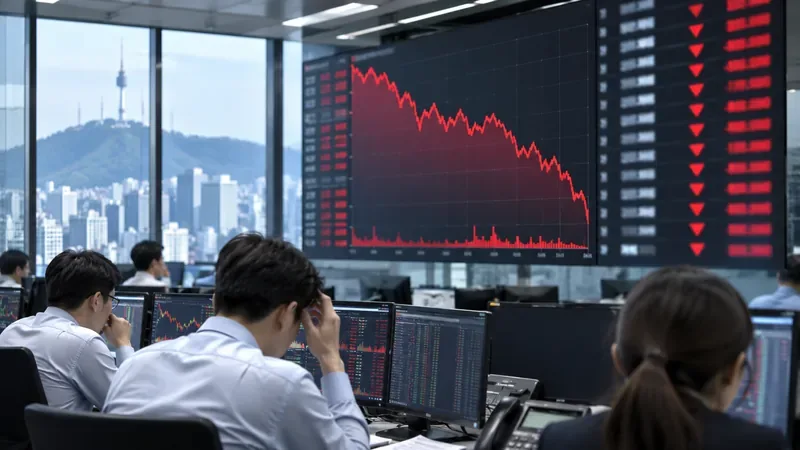
November 3, 2026, Seoul: South Korea’s KOSPI fell sharply as selling hit major semiconductor stocks. The supplied delayed Yahoo Finance session snapshot puts the benchmark at 5,648.79, down 210.29 points, or 3.59%, from the preceding valid close of 5,859.08 on November 2. The figures describe the November 3 session, not a rolling return. That precise November 3 figure has not yet been independently matched to the final Korea Exchange closing bulletin, so readers should treat it as a vendor snapshot rather than a separately confirmed official settlement.
The strongest documented explanation is a combination of renewed worries about the cost and returns of artificial intelligence investment, overnight losses in U.S. technology stocks, and selling by foreign and institutional investors in Seoul. The U.S. midterm election on November 3 added uncertainty, but there is no evidence that its eventual outcome caused the earlier Korean trading-day decline. These are evidence-backed market factors, not proof that any single headline mechanically produced the index move.
How far did the KOSPI fall on November 3?
| Measure | November 3, 2026 session | What the figure means |
|---|
| Previous valid close | 5,859.08 on November 2 | Confirmed prior-session reference |
| Supplied delayed-data reading | 5,648.79 | Yahoo Finance-derived snapshot, pending direct exchange-close cross-check |
| Change from prior close | −210.29 points (−3.59%) | Computed from the two supplied readings |
| Tuesday opening level | 5,715.19 (−2.46%) | Exchange-based opening figure reported by Yonhap |
The supplied quote timestamp, 3:32:40 p.m. Korea Standard Time (KST, UTC+09:00), corresponds to 06:32:40 UTC. The regular KOSPI session ends at 3:30 p.m. KST (06:30 UTC), according to Korea Exchange trading-hours guidance. The fact that a delayed feed is timestamped after that cutoff does not, by itself, verify its final official index value. For the earlier day's comparison, Yonhap’s November 2 closing report confirmed the November 2 gain of 2.24% to 5,859.08.
Why did Korean stocks sell off?
1. AI investment payback concerns hit semiconductor sentiment
The selling began before the November 3 Korean opening bell. U.S. trading on Monday, November 2, had left the Nasdaq Composite down 1.07% and the S&P 500 down 0.51%, even as the Dow rose 0.41%. That divergence is important: weakness was concentrated in technology-sensitive trades rather than representing a uniform collapse of U.S. equities. Yonhap’s November 3 opening report described concerns that large AI-infrastructure spending might weigh on near-term profitability.
One verifiable backdrop was Oracle’s capital plan. In a release dated October 28, 2026, Oracle’s October 28 investor-day release said it expected up to $20 billion of additional capital raising through fiscal 2030, excluding debt refinancing, split between approximately $10 billion of equity and $10 billion of gross debt. The date matters: this was an existing public financing plan being reassessed by investors, not a new November 3 announcement. A funding plan is not evidence that AI demand has disappeared; it makes financing cost, cash conversion, and returns on investment more salient to equity valuations.
2. Korean chip leaders transmitted the pressure into the benchmark
South Korea has sizable exposure to globally traded chip demand through large listed companies. At 9:15 a.m. KST, Samsung Electronics was down 4.59% and SK hynix 5.1%, according to Yonhap’s November 3 opening report. By 11:20 a.m. KST, they were down 2.95% and 3.8%, respectively, according to Yonhap’s 11:28 a.m. market update. Those are intraday observations, not asserted closing returns. They show how strongly sentiment moved among key technology names and why it is misleading to infer that every KOSPI constituent declined by the same percentage.
3. Foreign and institutional selling reinforced the slide
As of 2:15 p.m. KST, foreign investors had sold a net 2.0028 trillion won of main-board shares and institutions a net 860.3 billion won, while individuals had purchased a net 2.6061 trillion won, based on Financial News’ Korea Exchange-based 2:15 p.m. account. These figures describe a specific intraday cutoff; they are not final full-session flow totals. The imbalance is consistent with pressure on Korean equities, but investor-flow data cannot identify every seller’s motives or establish a single cause.
4. U.S. political and macroeconomic uncertainty remained in the background
Voting in the U.S. midterm elections was scheduled for Tuesday, November 3, U.S. local time. The Korean session ended before a meaningful nationwide election result could be known, so the vote is better described as an upcoming risk event than as a confirmed explanation of the KOSPI close. Market participants were also weighing the implications of lower oil prices and changing interest-rate expectations. None of those forces should be treated as a complete explanation without corroborating sector, currency, and trading-flow evidence.
What changed from Monday’s rebound?
On November 2, the KOSPI had risen 2.24%, with institutional demand helping it recover from an initially weak start. That recovery did not erase uncertainty about whether AI capital spending would translate into sustainable earnings and free cash flow. Tuesday’s retreat showed the fragility of a one-session rebound when U.S. chip shares and overseas investor appetite remained under pressure. It would be inaccurate to call the November 2 rally a durable trend reversal solely because it was large—or to say the November 3 decline proves a lasting bear market.
Next-session outlook: Wednesday, November 4, 2026
The next regular Korean trading session is scheduled for 9:00 a.m.–3:30 p.m. KST (UTC+09:00) on Wednesday, November 4, equivalent to 00:00–06:30 UTC. The three scenarios below are conditional monitoring frameworks, not forecasts or price targets.
| Scenario | Signals to watch | What it would suggest |
|---|
| Recovery case | U.S. chip shares stabilize; Samsung and SK hynix regain ground; foreign net selling moderates; won volatility eases | The decline may have been amplified by positioning and short-term sentiment; a rebound is possible but not assured |
| Uneven or range-bound case | Mixed U.S. tech performance, continued rotation between sectors, and no clear change in foreign flows | Expect two-way trading; index direction alone may conceal divergent stock performance |
| Further downside case | Another weak U.S. technology session, accelerating chip-stock sales, sustained overseas outflows or a sharp won move | The pressure may extend, especially in large-cap technology shares; avoid assigning an unsupported downside target |
What should readers verify before interpreting the next move?
- Confirm the final KOSPI close. Compare the delayed Yahoo Finance KOSPI quote page print with the Korea Exchange’s official daily index history when it becomes available. Do not confuse intraday values, vendor snapshots, and final exchange records.
- Separate index performance from market breadth. Check whether declines are concentrated in Samsung Electronics and SK hynix or spreading across financials, autos, industrials, and smaller shares.
- Compare full-session foreign and institutional flows. The 2:15 p.m. selling estimates are informative, but final figures can change before the close.
- Track events in their correct time zones. U.S. election counting occurs through the U.S. evening of November 3 and the Korean morning of November 4; no exact result-release time is guaranteed. The U.S. Bureau of Labor Statistics release calendar lists the October U.S. employment report for Friday, November 6 at 8:30 a.m. Eastern Standard Time (EST, UTC−05:00), equivalent to 10:30 p.m. KST that day.
Bottom line
The November 3 KOSPI selloff is well supported as a technology-led, risk-sensitive decline against a backdrop of AI financing concerns and heavy overseas selling. The supplied market reading points to a 3.59% drop to 5,648.79, but its status as the final official exchange close remains unconfirmed in the sources available for this article. The useful question for November 4 is not whether a rebound is guaranteed; it is whether chip prices, foreign flows, currency moves, and the U.S. overnight session begin to confirm—or contradict—the apparent stabilization. This is a market explainer, not personalized investment advice.