Home
» Today
»
Why Is Spains IBEX 35 Up Today, November 4, 2026? Banks Lead the Rally
Why Is Spains IBEX 35 Up Today, November 4, 2026? Banks Lead the Rally
Information checked: November 4, 2026, 6:05 p.m. Madrid time, Central European Time (CET, UTC+01:00); 5:05 p.m. UTC. The market session discussed here is Wednesday, November 4, 2026, regardless of when this article is subsequently read.
Spain's IBEX 35 jumped about 3% on Wednesday, November 4, 2026, as Spanish bank shares surged amid a broader European equity rebound following the U.S. midterm elections. The supplied Yahoo Finance delayed-data snapshot for the November 4 session puts the benchmark at 19,370.90 points, up 563.70 points (+2.9973%) from the preceding valid close of 18,807.20. That level is a vendor-reported end-of-session reading, not an independently confirmed official BME closing value.
Investors appeared to welcome the prospect of divided government in Washington and a potentially less confrontational policy backdrop for Europe, while Santander, CaixaBank and BBVA helped drive the Spanish index. A separate, potentially adverse development also arrived during the day: Eurostat estimated October euro-area inflation at 4.0%, up from 3.8% in September. The market rose despite that inflation surprise; the rally alone cannot prove which development mattered most to every investor.
Destaques
IBEX 35 session: 19,370.90 points, +563.70 points or approximately +3.00%, in the supplied delayed Yahoo Finance November 4 dataset; independent BME closing-price confirmation remains unavailable.
Most visible support: Spanish banks led the advance, with particularly strong intraday gains in CaixaBank, Banco Santander and BBVA; the gains were not universal across constituents.
News backdrop: The Democratic Party's U.S. midterm victories altered expectations for American economic and trade policy, according to contemporary market coverage.
Next session: Thursday, November 5, 2026; watch whether banking gains persist and how markets respond to higher euro-area inflation and ECB communications.
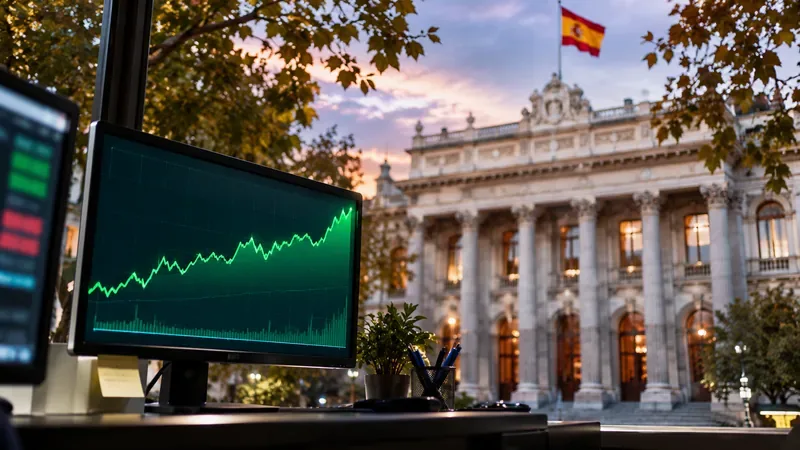
Illustration of a Madrid financial-market setting and an upward-trending chart. The display is conceptual, not a recorded IBEX 35 chart from November 4, 2026.
How much did Spain's IBEX 35 rise on November 4, 2026?
The delayed ^IBEX record supplied for this report identifies the immediately previous valid closing level as 18,807.20 and the November 4 reading as 19,370.90. Subtracting the two gives a 563.70-point advance; dividing that change by 18,807.20 yields approximately 2.9973%. These figures describe the cash equity index in index points, not a euro-denominated share price or an IBEX futures contract. The record carries a quote timestamp of November 4 at 5:37 p.m. Madrid CET (UTC+01:00), equivalent to 4:37 p.m. UTC. See the Yahoo Finance IBEX 35 quote page for the vendor series.
Spain's BME Exchange trading-hours schedule places continuous equity trading from 9:00 a.m. to 5:30 p.m. Madrid CET (UTC+01:00), followed by a closing auction generally ending shortly after 5:35 p.m. The supplied 5:37 p.m. quote is therefore after the scheduled closing auction. However, BME's public index display did not provide a usable independent final reading during the verification check. The reported change is consistent with independently observed, strong intraday IBEX gains, but should not be presented as an exchange-certified official close.
Why was the IBEX 35 up so much on November 4?
1. The U.S. midterm election result shifted market expectations
U.S. congressional election results provided the broad backdrop. Contemporary Reuters reporting on the European equity response described European shares advancing as Democrats won control of both chambers of Congress. Investors and analysts interpreted divided U.S. government as potentially limiting parts of President Donald Trump's agenda and reducing some policy risks for European companies.
That interpretation is a plausible catalyst, not a mechanically proven explanation for a 3% Spanish index gain. Prospective policy constraints, legislative bargaining and expectations for U.S. fiscal policy might influence the dollar, sovereign-bond yields, international risk appetite and European valuations. None of those transmission channels guarantees favorable outcomes for Spanish companies.
2. Banco Santander, CaixaBank and BBVA powered the financial sector
The clearest market-level evidence is the sector pattern. A bank-hosted IBEX component quote snapshot showed CaixaBank up roughly 6.6%, Banco Santander about 5.8% and BBVA about 5.0% at its 3:11 p.m. Madrid CET (UTC+01:00) observation. These were intraday component quotes, not verified final returns. Other lenders, including Bankinter and Banco Sabadell, also traded higher in available intraday observations.
Banks matter disproportionately because the IBEX 35 methodology described by BME weights constituents according to free-float-adjusted market capitalization rather than assigning each company an equal share. Strong rallies by large lenders can lift the headline index substantially even while other constituents lag. The available snapshots do not establish a complete final constituent-by-constituent contribution calculation.
3. The broader European rally and easing energy pressure helped sentiment
This was not an isolated Spanish move. European banking shares and other regional stock indexes also advanced. Energy and clean-energy shares benefited in parts of Europe as investors reassessed U.S. policy prospects, while oil prices retreated during the session from earlier levels, according to contemporaneous market reporting. A lower oil price can ease cost pressures for some businesses, although its direct impact differs between airlines, utilities, industrial companies and energy producers.
Even so, describing the day as a rise in every stock would be wrong. The same bank-hosted snapshot showed Indra and ACS trading lower in the afternoon. The observed rise was broad enough to lift the benchmark sharply but still reflected distinct sector winners and losers.
What changed in the economic data, and why does inflation matter?
Eurostat's official October 2026 euro-area flash inflation release reported annual headline inflation of 4.0%, versus 3.8% in September. Energy prices were the strongest major component, rising 20.8% year over year in the preliminary estimate. Excluding energy, food, alcohol and tobacco, the estimated rate was 2.5%. These are published estimates, not projections invented for this outlook.
Higher inflation can keep pressure on European Central Bank policy expectations, financing costs and equity valuations. It can also affect bank profitability in opposing ways: higher interest rates may support some lending margins, while slowing credit demand, funding costs and borrower stress can offset those benefits. It would therefore be too simple to declare that higher inflation caused the bank rally—or that falling yields automatically helped every lender. The day's verified data and market-price behavior demonstrate coexistence, not a single established causal chain.
What is the IBEX 35 outlook for Thursday, November 5, 2026?
The next regular Madrid equity session is scheduled for Thursday, November 5, 2026. Under BME's published timetable, continuous trading begins at 9:00 a.m. Madrid CET (UTC+01:00), or 8:00 a.m. UTC, barring an extraordinary change. A one-day rebound of approximately 3% does not determine the next session's direction.
Bull scenario: banking strength extends to other sectors
If Santander, CaixaBank and BBVA retain most of their gains, European equities remain firm and calmer energy or bond markets support sentiment, additional buying across industrial, consumer and utility stocks could help the index consolidate above its previous-session level. This is a conditional scenario, not a price target or prediction.
Base scenario: a pause after a powerful one-day rebound
If election-related optimism is already reflected in prices while investors digest the 4.0% inflation print, the index could trade unevenly as participants rebalance positions. A mixed session, with stronger banks offset by weakness elsewhere, would be compatible with Wednesday's sector-led rally.
Bear scenario: policy or inflation concerns trigger profit-taking
If the U.S. policy outlook becomes more uncertain, euro-area yields climb on inflation concerns, oil prices rebound or leading Spanish lenders give back part of their gains, the IBEX could retrace some of Wednesday's advance. Such a pullback would not by itself demonstrate that the prior day's rally was erroneous.
Which events and indicators matter for the next session?
ECB communication: Isabel Schnabel is scheduled to deliver opening remarks at the ECB Conference on Money Markets in Frankfurt on Thursday, November 5, at 9:05 a.m. Frankfurt CET (UTC+01:00), equal to 8:05 a.m. UTC. The official ECB conference program provides the agenda. Remarks may or may not address the policy questions investors are watching.
Inflation and rates: Monitor how bond markets and interest-rate expectations digest Eurostat's October flash estimate, rather than assuming the ECB will take a particular action at its next meeting.
Index participation: Follow whether financial-sector gains spread to Inditex, Iberdrola and other major constituents, and whether the prior day's laggards stabilize.
Global crosscurrents: Watch the U.S. dollar, Spanish and euro-area sovereign yields, oil prices and U.S. equity-market reactions to election-related policy news.
Bottom line: The November 4 IBEX rise is best understood as a bank-led response to a positive international equity session, with U.S. election developments providing a credible market backdrop. The decisive facts are the observed index increase and intraday component performance; the precise balance of investor motives is not verifiable from prices alone. The November 5 path depends on whether those supports persist and on the market's response to inflation and policy signals.
FAQ
How much did the IBEX 35 gain on November 4, 2026?
The supplied delayed Yahoo Finance series shows 19,370.90 points, up 563.70 points or about 3.00% from the prior valid close. An independent official BME closing reading was not available during verification.
Which shares helped push the IBEX 35 higher?
Intraday snapshots show particularly large gains in CaixaBank, Banco Santander and BBVA. Their precise final percentage contributions to the index were not independently established.
Will the IBEX 35 rise again on November 5?
No direction is assured. Continued bank strength and firmer European sentiment would support the bullish case; profit-taking, higher yields or renewed energy and policy concerns would favor a weaker session. This analysis is general market commentary, not investment advice.