Home
» Today
»
Why Is Microsoft Up Today? November 4, 2026: 6.68% Rally and Next-Session Outlook
Why Is Microsoft Up Today? November 4, 2026: 6.68% Rally and Next-Session Outlook
Last verified: November 4, 2026, 5:36 p.m. Eastern Standard Time (EST, UTC−05:00; 22:36 UTC).
Microsoft (NASDAQ: MSFT) finished Wednesday, November 4, 2026, at $555.80, up $34.81, or 6.68%, from its previous closing price of $520.99. The surge came during a broad rebound in major U.S. technology shares following the midterm elections. Market reporting connected the rally to investors' expectations that political resistance to new data-center projects could increase the relative value of infrastructure already owned by established technology companies.
Microsoft's strong fiscal first-quarter results, released a week earlier, also provided a fundamental backdrop: Azure revenue grew 48% year over year. But the earnings release was not a new announcement on November 4, and no single company-specific announcement has been established as the sole cause of the day's 6.68% gain.
Destaques
Verified close: MSFT ended November 4 at $555.80, up 6.68% from $520.99 on November 3.
Same-day catalyst: The post-election rebound in mega-cap technology stocks was accompanied by expectations about future U.S. data-center permitting and spending; those expectations are not enacted policy.
Company fundamentals: Microsoft's October 28 report showed $92.3 billion in quarterly revenue, 48% Azure growth, and $677 billion in commercial remaining performance obligations.
Next session: Thursday, November 5, could see follow-through, consolidation, or a reversal depending on sector sentiment and new information; the Wednesday close alone cannot predict which.
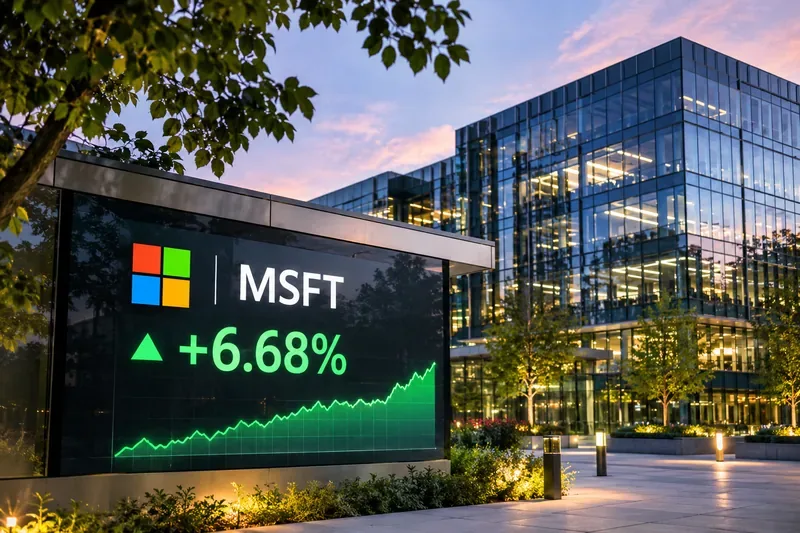
Illustration: A market display highlights Microsoft's 6.68% share-price rise on November 4, 2026. The building and display are illustrative, not a documentary photograph of the trading session.
How much did Microsoft stock gain on November 4, 2026?
The November 4 move was a regular-session gain, not a rolling one-day return or an after-hours quote. The U.S. market's normal session ended at 4:00 p.m. New York EST (UTC−05:00), or 21:00 UTC. Standard time was in effect following the November daylight-saving transition. The closing figures below match the supplied Yahoo Finance delayed snapshot and a separate market-data display from Charles Schwab.
Why was Microsoft stock up so sharply on November 4?
Did the U.S. midterm elections help lift Big Tech?
The clearest identifiable same-day theme was the marketwide rotation into established technology giants. Reuters reported on November 4 that investors interpreted Democratic midterm victories as potentially increasing resistance to building new U.S. data centers. Under that interpretation, companies such as Microsoft and Amazon could benefit from the scarcity value of existing computing capacity while facing pressure to be more disciplined about future infrastructure spending.
That is an investor thesis, not a confirmed change to data-center law. Political opposition could also increase costs, delay expansion, and constrain the supply needed to serve AI customers. The same news can therefore have positive and negative implications for Microsoft over different time horizons. Reuters also described losses in some smaller data-center-related stocks, emphasizing that the entire AI infrastructure sector did not move in the same direction. Read Reuters' November 4 reporting on the Big Tech rally.
What did Microsoft's latest earnings reveal about Azure and AI?
On October 28, Microsoft reported $92.3 billion in revenue for the quarter ended September 30, 2026, a 19% year-over-year increase. Microsoft Cloud revenue reached $63.9 billion, up 30%, while Azure revenue grew 48%. Commercial remaining performance obligations—contracted business not yet recognized as revenue—rose 73% to $677 billion. GAAP diluted earnings per share were $4.92, while non-GAAP diluted earnings per share were $4.89, with the latter excluding specified effects from OpenAI investments.
These results help explain why Microsoft remains prominent in discussions of AI revenue growth, enterprise cloud spending, and products such as Microsoft 365 Copilot. They also make the company a plausible beneficiary when investors return to established AI-related stocks. However, the gap between October 28 and November 4 matters: the reported earnings numbers cannot, on their own, establish the immediate cause of Wednesday's price surge. The original figures are in Microsoft's fiscal 2027 first-quarter earnings release.
What could limit the positive narrative?
Cloud growth comes with significant infrastructure costs. During the October 28 earnings call, Microsoft reported $45.2 billion in quarterly capital expenditures and $18.6 billion of free cash flow. Management said some third-party capacity deliveries had been delayed, and it expected calendar-year 2026 capital expenditures of approximately $170 billion. That is management guidance, not a final full-year spending figure.
Microsoft also projected fiscal second-quarter Azure revenue growth of 49% to 50% in constant currency, while acknowledging that customer demand continued to exceed available capacity. Those projections underscore both the opportunity and the execution risk: strong AI demand does not automatically translate into faster profits or a higher share price. See Microsoft's October 28 earnings-call transcript.
What is the outlook for Microsoft stock on Thursday, November 5?
The next regular U.S. stock-trading session is Thursday, November 5, 2026, from 9:30 a.m. to 4:00 p.m. New York EST (UTC−05:00), equivalent to 14:30–21:00 UTC. November 5 is not a scheduled Nasdaq market holiday. The Nasdaq trading calendar confirms normal U.S. equity market hours and the 2026 holiday schedule.
There is no reliable basis to guarantee a second straight gain after a 6.68% rally. A useful framework is to evaluate three conditional outcomes rather than inventing a price target:
Scenario
What would support it
What it would imply
Bull case
Broad technology buying persists; new information reinforces optimism about cloud demand and disciplined spending.
MSFT could extend its advance, though the November 4 intraday high near $559.15 may attract attention.
Base case
No important fresh news; investors reassess the earnings outlook and the election-driven narrative.
Choppy trading or consolidation around the previous close would be plausible without confirming a new trend.
Bear case
Profit-taking accelerates, data-center policy expectations change, or concern about AI investment costs returns.
Some of Wednesday's gain could reverse; the previous close of $520.99 is a comparison point, not a forecast or a guaranteed support level.
What should investors watch before the November 5 opening bell?
The most useful checks are new primary-source disclosures rather than attempts to reverse-engineer one day's price movement. Watch for any Microsoft investor-relations or regulatory filing that materially changes guidance; concrete U.S. policy proposals affecting data-center construction or energy availability; and whether large technology peers continue to move together. Treasury yields, broad equity-index futures, and market-wide risk appetite can also affect a highly valued large-cap stock even without company-specific headlines.
Price action during premarket hours can help identify changes in sentiment, but it is not equivalent to the official regular-session close and can be thinner and more volatile. The reported November 4 high is a reference point, not a guaranteed breakout threshold. Likewise, the fact that Microsoft rose more than the broad market does not by itself prove that a specific analyst note, trade, or policy announcement caused the entire move.
Frequently asked questions about Microsoft's November 4 rally
Why did Microsoft stock go up on November 4, 2026?
MSFT rose amid a post-election rally in major technology shares. Investors considered how potential constraints on new data centers might favor established operators, while Microsoft's previously reported Azure and cloud growth strengthened the broader investment case. The exact contribution of each factor is not verifiable from price action alone.
What was Microsoft's closing price on November 4?
Microsoft closed the regular Nasdaq session at $555.80, up $34.81 (6.68%) from the November 3 close of $520.99.
Will MSFT keep rising on November 5?
It might, but there is no confirmed direction for the next session. Continued technology-sector strength could support further gains, whereas profit-taking, shifting political expectations, or worries about AI infrastructure spending could bring consolidation or a decline.
This article explains the completed November 4, 2026 trading session and outlines conditional scenarios. It is not personalized investment advice, and no outcome or share-price target is guaranteed.