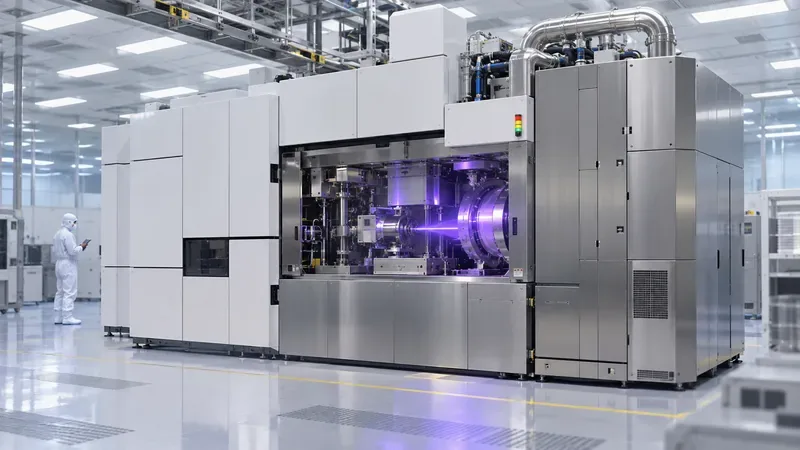
ASML Holding shares fell 6.11% on Euronext Amsterdam on Friday, October 30, 2026, closing at €1,412.80. The drop came during a wider selloff in semiconductor and technology stocks after Intel's weaker near-term outlook and Amazon's substantial AI infrastructure spending renewed questions about the returns on the AI boom. That is the clearest supported market explanation, but it is not proof that any one announcement caused exactly 6.11% of selling in ASML.
This is a review of a completed trading session, not a live quote. The Amsterdam-listed security trades in euros under ASML (commonly shown as ASML.AS by market-data services). The delayed quote supplied for this session was timestamped Friday, October 30, 2026, at 5:38:39 p.m. Amsterdam, Central European Time (CET, UTC+01:00), equivalent to 16:38:39 UTC. Amsterdam had already switched from summer time on October 25. ASML also trades on Nasdaq in U.S. dollars; its later U.S. closing price must not be substituted for the Amsterdam close.
What happened to ASML's Amsterdam shares?
| October 30, 2026 session | ASML on Euronext Amsterdam |
|---|
| Previous close (October 29) | €1,504.80 |
| October 30 close | €1,412.80 |
| Change | −€92.00 (−6.11%, rounded) |
| October 30 opening price | €1,444.40 |
| October 30 intraday range | €1,404.20–€1,446.00 |
| Volume | Approximately 818,700 shares |
| Trading venue and currency | Euronext Amsterdam; EUR |
The figures refer to the October 30 Amsterdam trading session, not a subsequent after-hours indication or the U.S. listing. The difference between the two Amsterdam closes is €92.00; dividing that by €1,504.80 gives approximately −6.1138%. See ASML.AS historical market data and the Euronext Amsterdam ASML instrument page for the listing and market context.
Why did ASML shares fall so sharply?
1. Intel's outlook helped trigger a semiconductor-sector retreat
Intel released third-quarter results on October 29, before the October 30 European session. Although it reported third-quarter revenue of $16.5 billion, its fourth-quarter revenue outlook was $15.0 billion–$16.0 billion, and management acknowledged near-term headwinds in the PC industry. Investors responded by selling semiconductor names well beyond Intel itself. A contemporaneous Reuters report carried by Euronext described a global chip rout following Intel's outlook.
ASML is an important supplier of lithography equipment used in chip manufacturing, so concerns about semiconductor companies' investment capacity can spill over to equipment makers. However, Intel's PC-related outlook is not a direct measure of ASML's order book, and the companies do not have identical business models. The original figures appear in Intel's October 29 financial release; the market reaction was reported by Reuters via Euronext.
2. Investors questioned how quickly AI spending will pay off
Amazon's October 29 results reinforced those concerns. The company projected approximately $220 billion in cash capital expenditures for 2026, even as it reported rapid growth at Amazon Web Services. Spending at that scale can signal substantial opportunities for semiconductor suppliers, but it also raises questions about customers' cash flow, financing requirements, data-center utilization and the timing of returns.
ASML sells equipment that helps manufacturers expand capacity for advanced logic and memory chips. If customers ultimately scale back fabrication plans, demand assumptions for such equipment could be reassessed. Conversely, if AI-related capacity expansion remains durable, high spending could support ASML's longer-term business. The October 30 price action does not establish that actual ASML orders were canceled or reduced. Read Amazon's original third-quarter release for its spending outlook.
3. The European technology sector fell much more than the broad market
The October 30 decline was not isolated to ASML. Reuters reported that the pan-European STOXX 600 closed down about 0.36%, while its technology sector dropped roughly 2.75% amid the global AI-related selloff. ASML's 6.11% loss was therefore steeper than both, but it occurred in a demonstrably weak industry session.
That comparison helps avoid a misleading conclusion: a sharp drop in a single company can reflect both the market's reassessment of an industry and stock-specific positioning. Without verified order cancellations, a revised ASML forecast, or another direct disclosure on October 30, it would be unsound to assign the entire loss to an undisclosed ASML operating problem. The broader market account appears in Reuters' European market coverage on Euronext.
Did ASML's latest results point to an immediate business slowdown?
Not on their face. ASML's most recent reported quarterly figures, released on October 14, 2026, showed €11.7 billion in third-quarter net sales, a 57.5% gross margin and approximately €5.0 billion in net income. Management expected full-year 2026 sales of €44 billion–€45 billion and fourth-quarter sales of €14.2 billion–€15.2 billion.
The company also said that demand visibility was strong enough for some customers to discuss equipment orders as far ahead as 2029 and 2030, and that its planned supply for 2027 and 2028 would not fully meet the demand indicated by customers. These were company statements and forecasts as of October 14, not guarantees of future sales or delivery schedules. They provide important context when interpreting a selloff only two weeks later. See ASML's official third-quarter earnings release.
ASML's position in advanced lithography makes it sensitive to expectations for long-cycle factory investment. Strong reported results and a sharp share-price decline can coexist when investors change what they are willing to pay for future growth. Neither outcome automatically invalidates the other.
What should readers check after the October 30 selloff?
For anyone assessing whether the decline reflected lasting company risk or temporary sector pressure, the useful checks are specific:
- ASML order and delivery disclosures: Look for any new company statement changing its published demand, capacity or sales outlook. An actual revision carries more weight than general market commentary.
- Customer spending plans: Separate announced semiconductor fabrication investments and confirmed procurement changes from speculation about AI returns.
- Relative share performance: Compare the Amsterdam stock with European technology shares and other semiconductor equipment companies. A divergence could point toward ASML-specific news, though it would not prove causality on its own.
- Correct listing and timestamp: Use euro-denominated Euronext Amsterdam prices for the 6.11% move. ASML's Nasdaq security trades in dollars and has a different closing time. ASML's share-information page identifies both listings.
The next scheduled Amsterdam regular trading day after Friday, October 30, was Monday, November 2, 2026, with the Netherlands on CET (UTC+01:00). Any follow-up move would need to be evaluated against new disclosures and that day's wider market conditions; it cannot be predicted from a single negative session.
Bottom line
ASML's Amsterdam-listed shares lost 6.11% on October 30, 2026 as investors sold technology and semiconductor stocks amid concerns about Intel's near-term outlook and the cost of AI expansion. ASML's October 14 operating results remained strong, and the available sources do not demonstrate one definitive company-specific trigger for the full decline. This is a historical market explanation, not a live quote, forecast or personalized investment recommendation.