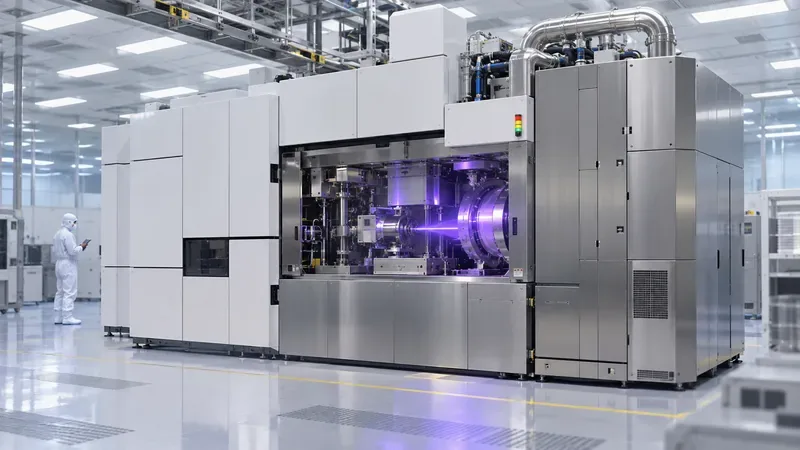
As of October 31, 2026, the most useful Intel (NASDAQ: INTC) forecast for December is conditional, not a single price target. A bullish outcome would require evidence that server-chip strength and manufacturing progress can outweigh the weakening personal-computer business. A base case would see those forces largely offset one another, leaving shares sensitive to every new data point. A bearish outcome would emerge if PC demand or factory execution deteriorates further while Intel continues spending heavily.
The reference point is Intel's $65.76 regular-session close on Friday, October 30, 2026, down 28.58% from the $92.07 close on October 29. INTC is listed on Nasdaq and quoted here in U.S. dollars, not euros. The October 30 close corresponds to 4:00 p.m. in New York, Eastern Daylight Time (EDT, UTC−04:00), or 20:00 UTC. It is a historical closing price, not a live December quote or an after-hours print. See Nasdaq's INTC historical-quote page; market-data feeds were also cross-checked for the October 29–30 closes.
What would make a December 2026 forecast useful?
For this company, a good forecast should tell readers what to check, what would change the interpretation, and what cannot yet be known. Intel's October decline followed financial results that contained genuine operational progress but a much weaker fourth-quarter outlook. A rebound by December would not, by itself, establish that the underlying business had improved; conversely, a falling share price would not prove that every product and manufacturing initiative had failed.
This analysis runs from the information available on October 31 through December 2026. It assigns no probability to any outcome and offers no guaranteed return, analyst consensus or personalized trading recommendation. The three cases below are testable scenarios, not predictions of reported December earnings.
What did Intel actually report before the selloff?
In its official third-quarter 2026 earnings release, Intel reported $16.513 billion of revenue, up approximately 21% year over year. Diluted earnings per share (EPS) attributable to Intel were $0.60 under GAAP and $0.52 on the company's non-GAAP basis. GAAP means results measured under generally accepted accounting principles; non-GAAP EPS makes company-defined adjustments and must be read alongside the reconciliation. Neither figure is an analyst forecast.
| Measure | Q3 2026 result or Q4 2026 company outlook | Why it matters for December |
|---|
| Q3 revenue | $16.513 billion, up about 21% year over year | Shows the existing revenue base, not proof of continued Q4 acceleration. |
| Client Computing and Physical AI Group (CCPG) | $8.1 billion; down 5% year over year | PC weakness could pressure volumes and product mix. |
| Data Center and AI (DCAI) | $7.3 billion; up 78% year over year | Demand for server processors is a potential offset. |
| Intel Foundry segment | $6.7 billion revenue, with a $1.853 billion operating loss | Manufacturing growth is not yet equivalent to operating profitability. |
| Q4 company guidance | $15.0 billion–$16.0 billion revenue; GAAP EPS $0.10; non-GAAP EPS $0.25 | Sets Intel's stated expectations, not actual Q4 results. |
| Q4 company margin outlook | 37.1% GAAP gross margin; 38.0% non-GAAP gross margin | Any further pressure could undermine the recovery thesis. |
Intel attributed near-term pressure in part to PC-market weakness expected to persist at least through the first half of 2027. Management also emphasized strong Xeon server-processor demand and the need to expand supply. The simultaneous presence of PC weakness and data-center growth is precisely why the December cases should not be collapsed into a simple positive or negative earnings headline.
Why does foundry revenue require extra care?
Intel's third-quarter Form 10-Q explains that substantially all foundry activity still serves Intel's own products. Of the reported $6.697 billion in Q3 foundry segment revenue, about $6.3 billion represented intersegment revenue, while external revenue was $411 million. The filing says the increase in external revenue primarily reflected a nonrecurring foundry contract. Those numbers cannot be treated as $6.7 billion of independent outside-customer sales.
The foundry operating loss narrowed from $2.321 billion a year earlier to $1.853 billion, but it remained significant. Intel said it released an Intel 14A process design kit in October. That is a product-development milestone, not proof that a high-volume, profitable outside-customer manufacturing business has already arrived. Yield, throughput, customer qualification and production economics remain essential evidence.
Does the balance sheet support the turnaround?
Intel reported Q3 operating cash flow of approximately $5.1 billion and gross capital expenditures of approximately $4.2 billion. Its reported adjusted free cash flow was about $1.6 billion, a non-GAAP measure that includes items such as partner contributions and government-related incentives. Readers should not mistake that adjusted number for recurring cash remaining after every investment. Intel also disclosed completion of a $23 billion public equity offering; additional financing capacity can support investment, but share issuance can dilute existing owners. The December assessment should look for financing and execution progress together, not just headline liquidity.
Bull scenario: What would support a durable recovery?
Assumptions: the slowdown in client PCs is less damaging than feared, Intel captures more of the strong Xeon demand through improved supply, and factory ramp milestones stay on schedule without a fresh cost surprise. Broader equity-market conditions would also need to stop amplifying semiconductor selling.
Observable triggers during December: credible management or customer disclosures about server-processor supply and orders; evidence that PC inventories are stabilizing rather than worsening; specific updates on Intel 18A/14A technology progress; or better visibility into external foundry demand and manufacturing economics. A share-price recovery supported by new operational information would be more persuasive than a brief rebound following October's sharp loss.
What invalidates the bull case: fresh indications that PC orders are deteriorating faster than guided, server capacity cannot be converted into deliverable revenue, manufacturing yield or qualification milestones slip, or financing requirements grow materially without offsetting cash generation. An announcement of a technical milestone alone is insufficient if it fails to translate into customer demand or margins.
Base scenario: What if progress is real but insufficient?
Assumptions: Intel's data-center business remains a relative bright spot, but weak PC demand and substantial foundry costs limit confidence. The company does not provide a decisive December update that changes its Q4 revenue range of $15.0 billion–$16.0 billion. Investors continue distinguishing a long-term manufacturing turnaround from short-term earnings pressure.
Observable triggers: mixed business commentary, no material improvement in the client-demand outlook, continued positive server demand without enough detail to quantify upside, and limited new evidence on recurring external foundry customers. INTC could trade unevenly as macroeconomic releases move discount rates and appetite for semiconductor risk.
What invalidates the base case: a verified improvement that meaningfully changes expected profit or cash generation would shift the analysis toward bull; new operating disruption, a sharper demand warning, or a materially worse financing picture would shift it toward bear. Price volatility alone is not a sufficient reason to reclassify the fundamentals.
Bear scenario: What could extend the decline?
Assumptions: PC demand and inventory adjustment worsen, server supply constraints persist or fail to create profitable incremental sales, and foundry losses or capital needs remain burdensome. Competition in client and server processors could make recovery harder, while delays in advanced manufacturing would magnify uncertainty.
Observable triggers: weaker industry shipment or order signals supported by identifiable data, an unfavorable company outlook update, missed manufacturing milestones, widening operating losses, or reliance on additional financing without clearer future returns. Rising macroeconomic yields or a broad technology selloff could aggravate these company-specific problems.
What invalidates the bear case: tangible stabilization of PC demand, better supply execution in DCAI, verified production progress and less capital intensity than feared. A short-lived uptick in share price is not enough; new evidence would need to address why the business risks have diminished.
Which December 2026 events could change the scenarios?
Macro releases do not establish Intel's operating performance, but they can move the valuation investors are willing to pay for a capital-intensive semiconductor company. The following dates were on the official schedules as reviewed on October 31, 2026:
| Event | Confirmed date and time | Possible relevance to INTC |
|---|
| U.S. November employment report | Friday, December 4, 2026, 8:30 a.m. New York EST (UTC−05:00), 13:30 UTC | Could change expectations for economic growth and interest rates. |
| Federal Reserve FOMC meeting | December 8–9, 2026, Washington, D.C., EST (UTC−05:00); decision time not specified here | Policy guidance and the scheduled economic projections could affect technology-stock valuations. |
| U.S. November CPI report | Thursday, December 10, 2026, 8:30 a.m. New York EST (UTC−05:00), 13:30 UTC | Could affect inflation and rate expectations shortly after the Fed meeting. |
The dates come from the U.S. Bureau of Labor Statistics December release calendar and the Federal Reserve FOMC calendar. Eastern Standard Time applies in December after the U.S. daylight-saving change on November 1; it must not be confused with the EDT offset used for the October 30 Nasdaq close. Schedules may change, and no December employment, inflation or interest-rate outcome is known as of this analysis date.
Intel's complete Q4 financial results should not be presumed to arrive in December: no verified December earnings-release date is being asserted here. Any new investor-relations statement, manufacturing disclosure or material regulatory filing would need to be evaluated when published, rather than treated as an event already scheduled.
How can readers judge which scenario is working?
A useful December scorecard separates company evidence from market reactions. First, compare each new management statement with the actual Q4 guidance: Does it alter the expected PC downturn, Xeon supply picture, gross margins, or cash requirements? Second, check whether a foundry announcement concerns recurring external demand and operating economics, rather than revenue recognized between Intel divisions. Third, distinguish a stock move driven by a company disclosure from one driven by Fed-related repricing across the semiconductor sector.
For example, suppose INTC rises in the days after a softer-than-expected inflation report but Intel provides no new manufacturing or customer evidence. That would illustrate a potentially favorable valuation backdrop, not independent confirmation of the bull operating scenario. If instead a specific supply or customer milestone is disclosed and supported by subsequent financial information, that is stronger evidence for changing the business assessment. This is an illustrative decision rule, not an observed December market event.
A review at the end of December should record: what was known on October 31; which December catalysts actually occurred; whether Intel's own guidance changed; the evidence behind any reassignment among bull, base and bear; and the stock's then-observed regular-session price. The method can produce a clear, auditable conclusion even when price direction remains uncertain.
What are the biggest mistakes in assessing Intel's December outlook?
- Confusing prices: the $65.76 October 30 regular-session close is not an after-hours quotation or a December price.
- Mixing earnings definitions: Q3 GAAP EPS of $0.60 and company-adjusted EPS of $0.52 are different accounting measures; Q4 figures of $0.10 and $0.25 are guidance, not results.
- Double-counting foundry sales: most foundry segment revenue is internal and is eliminated on consolidation; a nonrecurring external contract does not prove a repeatable customer pipeline.
- Equating technology announcements with cash generation: process design kits, manufacturing nodes and future capacity do not automatically demonstrate yields, customer adoption or returns on invested capital.
- Assigning certainty to macro events: the December Fed decision and economic data must be treated as unknown until officially released.
December 2026 outlook: the evidence that matters most
Intel enters this forecast window with a meaningful server-growth opportunity and substantial technology assets, but also a deteriorating PC outlook, continuing foundry losses and large capital demands. The bull case needs proof of operational conversion, the base case assumes competing forces remain unresolved, and the bear case follows from new evidence that cash costs or demand weakness are exceeding the company's plan.
There is no verified December endpoint price, analyst target or scenario probability in this article. Its value is the set of measurable tests for revising the outlook as facts arrive. This dated scenario analysis is educational market commentary, not personalized investment advice.