Home
» Sports
»
October 2026 Fishing in Greater London: Open Seasons, Closures, Licenses and Local Rules
October 2026 Fishing in Greater London: Open Seasons, Closures, Licenses and Local Rules
Quick answer for October 2026: In the Environment Agency’s Thames byelaw area—which covers the River Thames catchment, including the Lee, Wandle, Roding and other Greater London waters—coarse fishing on rivers is open throughout October. The seasonal change arrives on October 1: brown and rainbow trout fishing closes on rivers, streams and drains, and salmon and migratory-trout fishing closes in all waters. Most stillwaters and canals have no statutory coarse-fish close season, but a fishery permit, landowner restrictions, protected-site conditions or a temporary notice can still close a particular spot. There is no single “Greater London fishing season” that overrides those local rules.
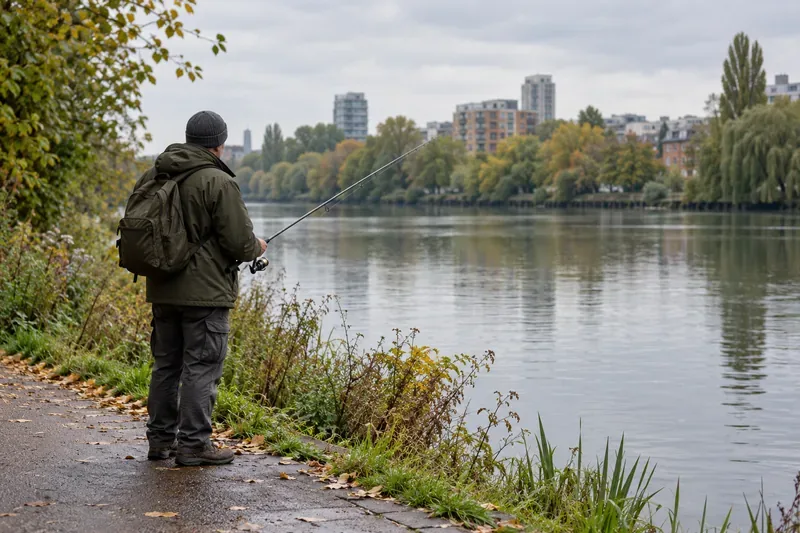
An angler casts beside a calm urban river in autumn; access and seasonal rules depend on the particular reach and fishery.
First, identify the water and the rule-maker
Greater London is a useful place name, but it is not one fishing-law zone. For rod-and-line fishing for freshwater fish in England, the Environment Agency (EA) sets national rules and regional byelaws. Most Greater London freshwater sits in the EA’s Thames byelaw area, defined by the River Thames catchment. The EA says that area includes the Thames, Lee, Wandle, Roding, Colne, Darent and other catchments, and excludes the River Medway catchment. A borough boundary does not decide which byelaws apply; the water’s catchment does.
Then check who controls the bank and fishing rights. A public footpath may let you walk beside water, but it does not automatically give you permission to fish. A club, council, private fishery or waterway owner can require a separate permit and stricter catch-and-release, tackle, access or opening-hour rules. The EA states that owner permission is required in addition to the rod license. Its South East byelaws page was last updated October 12, 2021; checked September 29, 2026, it remains the published regional guide. Treat the October 1 seasonal boundary below as the key 2026 changeover and check for later venue notices before traveling.
What is open or closed in October?
Water or target
October 2026 status under Thames-area rules
What still needs checking
Coarse fish—such as carp, bream, roach, perch, tench and pike—on rivers, streams and drains
Open all October. The statutory river close season runs March 15 through June 15, inclusive.
Fishery permit, access, local catch-and-release rules and any temporary closure.
Brown or rainbow trout on rivers, streams and drains
Closed October 1 through March 31, inclusive, in the Thames byelaw area.
Whether a water is legally an enclosed stillwater rather than a flowing river, plus its own rules.
Salmon and migratory trout
Closed in all waters October 1 through March 31. Any salmon caught in the Thames and its tributaries or estuary must be released immediately with the least possible injury.
Local byelaws and reporting instructions for any relevant catch.
Coarse fish in most canals and enclosed stillwaters
Generally open in October; the statutory coarse close season is spring, not autumn.
Named canal exceptions, fishery rules, permit validity and opening hours.
Eels
October is outside the ordinary spring river close season. The Thames-area byelaw has no eel close season on the tidal Thames downstream of the Thames Barrier.
Every eel other than a conger eel must be released alive; check the exact reach and any venue restrictions.
The trout exception is easy to misread. In the Thames area there is no statutory close season for brown trout in fully enclosed waters, or for rainbow trout in stillwaters. That does not mean a lake owner must allow October fishing. The EA guidance for the South East also says trout, sea trout and rainbow trout may only be fished with an artificial fly or lure during the coarse-fish close season; October is outside that spring period, but ordinary trout-season dates still apply.
Canals and protected waters
The EA lists the Regent’s Canal, Grand Union Canal and Lee Navigation downstream of Aqueduct Lock as having no statutory coarse-fishing close season. The Lee Navigation upstream of Aqueduct Lock is one of the canal stretches with a March 15–June 15 close season, so that particular statutory closure has ended by October. “No statutory close season” means only that the seasonal byelaw does not close coarse fishing; it is not a public invitation to fish without permission.
The same EA regional page names three Greater London SSSI waters—Mid Colne Valley, Brent Reservoir and Denham Lock Wood—among stillwaters where fishing is prohibited during the spring close season, March 15 through June 15. That specific seasonal restriction does not itself create an October closure. SSSI status and a season listing also do not prove that the public can enter or fish: check the actual owner or fishery’s current access and permit terms. Elsewhere in the South East, local protected-site schedules can identify other waters, so do not assume a rule attached to one site applies to all London ponds.
Licenses, permits and limits to prepare before you go
Anyone aged 13 or older fishing for freshwater fish, trout, salmon, smelt or eel with a rod and line in England needs an EA rod-fishing license. Children under 13 are exempt; ages 13–16 need a free junior license. The license covers the legal right to use specified rods for the relevant fish category. It does not buy access to a bank, park pond, canal stretch or club fishery. Get the landowner or fishery permit separately and carry both where required.
For example, the City of London Corporation’s current Hampstead Heath page, updated June 15, 2026, allows fishing on five named ponds only: Highgate Men’s Pond, Model Boating Pond, Hampstead No. 2 Pond, Viaduct Pond and Vale of Health Pond. It requires both a Heath permit and an EA rod license, sets a local three-rod maximum, bans live bait, lures and keepnets, and requires all fish to be returned promptly. Those conditions apply to those Heath ponds; they are not rules for every London water.
On rivers, national daily take limits include one pike up to 65 cm, two grayling from 30 to 38 cm, and up to 15 small listed fish up to 20 cm. Eels must be released alive. The regional Thames byelaw says trout under 25 cm may not be taken, measured from snout tip to tail end. The Thames salmon rule requires release. These are statutory ceilings or minimum sizes, not a promise that a venue lets you keep fish: owners can set stricter rules, including mandatory catch-and-release. Ask about a named fishery’s bag limit—the number of fish a person may retain—before baiting up.
Special case: Thames locks and weirs
An EA lock-and-weir permit is a separate, site-specific permit. It allows fishing only from marked fishing areas at participating locks or weirs, subject to availability and each site guide. The EA permit season is June 16 through March 14 inclusive, so October falls inside it; fishing is prohibited at those permit sites during the March 15–June 15 river close season. Lock-and-weir anglers need an EA rod license too, may use two rods per permit, must show the permit to the lock keeper, and cannot use keepnets. Do not mistake this permit for general permission to fish any Thames bank.
Riverside access, tidal water and common mistakes
On the tidal Thames, the Port of London Authority (PLA) confirms that freshwater angling is possible with the correct season, rod license and landowner permission. Its foreshore permits concern access/search activity and do not substitute for permission to fish; the PLA explicitly prohibits magnet fishing on the tidal Thames even with a foreshore permit. Tides, vessel traffic and steep or slippery banks create additional hazards, so use the PLA’s location-specific tide information and fish only from a lawful, safe bank or designated site. Marine fishing rules can differ from freshwater rod-fishing rules; this article’s EA license summary concerns freshwater species.
Before leaving home, use this sequence:
Pin the exact water and bank on a map; note whether it is river, canal, enclosed stillwater or tidal reach.
Check the EA Thames byelaw and national rules for that water type and species, especially the October 1 trout and salmon closure.
Check the owner’s or club’s official page for permission, local limits, tackle restrictions, opening hours and temporary notices.
Carry the right EA rod license and venue permit; confirm any age, rod-count and fish-handling conditions.
At the water, obey signs, barriers, site guides and staff directions. If the fishery cannot confirm access or a limit, do not assume the broad seasonal rule settles it.
For a practical example: a person targeting roach on a permitted river swim in October is outside the statutory coarse-fish close season, but still needs the rod license and the fishery’s permission. A person targeting trout in a Thames-area stream on October 1 must stop because the river-trout close season starts that day. A carp angler at Hampstead Heath can fish only one of the five named ponds with both required permissions and must return the fish. Each answer changes with the species, water type and owner.